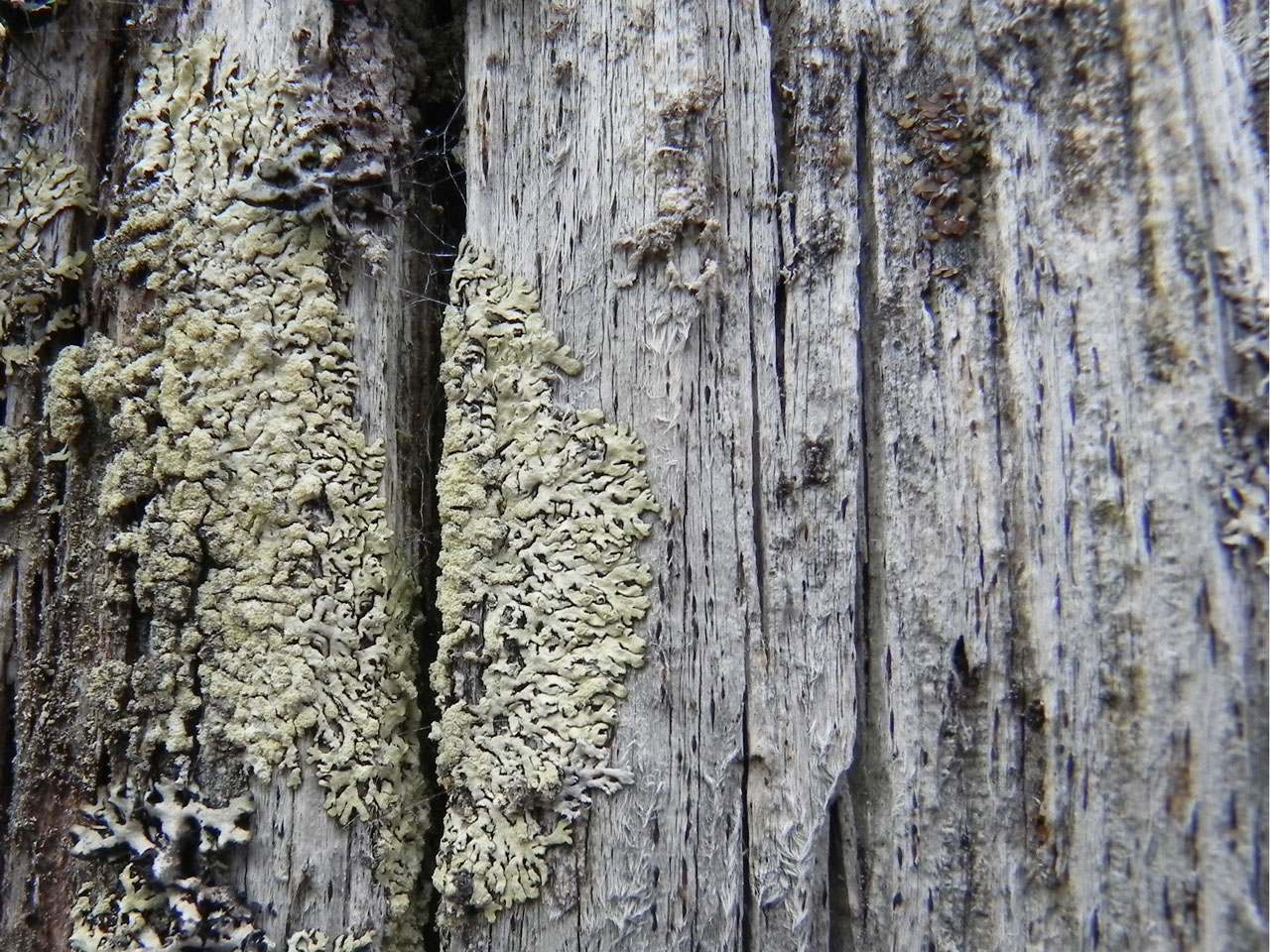
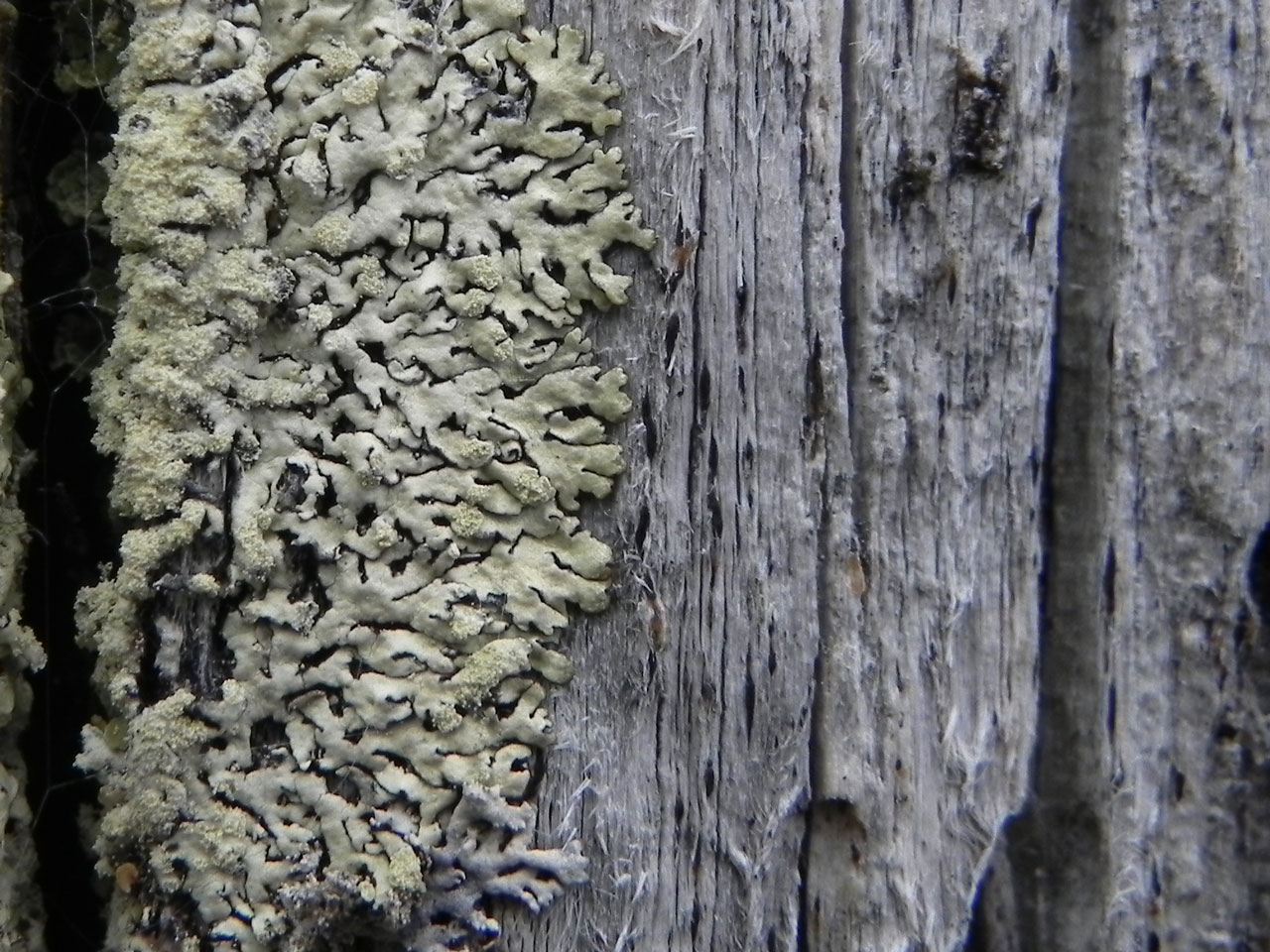
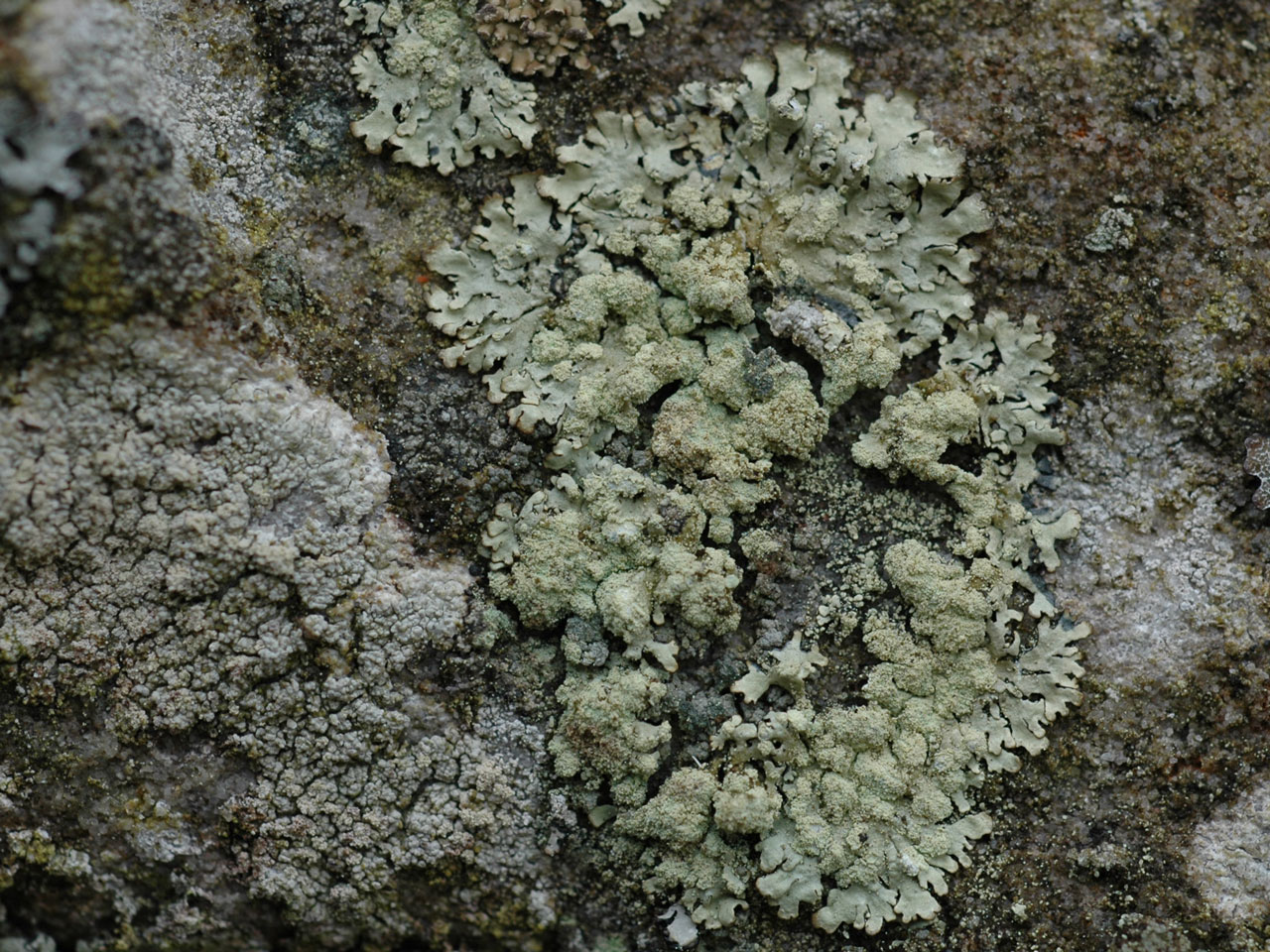
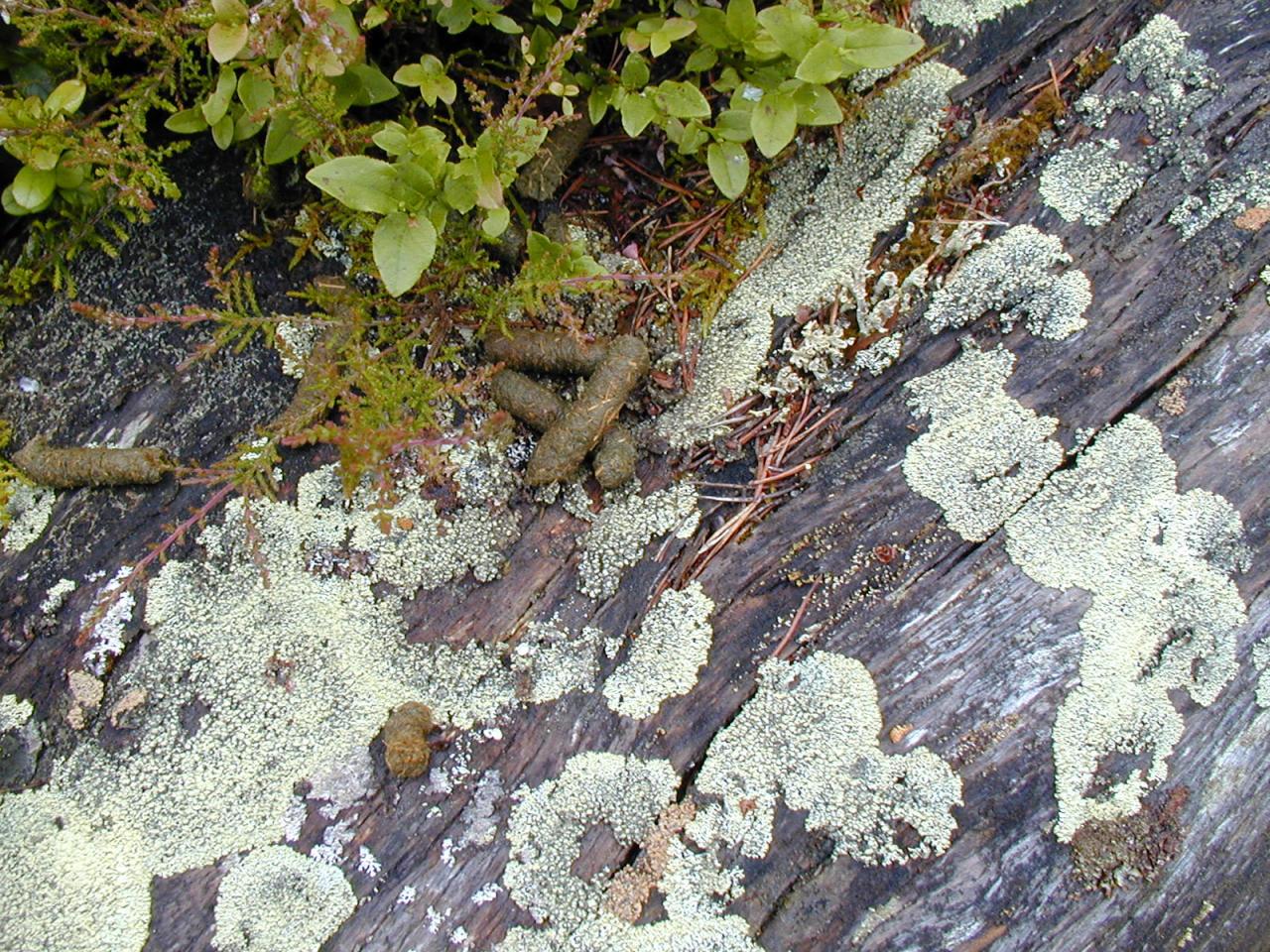
A yellowish leafy lichen with a closely appressed thallus and laminal yellow soralia. Resembles the saxicolous Xanthoparmelia mougeotii, but is found on acid bark and lignum and has different spot tests. Prior to sulphur dioxide pollution, this appears to have been a local species of lignum in native pinewoods in Scotland and fence posts to the south, but it had spread widely on to polluted bark by the mid 20th century. Now in decline with the reduction in acidifying pollution.
Thallus 1–3 (–4) cm diam., closely appressed, often forming neat rosettes, or of scattered, ± unoriented lobes, often contiguous with adjacent thalli and forming extensive patches; lobes 0.5–1 mm broad, sometimes much reduced, ± elongate, often radiating, flat or concave, contiguous or partly overlapping centrally; margins sparingly indented; upper surface bright to dull yellowish green or yellowish grey, ± brown-speckled towards the apices, matt; soralia frequent, laminal, yellow, flat or convex, rarely pustular and concave, paler or concolorous with the thallus, sometimes contiguous to form a ± continuous sorediate crust in older parts of the thallus; lower surface pale brown to dark brown; rhizines scattered, concolorous with white tips. Apothecia rare, to 2 mm diam. Ascospores 7–11 × 2.5–3 µm. Pycnidia rare. Conidia 12–18 (–22) × 0.5–1 µm. Cortex K+ faintly yellow; medulla C–, K–, KC–, Pd–, UV+ glaucous-white (atranorin, usnic and divaricatic acids).
Mainly distinguished from P. hyperopta by the colour of the upper surface, which in the past has led to the suggestion that it is simply a chemotype. However, recent molecular studies support P. ambigua at the species level (Tehler & Källersjö 2001, Divakar et al. 2017). Saxicolous morphs sometimes resemble Xanthoparmelia mougeotii, which differs in the K+ yellow medullary reaction (stictic acid). Arctoparmelia incurva differs in being consistently rhizinate, having convex lobes, globose soralia restricted to lobe tips and a KC+ pink and UV+ blue-white medulla.
On acid-barked, wayside and parkland broad-leaved trees, rarely on worked timber or siliceous rocks (mainly sandstone) in moderately polluted areas, but on lignum on dead trees in native pinewoods.
Early 19th century records (Leighton, 1879) suggests that Parmeliopsis ambigua was originally found in native pinewoods in the eastern Highlands and rarely to the south on fence posts. Since then, P. ambigua appears to have massively increased in the south with SO2 pollution, especially on bark, and was widespread but is now retreating and becoming rarer in C. & S.E. England, due to the decrease in SO2 pollution and increased nutrient enrichment.
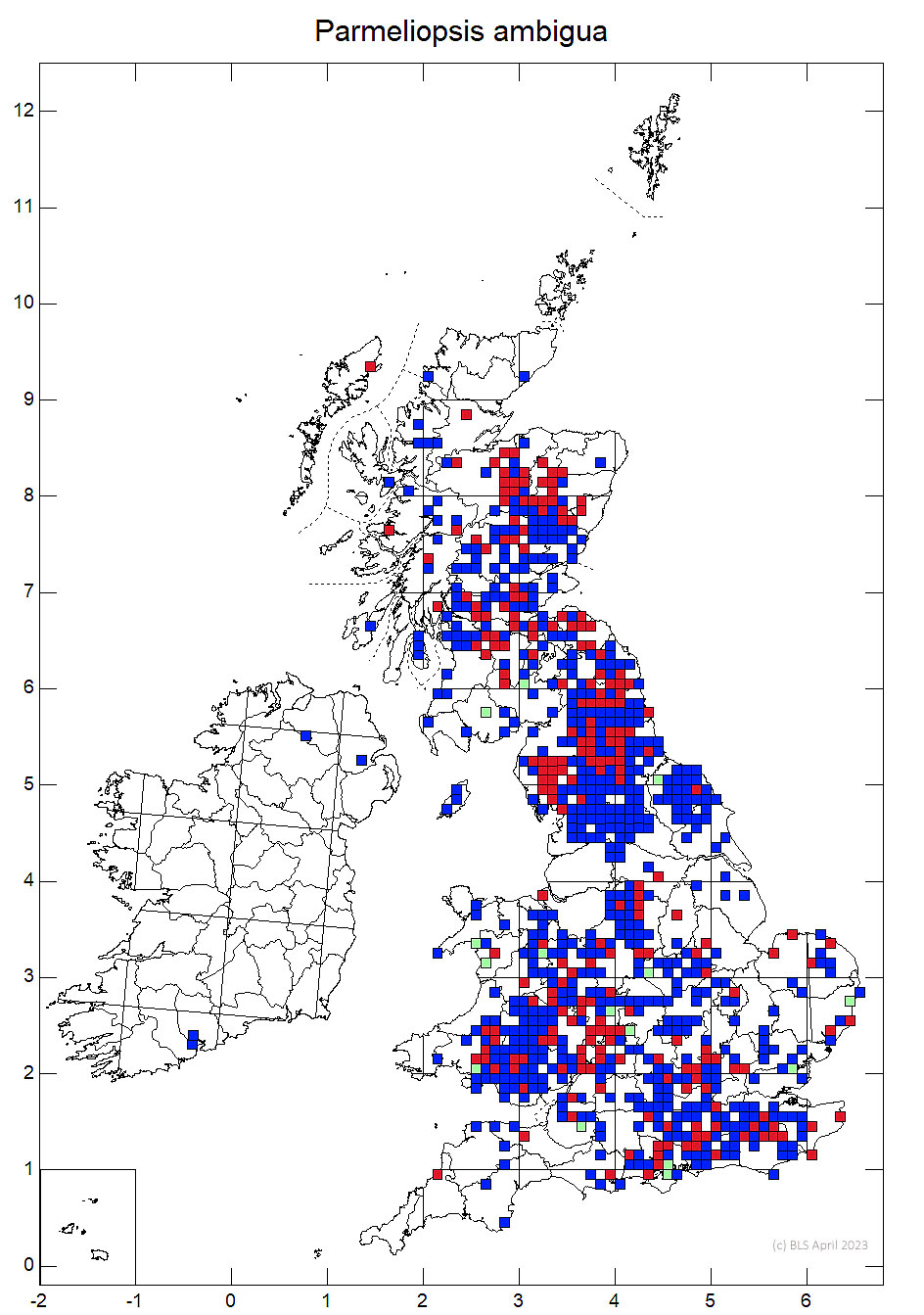

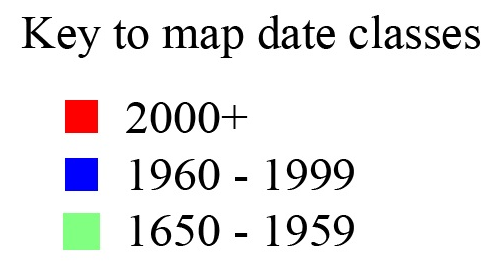
Throughout N., central & S.E. England and S. and central Highland Scotland, rare in oceanic areas and Ireland.
Cannon, P., Divakar, P., Yahr, R., Aptroot, A., Clerc, P., Coppins, B., Fryday, A., Sanderson, N. & Simkin, J. (2023). Lecanorales: Parmeliaceae, including the genera Alectoria, Allantoparmelia, Arctoparmelia, Brodoa, Bryoria, Cetraria, Cetrariella, Cetrelia, Cornicularia, Evernia, Flavocetraria, Flavoparmelia, Hypogymnia, Hypotrachyna, Imshaugia, Melanelia, Melanelixia, Melanohalea, Menegazzia, Montanelia, Nesolechia, Parmelia, Parmelina, Parmeliopsis, Parmotrema, Platismatia, Pleurosticta, Protoparmelia, Pseudephebe, Pseudevernia, Punctelia, Raesaenenia, Tuckermannopsis, Usnea, Vulpicida and Xanthoparmelia. Revisions of British and Irish Lichens 33: 1-98.
Divakar, P.K., Crespo, A., Kraichak, E., Leavitt, S.D., Singh, G., Schmitt, I. & Lumbsch, H.T. (2017). Using a temporal phylogenetic method to harmonize family and genus-level classification in the largest clade of lichen-forming fungi. Fungal Diversity 84: 101–117.
Leighton, W. A. (1879) The Lichen Flora of Great Britain, Ireland, and the Channel Islands, third edition. Shewsbury: Leighton
Tehler, A. & Källersjö, M. (2001). Parmeliopsis ambigua and P. hyperopta (Parmeliaceae): species or chemotypes? Lichenologist 33: 403-408.
Text by Neil A Sanderson based on Cannon et al (2023)