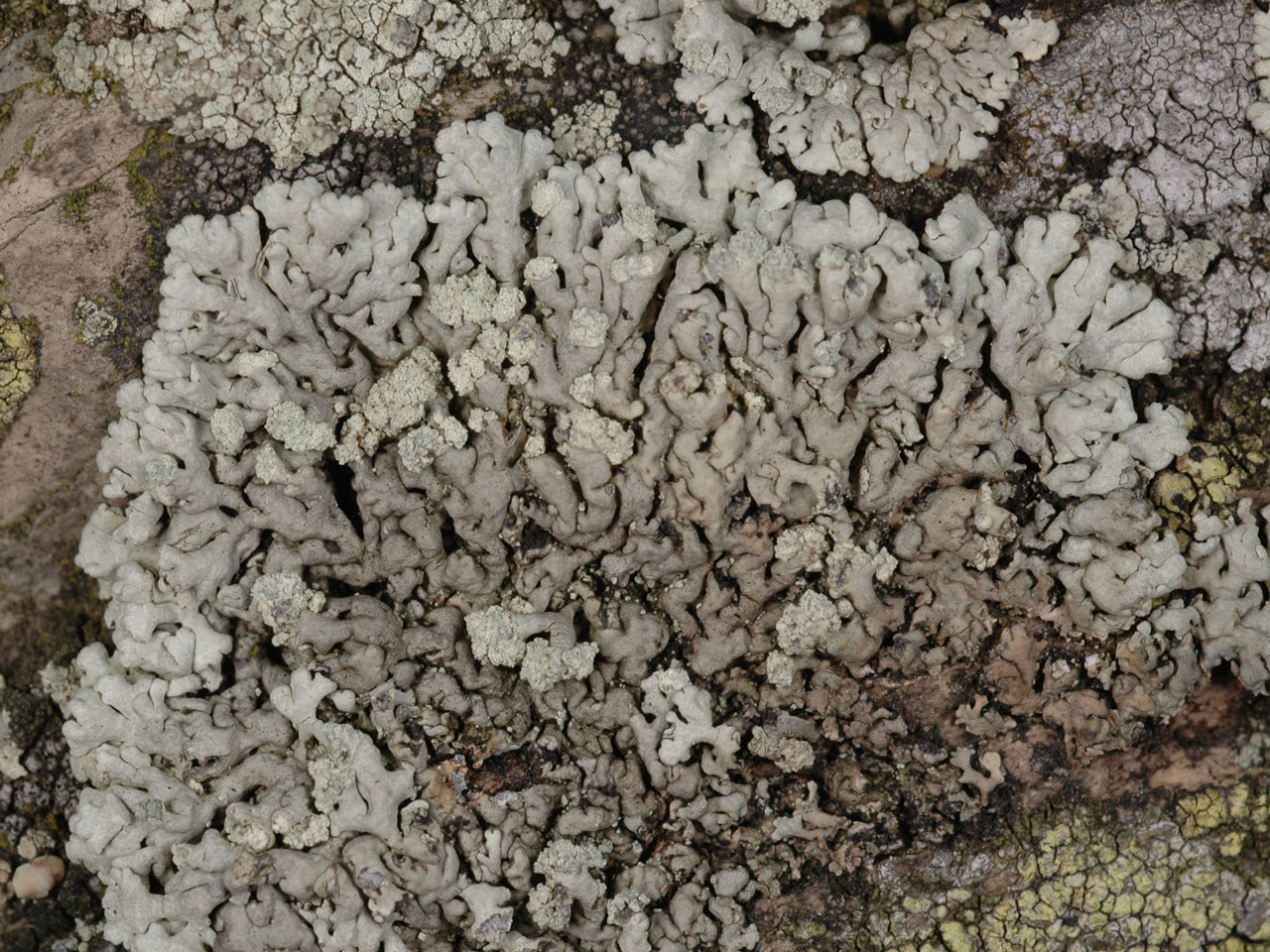
A small, dull yellow-grey, leafy lichen of well-lit siliceous rocks, which often coalesces to form much larger thalli. Sorediate, with the soralia on the ends of smaller, inner lobes within the thallus. Resembles Xanthoparmelia mougeotii which differs in the flatter lobes, laminal, more flattened, circular soralia and spot test differences. This lichen was tolerant of sulphur dioxide pollution and spread on to man-made substrata during the era of high acidifying pollution.
Thallus 0.5–2 cm diam., often coalescing to form much larger thalli, very closely appressed, the inner part often ± degenerating; lobes narrow, to 3 (–4) mm broad, radiating, intricate, not overlapping, markedly convex; upper surface dull yellow-grey, becoming darker grey-yellow at the centre; soralia 2–4 mm diam., on the ends of smaller, inner lobes within the thallus, globular, scattered; lower surface pale, finely pubescent; rhizines sparse, dark, short, aseptate. Apothecia rare; disc brown. Medulla and soralia C–, K–, KC+ pink, Pd+ rust-red or Pd–, UV+ vivid glaucous blue (alectoronic, sometimes also α-collatolic and/or protocetraric acids); cortex KC+ yellow (usnic acid). There is considerable variation in the protocetraric acid content; in some populations it is absent, in others it is predominant.
Arctoparmelia incurva resembles Xanthoparmelia mougeotii which differs in the flatter lobes, laminal, more flattened, circular soralia, the medulla which is K+ yellow→red, UV–, and the smooth shiny cortex. Parmeliopsis ambigua has few or no rhizines, spreading soralia and the medulla is K–, Pd–, UV–. The similar A. centrifuga (L.) Hale (1986), which has been erroneously reported from Scotland, lacks soralia and usually has well-developed apothecia.
On well-lit siliceous rocks, very rarely on wood, acid pollution-tolerant; rather local. The range expanded on man-made substrata during the era of high sulphur dioxide pollution.
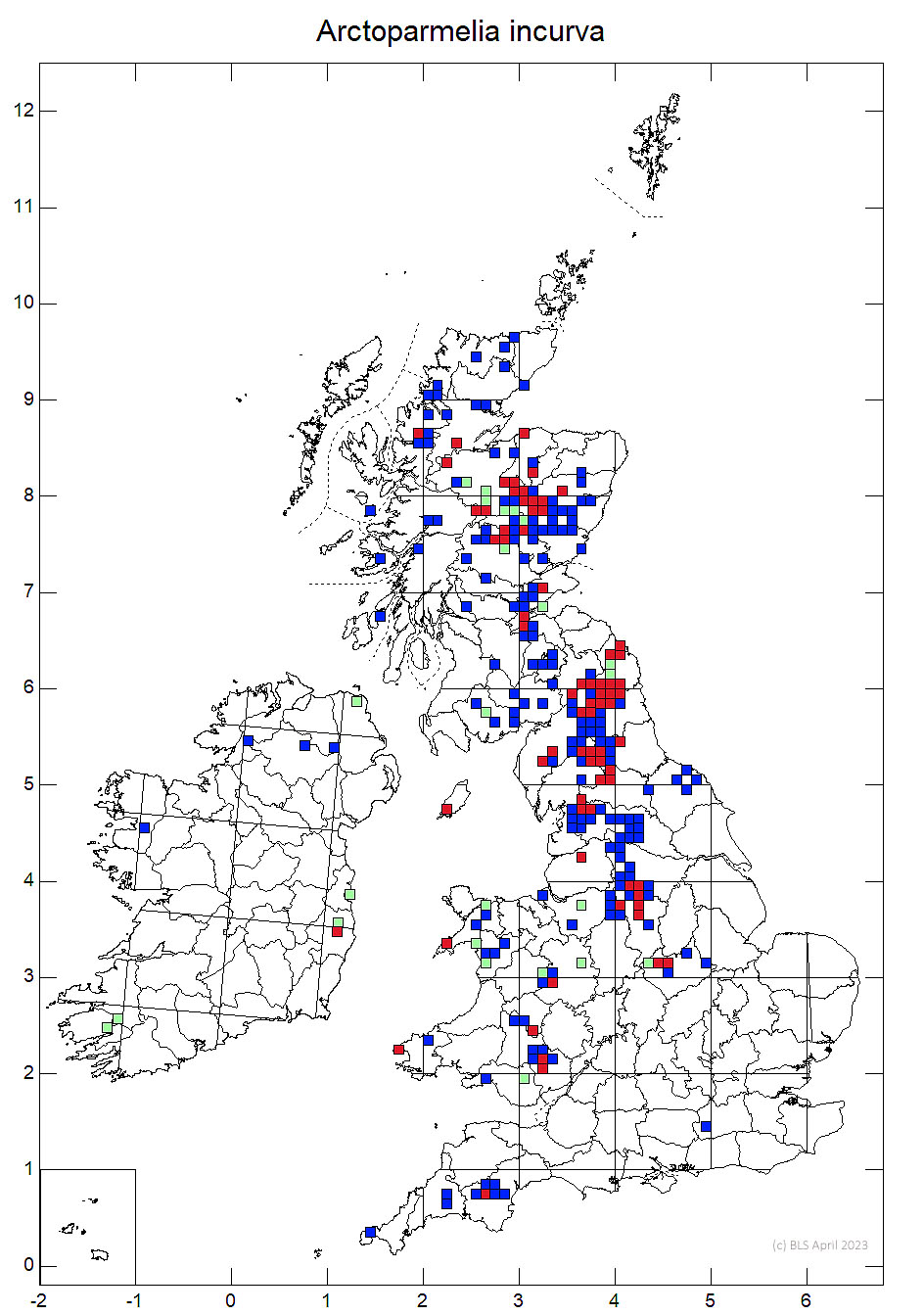


Upland Britain, from W. Cornwall to Sutherland, a few scattered records in Ireland, There is a solitary record from S.E. England on imported stone.
Cannon, P., Divakar, P., Yahr, R., Aptroot, A., Clerc, P., Coppins, B., Fryday, A., Sanderson, N. & Simkin, J. (2023). Lecanorales: Parmeliaceae, including the genera Alectoria, Allantoparmelia, Arctoparmelia, Brodoa, Bryoria, Cetraria, Cetrariella, Cetrelia, Cornicularia, Evernia, Flavocetraria, Flavoparmelia, Hypogymnia, Hypotrachyna, Imshaugia, Melanelia, Melanelixia, Melanohalea, Menegazzia, Montanelia, Nesolechia, Parmelia, Parmelina, Parmeliopsis, Parmotrema, Platismatia, Pleurosticta, Protoparmelia, Pseudephebe, Pseudevernia, Punctelia, Raesaenenia, Tuckermannopsis, Usnea, Vulpicida and Xanthoparmelia. Revisions of British and Irish Lichens 33: 1-98.
Text by Neil A Sanderson based on Cannon et al (2023)