The Lichen Recording Scheme is the focus for recording activity in the BLS. It was relaunched at the 2016 AGM to formalise a number of things we were doing already, but further developments are planned to enhance our support for individual recorders and projects. At present it is coordinated by Janet Simkin, who also manages the database. The recording scheme:
- Provides a central point of contact for members and other organisations
- Runs an informal network of vice county recorders and referees
- Assists with national and regional projects
- Encourages members to send in their records for inclusion in the database and highlights gaps in the database that need filling, such as species or areas that are under-recorded or have not been surveyed for a long time
- Makes our lichen records available to all who need them through the online facilities provided by the National Biodiversity Network (the NBN Atlas) and the Global Biodiversity Information Facility (GBIF)
- Provides detailed data and distribution maps to members and academics, for use in atlases, research and conservation
- Provides online species accounts that are approachable and helpful to beginners as well as experts, and include distribution maps and information on habitat and ecology that may not be available elsewhere
- Develops ID aids including the NBN Record Cleaner, the ID difficulty guide, and computerised identification keys
Future developments might include and annual recorders conference, e-newsletters to keep active members informed of interesting finds, new species and taxonomic revisions, records needed, etc., and updating the British Lichens website.
Anyone interested in getting involved in current or future aspects is encouraged to get in touch with Janet Simkin on records@britishlichensociety.org.uk.
The BLS database
At the heart of our recording scheme is the BLS database.
Over the past 75 years BLS members and others have been recording lichens and lichenicolous fungi, and we now hold more than 2.6 million records for Britain. We continue to add to this almost every day and new records are always welcome.
The records are held in a Recorder6 database, specialist software that was developed specifically for biological recording in Britain by JNCC. and they all include basic information such as the location, grid reference, date, recorders and the species. For older records that is often all we have, but these days we try to record more detail for records and species of interest, including the substrate and any information that is available to support the identification such as chemical tests, microscopic characters, the location of a specimen or photo, and the determiner.
The design of the database makes it easy for us to extract records and analyse them in many different ways, and we try to respond to requests for information quickly. The most popular are for the records or a species list for a particular site or vice county, or for the detailed records and distribution map for a particular species, but we also provide information for use in research and conservation:
- identifying the most important lichen sites, many of which are now designated as SSSIs or managed as nature reserves
- monitoring changes in distribution over time as atmospheric pollution levels have changed
- mapping lichen distributions and studying their ecology, to inform the conservation of both species and habitats
- assessing the rarity and threat status of each species
- assessing the relationships between species and their substrates or tree hosts, for instance to predict the impact of tree diseases such as Chalara ash dieback.
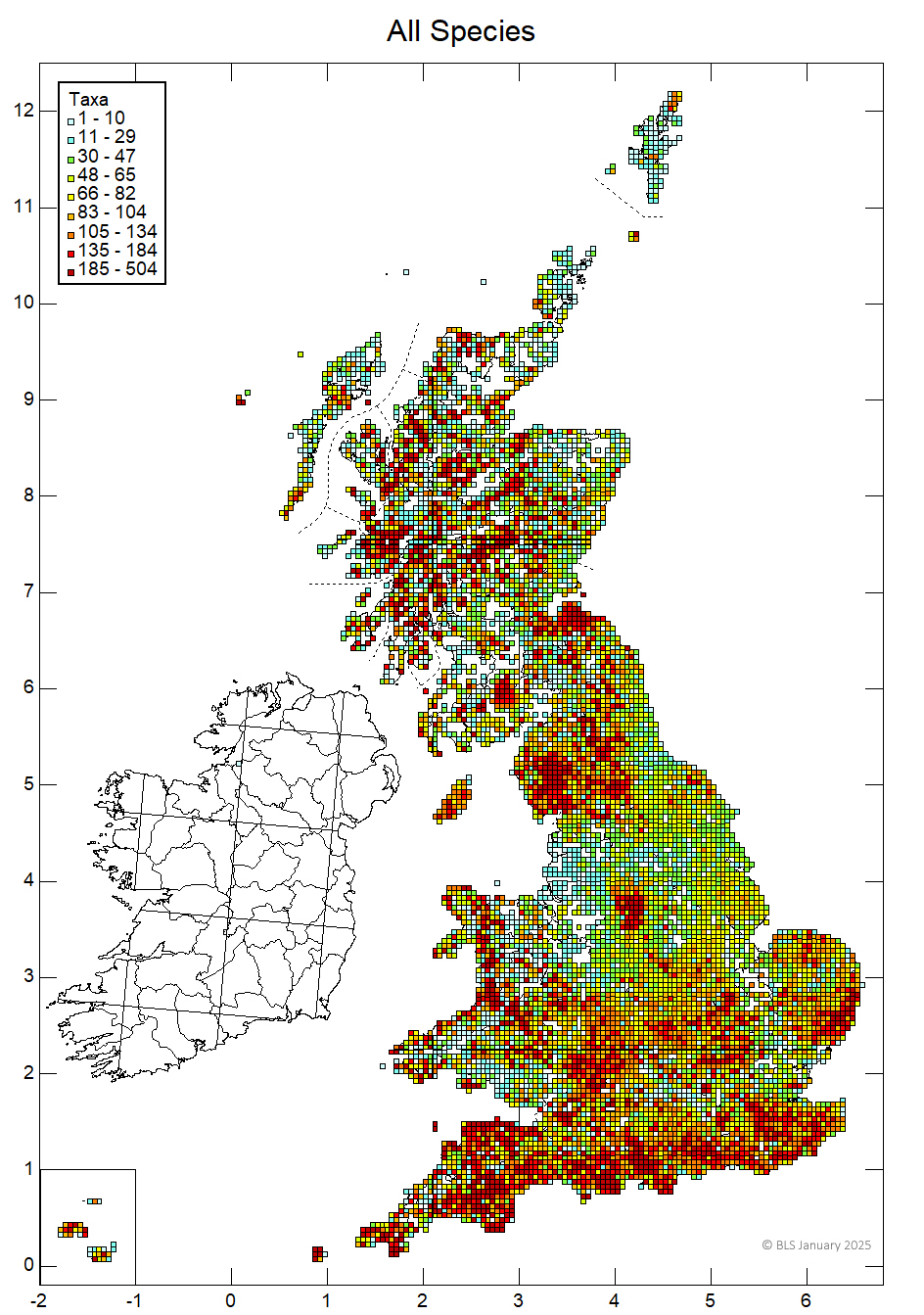
This map shows the number of species recorded for each 5km square as in July 2023. Areas shown in white, blue or green are very much under-recorded.
The Mapping Scheme
Our present database was preceded by the Mapping Scheme, established by Prof. Mark Seaward in 1963, and this was central to the society’s work for many years. It was designed to produce distribution dot maps at hectad (10km square) level showing two time periods pre-1960 and post-1960. Some of these maps were published in the Atlas of the Lichens of the British Isles (Seaward & Hitch, 1982) and the Lichen Atlas of the British Isles (ed. Seaward, published in five fascicles 1996-2001). A copy of the Mapping Scheme database is included in our main BLS Database and the records are still included in our maps.
Mapping
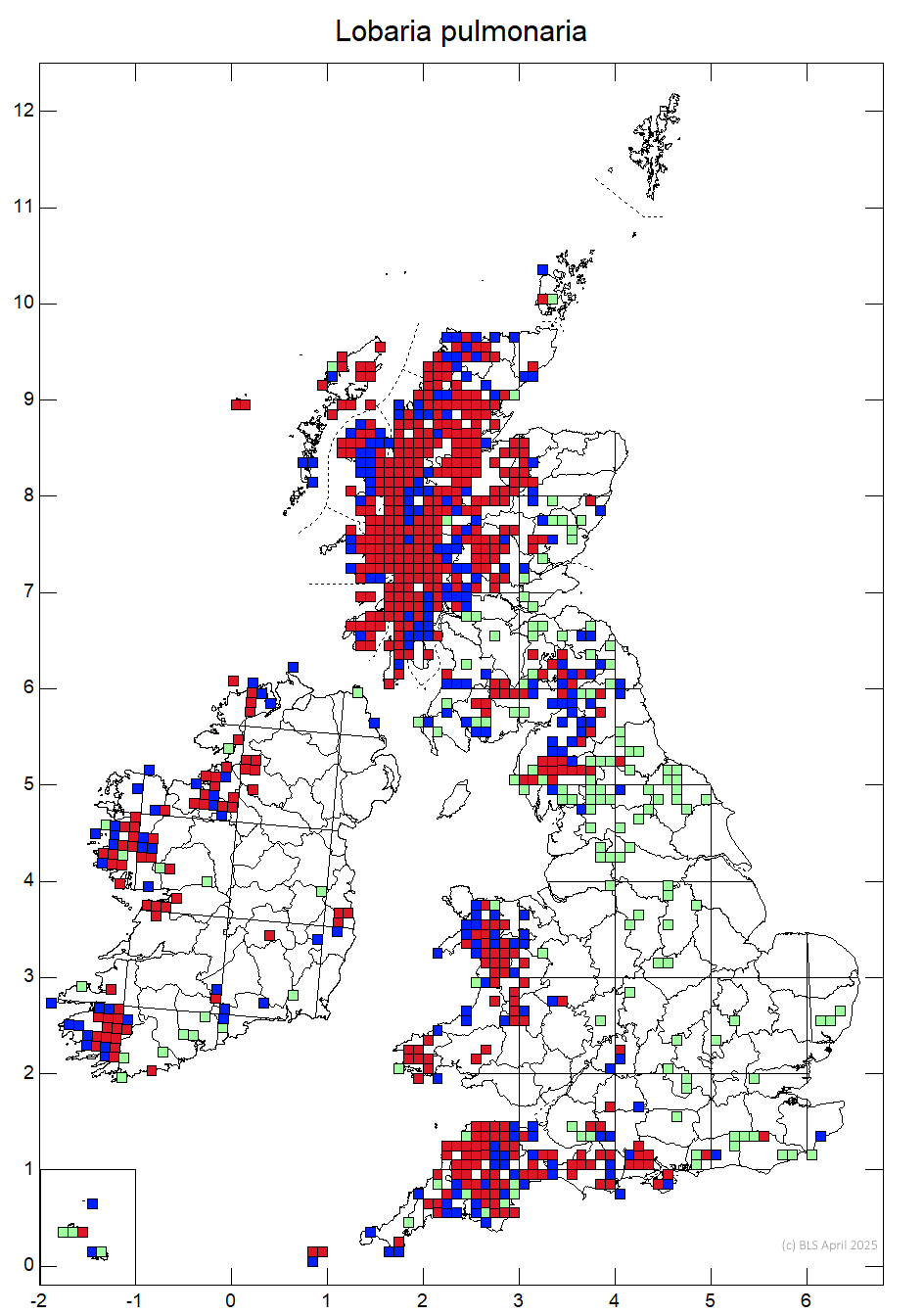 Distribution dot maps are produced from the database using Alan Morton's DMAP software or QGIS. These maps may be produced using different layouts and at any resolution, and can be based on the whole database or an extract from it. Hectad (10km square) maps for Britain and Ireland include records from the Mapping Scheme, some local record centres, and LichenIreland (used with permission).
Our data is also available on the NBN Atlas and distribution maps can be produced online from there.
Local recording software
Lichen recorders who wish to collate and analyse their own data, or to produce site lists or distribution maps for the local area, may wish to set up their own database. There are several packages available and they are not expensive, but in choosing a package you should check that it is compatible with your PC and with the data that can be supplied from the BLS database.
For mapping only, there are a number of options:
- DMAP - mapping software designed specifically for producing Distribution Maps and Coincidence Maps
- a GIS (Geographical Information System). The most widely-used professional packages are MapInfo and ArcGIS Desktop but these are expensive. QGIS is open-source, free and easier to use
- Google Earth and Google Maps. You can add points individually to these applications or use the Spreadsheet Mapper tool for bulk imports
For recording a more sophisticated system is needed, one that can export data directly to Recorder6 and that includes an up to date copy of the UK Species Inventory as its taxon dictionary. R6 itself can be used in this way and gives full compatibility with the central database, including an automatic export of new and amended records, but many people prefer to use our standard spreadsheets which can be sent to the BLS for import to the database.
Lichen records can be input to iRecord (preferably using the BLS recording activity) and to other apps, but at present we are unable to take these records into the BLS database. If you are thinking of using these, MapMate or any other recording package please discuss this with us (records@britishlichensociety.org.uk) first.