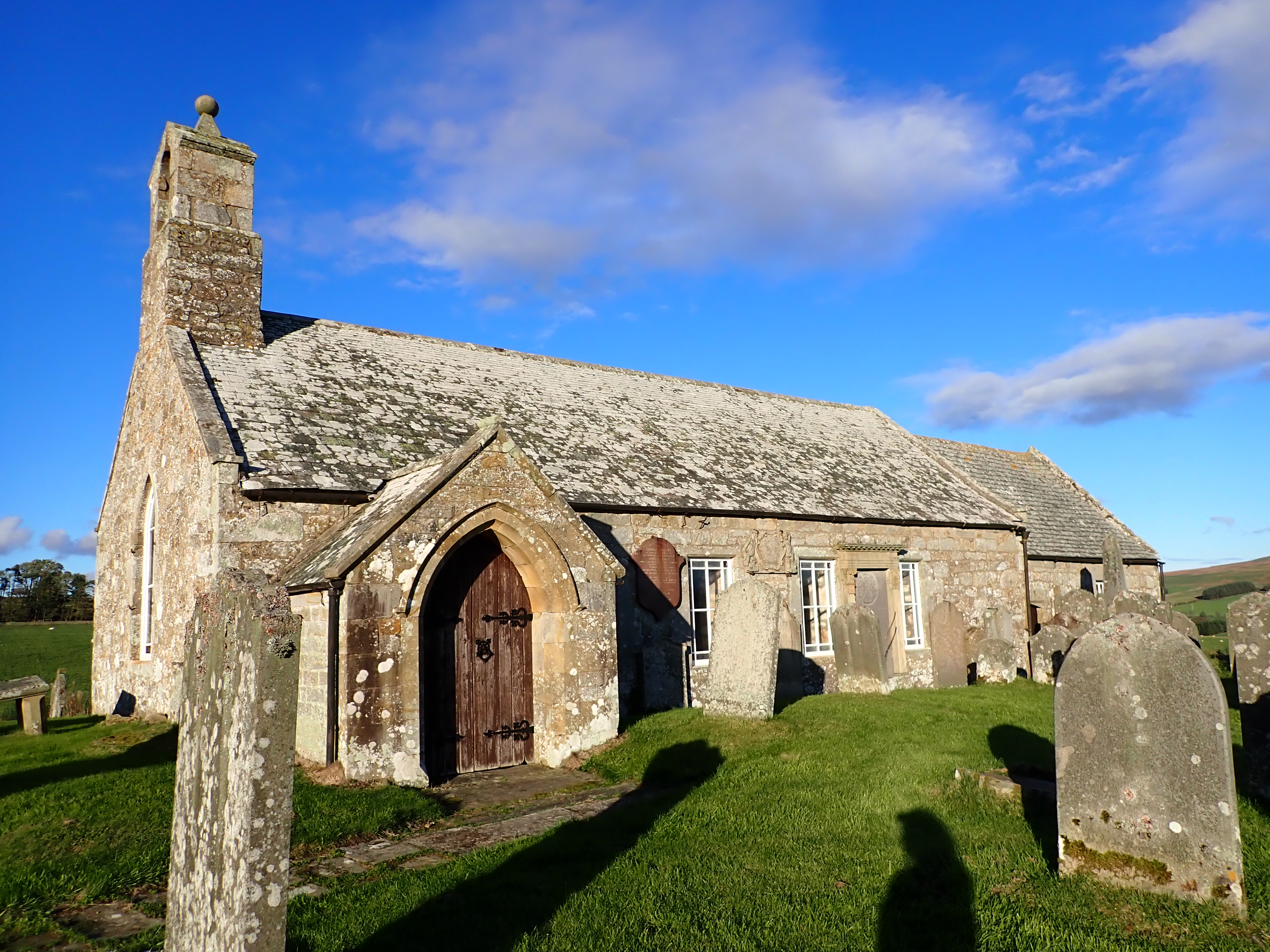
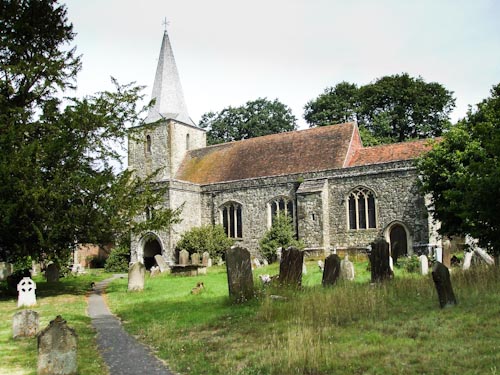
 | Churchyards support a great diversity of lichens, and are especially important in areas where there are few natural rock outcrops.
They also provide an excellent environment for the study of lichen biology and colonisation, and are convenient and accessible places to learn identification skills. |
Churchyard habitats
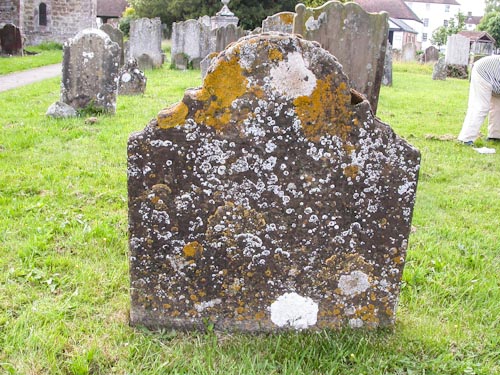
Provided there is sufficient light and moisture, lichens are able to colonise surfaces mostly unsuitable for flowering plants.
The geology is often varied, with limestone, sandstone, ironstone, marble, brick, mortar, slate and granite, each having their distinctive lichen communities. Different rock types may be found in the walls of the church, the boundary wall, and the various gravestones and monuments, and to add to that these stone surfaces vary from rough to smooth, shaded to exposed, damp to dry, horizontal to vertical, providing a multitude of micro-niches for lichens and bryophytes. The lichens on the shaded north side and the sunny south side of the church are, for example, markedly different.
Further micro-habitats are provided by recessed lettering, soil crevices in boundary walls, and the granite chippings within a kerbed grave. There may even be different lichens where the stone is affected by lead run-off from windows, or copper from a lightning conductor.In addition, lichens are to be found on well-established trees, wooden structures such as seats and fences, grassy areas, pathways and even rubber dustbin lids!
Each of these micro-niches will be ideal for some species but not at all suitable for others, and that leads to a great variety of lichens within the churchyard.
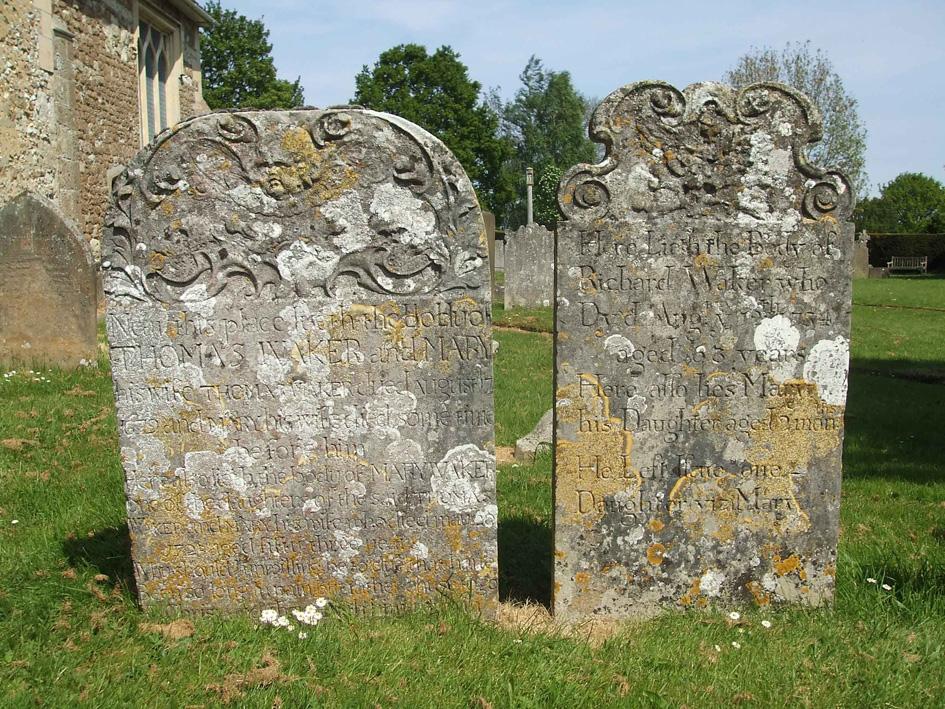
Limestone headstones with typical orange and grey crustose lichens
Some species grow very slowly, sometimes less than half a millimetre a year, while others grow more rapidly. Many are long-lived, and individual lichens may well be almost as old as the gravestones upon which they live. The ancient stonework of churches and churchyards, when undisturbed and unpolluted by chemical sprays, thus provides a sanctuary for them.
Species lists can contain more than a hundred species in a single churchyard, and in Indeed, in lowland Britain churchyards are often the only habitat where many species are recorded. For example, limestone memorials are often found even in areas where the local stone is granite, and are easily distinguished by the golden orange circles of Caloplaca and related species which grow on them.
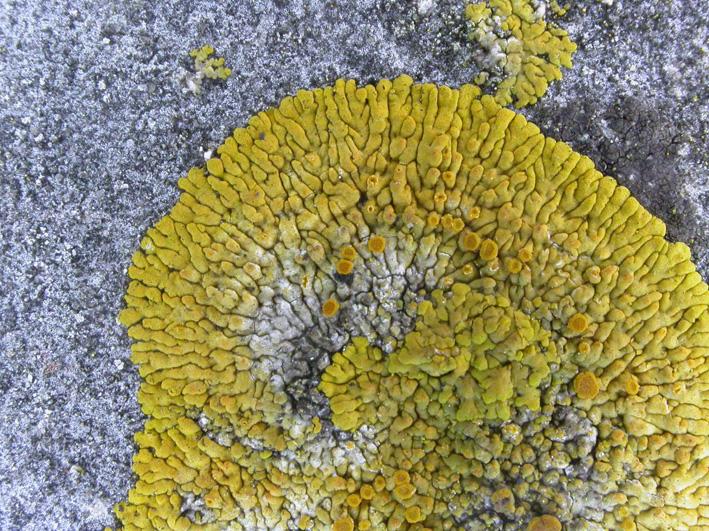
The orange crustose lichen Variospora flavescens on limestone
Some species occurring in churchyards are quite uncommon, or at least uncommon in other habitats. Churches, their memorials and surrounding walls are often the oldest man-made stone structures in the landscape. Although some lichens can colonise substrates quite quickly, with species first appearing within a few years, others can take hundreds of years to become established and may only settle over other, already well-established, lichens.
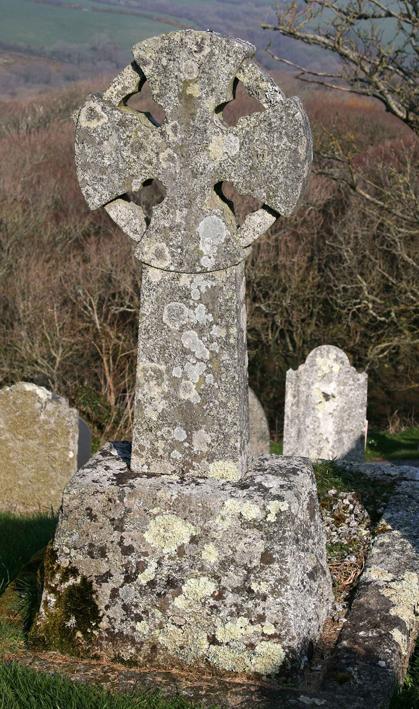
Granite Celtic cross with foliose and crustose lichens
The Lowland Churchyard survey
 The BLS Lowland Churchyard project was instigated in the early 1990s with the initial aim of surveying at least one churchyard in each of the Ordnance Survey’s 10km squares (hectads) in lowland Britain, This was achieved as a Millennium Project but surveying continues in some areas and has extended the scope into the South-west, Wales and the Borders, and Northern England. We now have more than 550,000 records from churchyards, but there are still plenty of gaps to fill.
The environment of Britain is changing in complex ways that vary from one area to another, so it is important that we continue this survey by recording new sites and by revisiting those that were last surveyed some time ago. Some have changed little since the 1980-90s or have increased in diversity as air quality has improved, but in others changing environmental conditions have led to considerable losses from the lichen flora. The increasing shade from maturing trees, the modern practice of leaving parts of churchyards unmanaged as "wildlife" areas , and the increase in atmospheric nitrogen pollutants, ammonia and NOX, in some areas, are all factors in this. Resurvey of churchyards will provide valuable data on how widespread these issues are and their effects on different lichen species.
Map of churchyards surveyed
An interactive map of the churchyard surveys carried out over the last 70 years is available here: Churchyard Survey map . If you want the records from any of those surveys just ask records@britishlichensociety.org.uk and we will send them to you.
Conservation of lichens in churchyards
Lichen colonisation is the natural result of leaving any surface exposed to the environment for a long time, and this is regarded by many as decorative rather than disfiguring. Lichens are very sensitive to environmental change and pollution, and our lichen flora is constantly under threat from human activities, so the survival of the wonderful lichen diversity in churchyards and graveyards is very much dependent on how they are looked after. More information on this can be found on our Conservation pages, under Habitats - Anthropogenic.: Churchyard Lichens | The British Lichen Society.
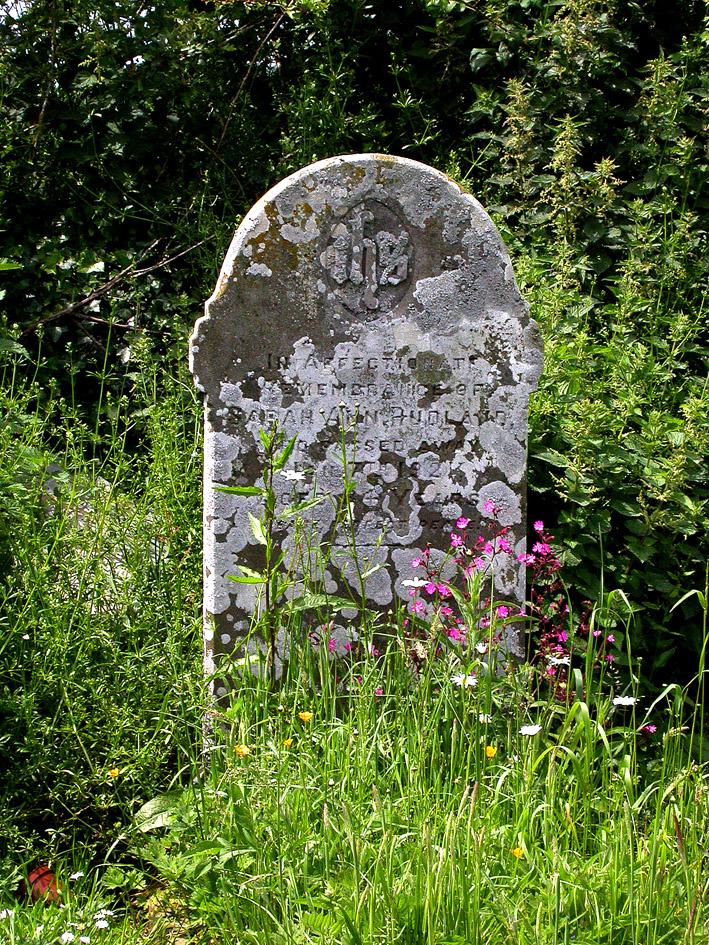
Grey and white crustose lichens on a sandstone headstone
More information
Anyone wishing to get involved in the churchyard lichen survey should start by getting in touch with the local contact for their area, it is always a good idea to visit a few churchyards with someone more experienced before setting out on your own. Various resources are available on this website to support churchyard surveys, including a Photo Guide to Common Churchyard Lichens, a guide to Lichen Communities of British Churchyards, originally produced by Tom Chester but since updated, and an Analysis of the churchyard records in the BLS database.
Once you get into recording churchyard lichens please use the BLS spreadsheet to send your records in to the database. It helps if you can use the substrate and scale habitat codes to provide more information about species of interest, these are listed in the spreadsheet and a useful guide to the position codes can be downloaded below.
Links to all these resources are at the bottom of this page.
If you want to find out what is already known about the lichens of a particular churchyard, please email records@britishlichensociety.org.uk and we will send you a spreadsheet and summary of the records we hold.