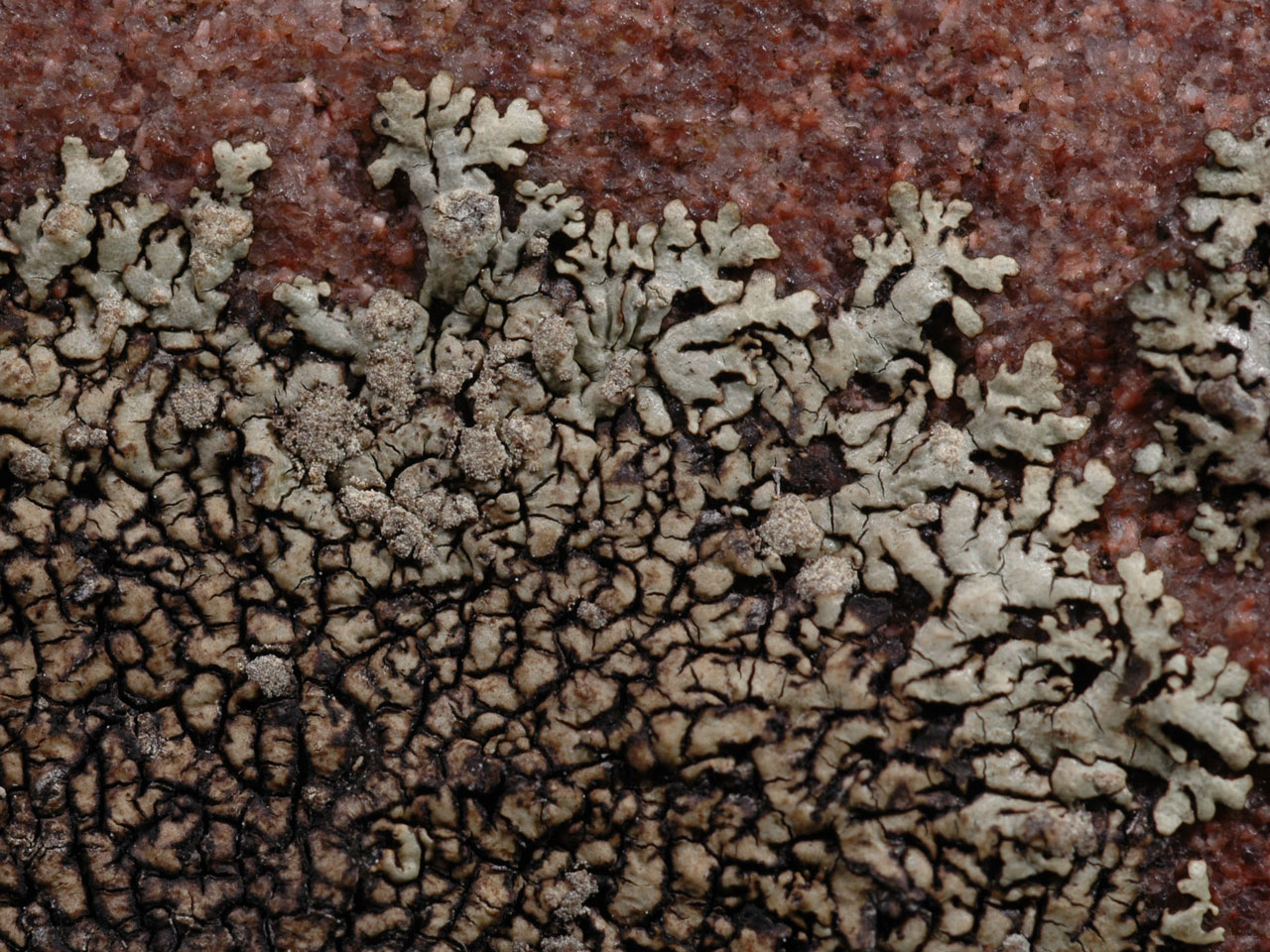
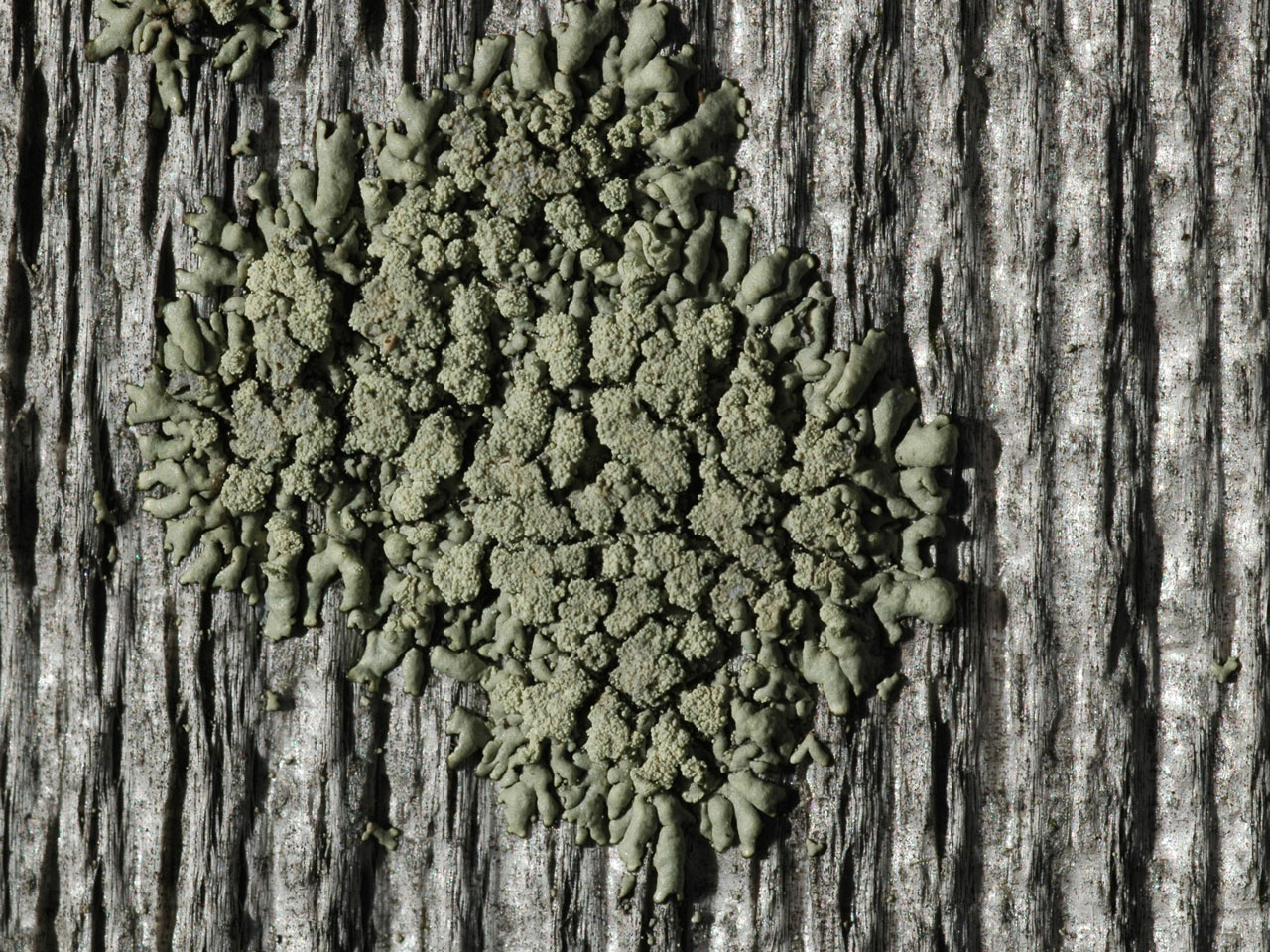
A small, yellow-grey, leafy lichen of well-lit siliceous rocks in the uplands, but also widespread on artificial substrates in the lowlands, where it is increasing. Sorediate, with the soralia laminal and UV–. The lichen is similar to Parmeliopsis ambigua but that is corticolous and lignicolous in habitat and has a different medullary chemistry (UV+ white). Arctoparmelia incurva also resembles X. mougeotii, and is mainly found on rocks, but also has a UV+ medulla and the soralia are on ends of small, inner lobes within the thallus and not laminal.
Thallus 0.5–1 (–1.5) cm diam., ± forming rosettes and coalescing to form larger patches, or partially scattered, very closely appressed, inner part subcrustose, cracked; lobes narrow, to 1 (–3) mm broad, radiating, ± discrete and scattered, or contiguous, fan-like, not overlapping, elongate, incised, ± flat; upper surface yellow-grey, becoming ± darker grey-yellow at the centre, sorediate; soralia ca 1 mm diam., laminal, rounded, ± convex, flat or excavate, scattered; lower surface black, rhizines short, stout, unbranched. Apothecia rare, to 2 mm diam.; disc brown; thalline margin entire, often sorediate. Ascospores 6–9 × 4–5 µm, ellipsoidal. Conidia 4–5 × ca 1 µm, cylindrical. Cortex K–; medulla C–, K+ yellow-orange, KC+ orange, Pd+ orange, UV– (usnic and stictic acids).
Parmeliopsis ambigua is separated by the predominantly corticolous habitat and different medullary chemistry (UV+ white and containing divaricatic acid). Arctoparmelia incurva resembles X. mougeotii but differs in the laminal, convex to globose soralia, markedly convex lobes and medulla K–, KC+ pink, Pd+ rust-red or Pd–, UV+ glaucous blue.
On well-lit siliceous rocks, also on roofing tiles, slate, memorials and quartzite chips in churchyards, occasionally on lignum.
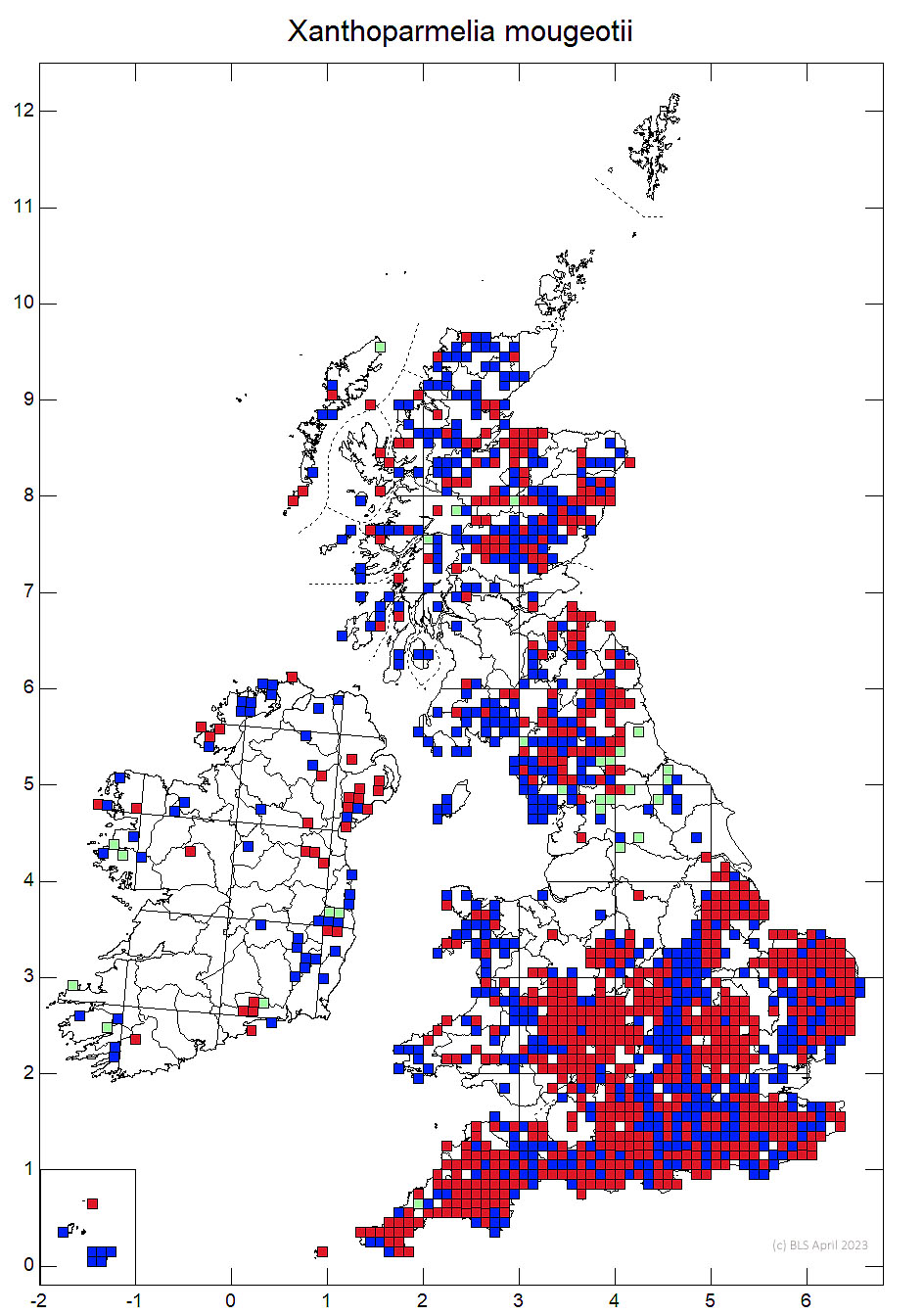

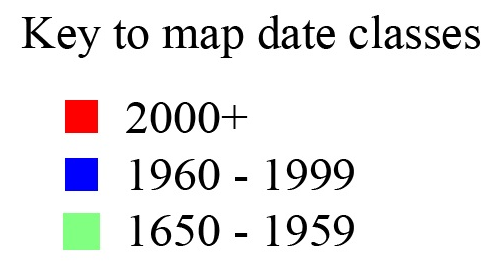
Widespread and common in upland Britain and Ireland, locally common and increasing in S. & E. England on artificial substrata.
A., Sanderson, N. & Simkin, J. (2023). Lecanorales: Parmeliaceae, including the genera Alectoria, Allantoparmelia, Arctoparmelia, Brodoa, Bryoria, Cetraria, Cetrariella, Cetrelia, Cornicularia, Evernia, Flavocetraria, Flavoparmelia, Hypogymnia, Hypotrachyna, Imshaugia, Melanelia, Melanelixia, Melanohalea, Menegazzia, Montanelia, Nesolechia, Parmelia, Parmelina, Parmeliopsis, Parmotrema, Platismatia, Pleurosticta, Protoparmelia, Pseudephebe, Pseudevernia, Punctelia, Raesaenenia, Tuckermannopsis, Usnea, Vulpicida and Xanthoparmelia. Revisions of British and Irish Lichens 33: 1-98.
Text by Neil A Sanderson based on Cannon et al (2023)