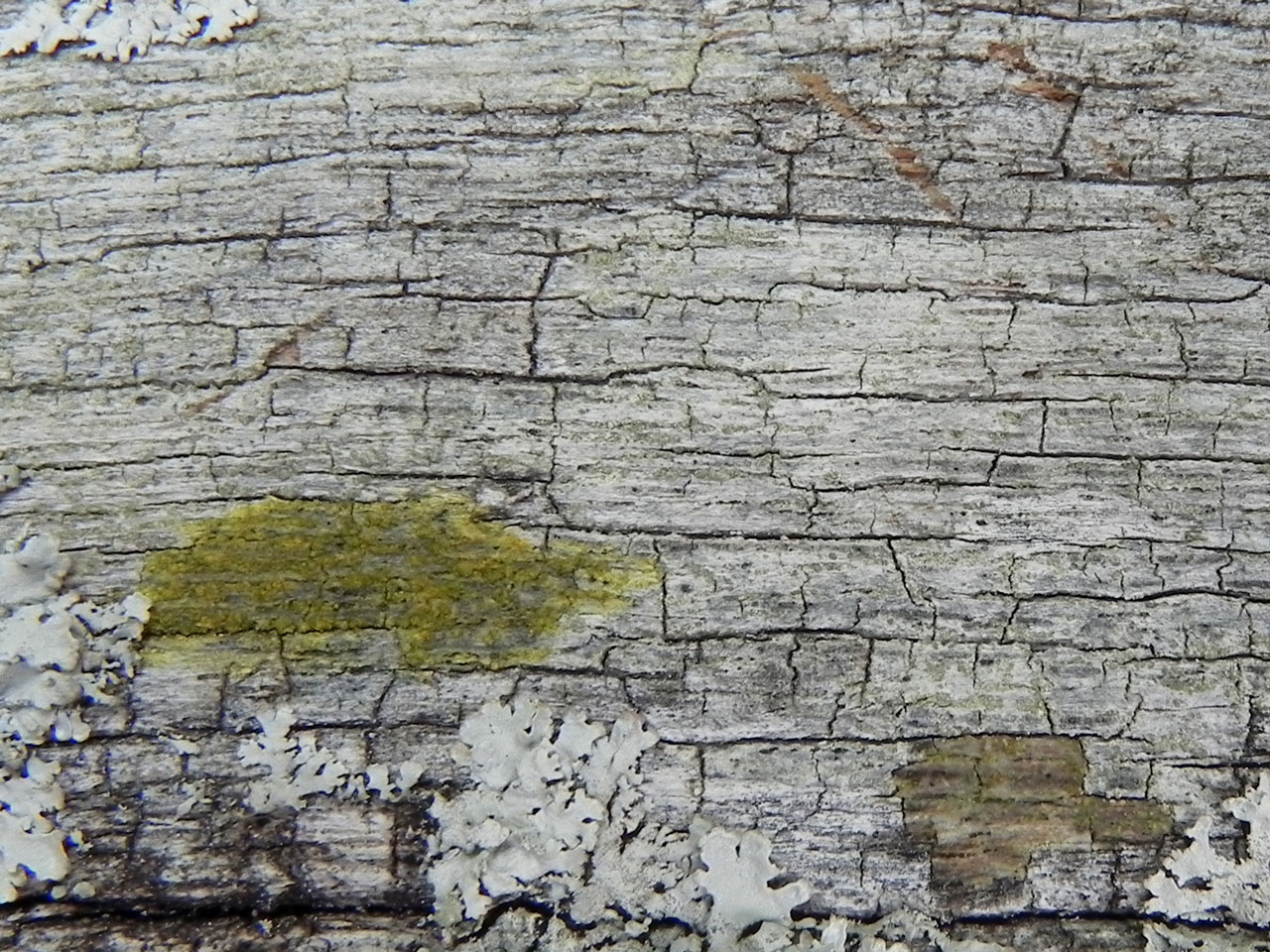
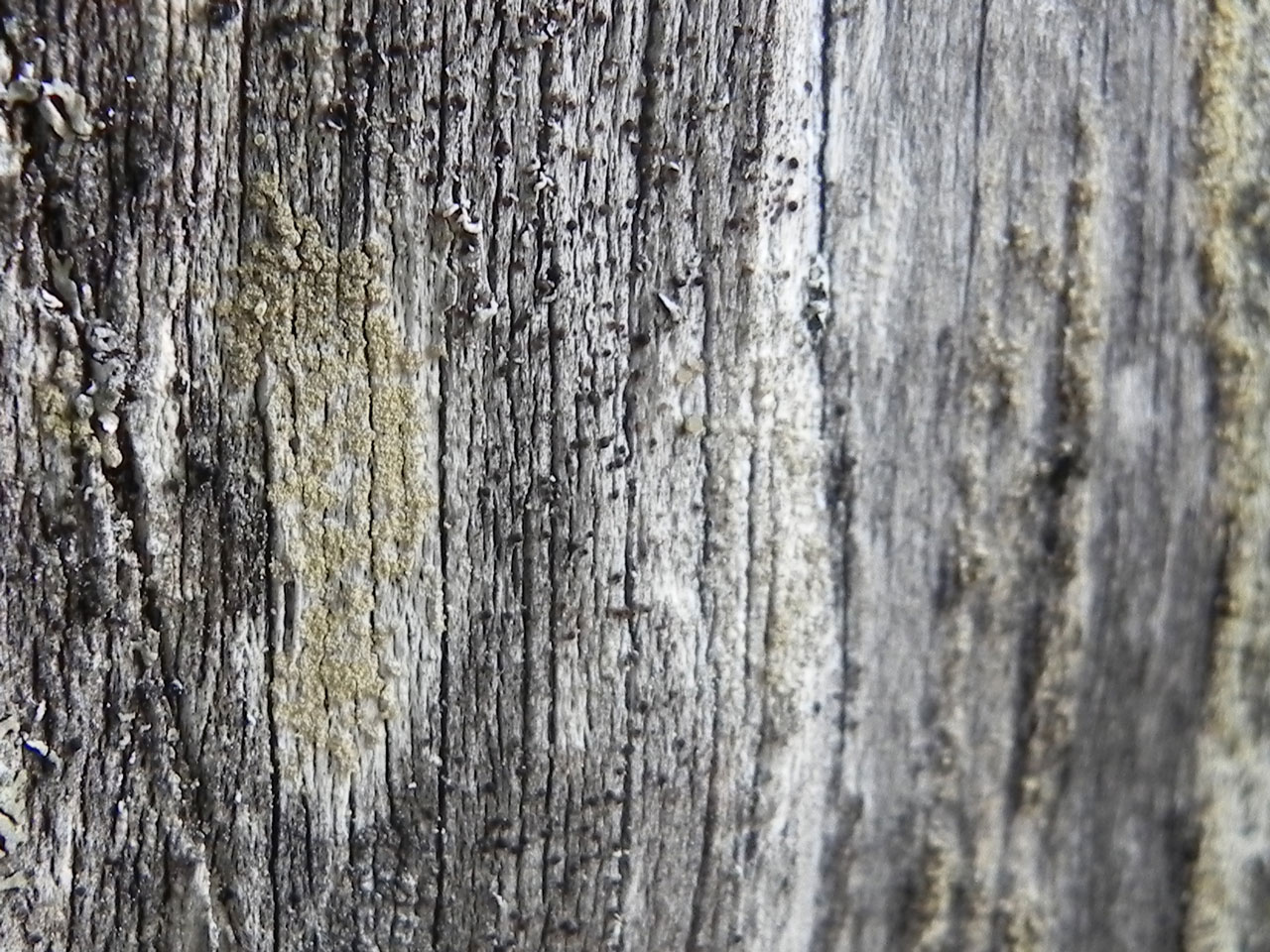
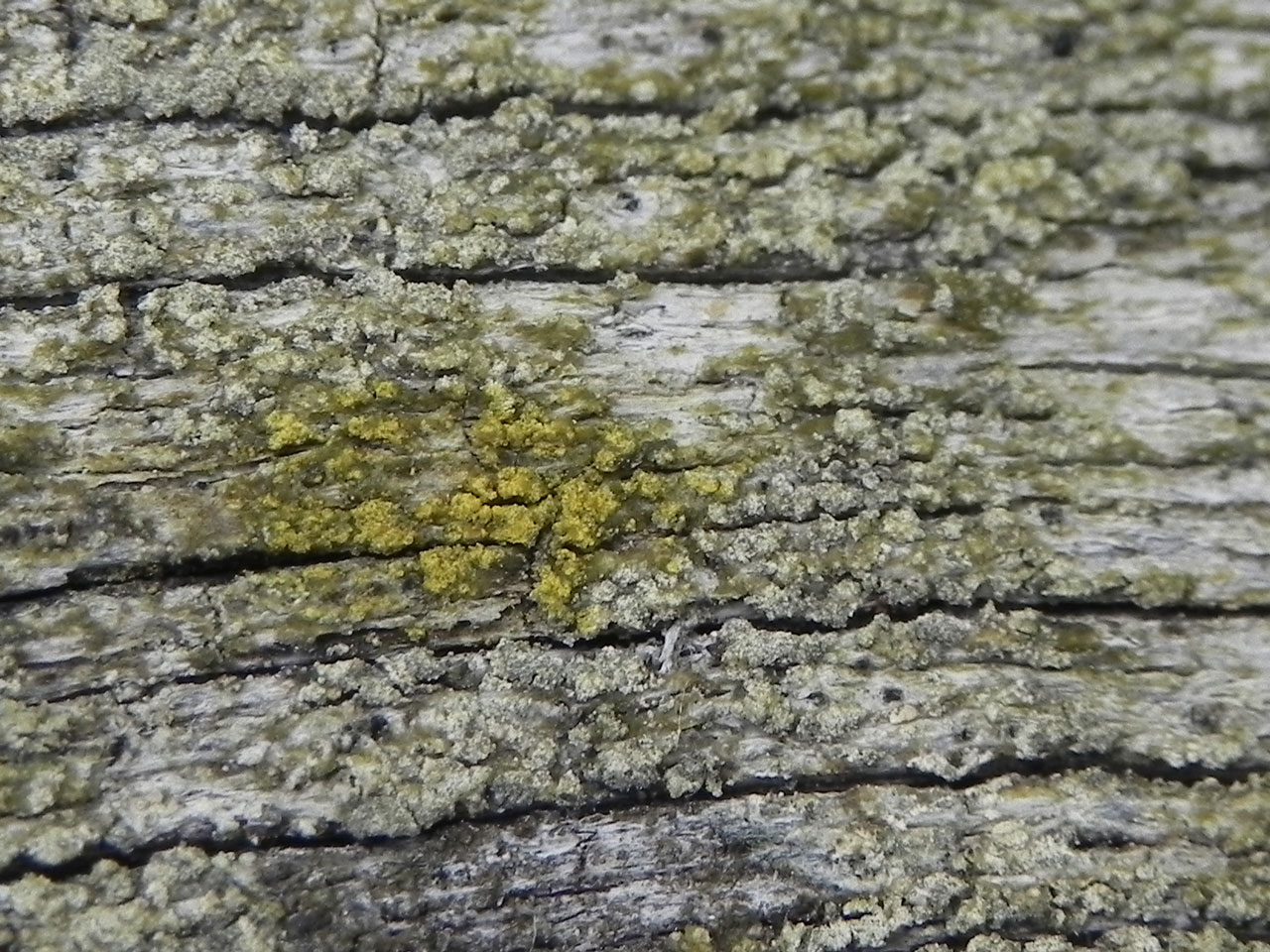
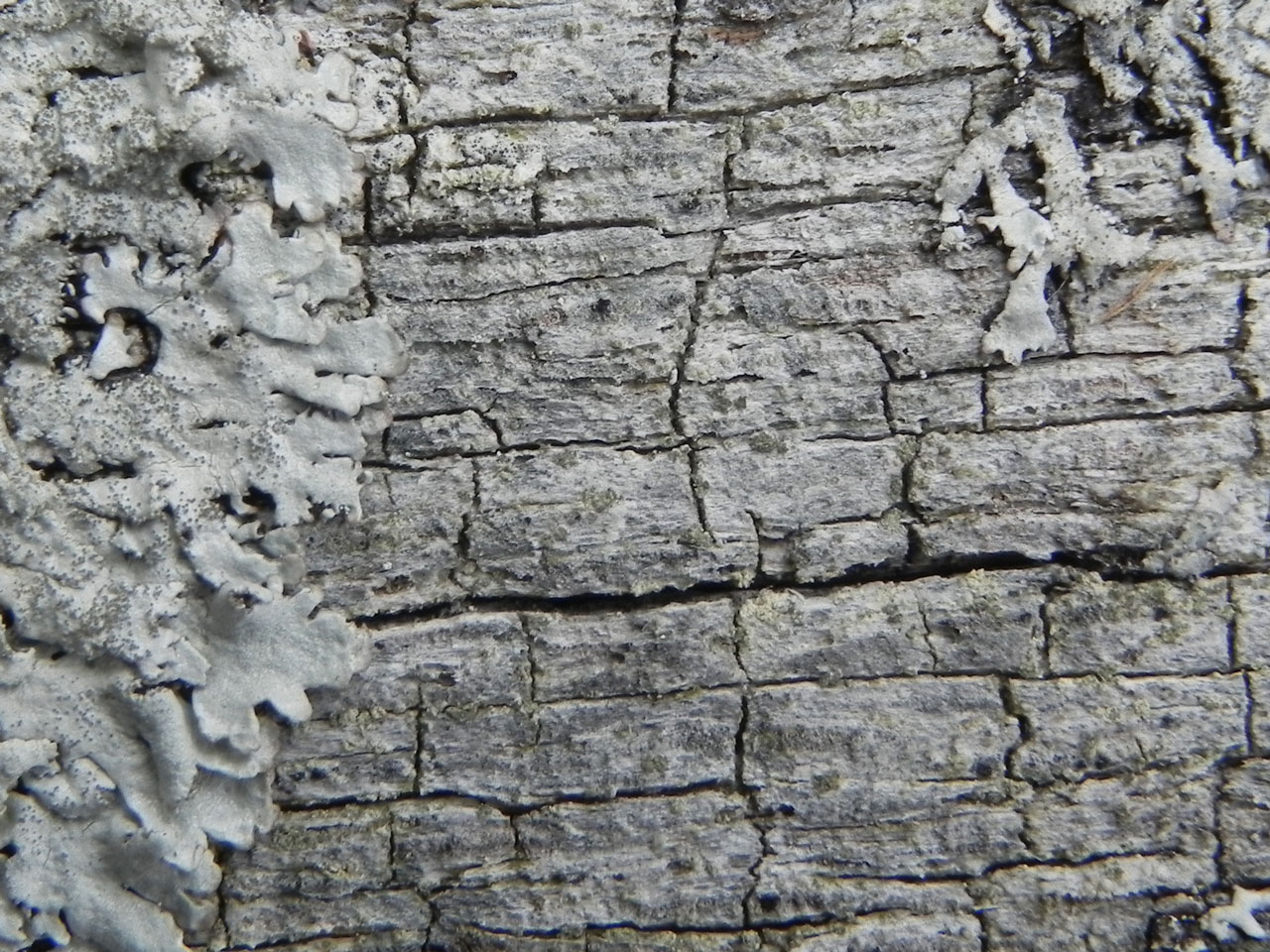
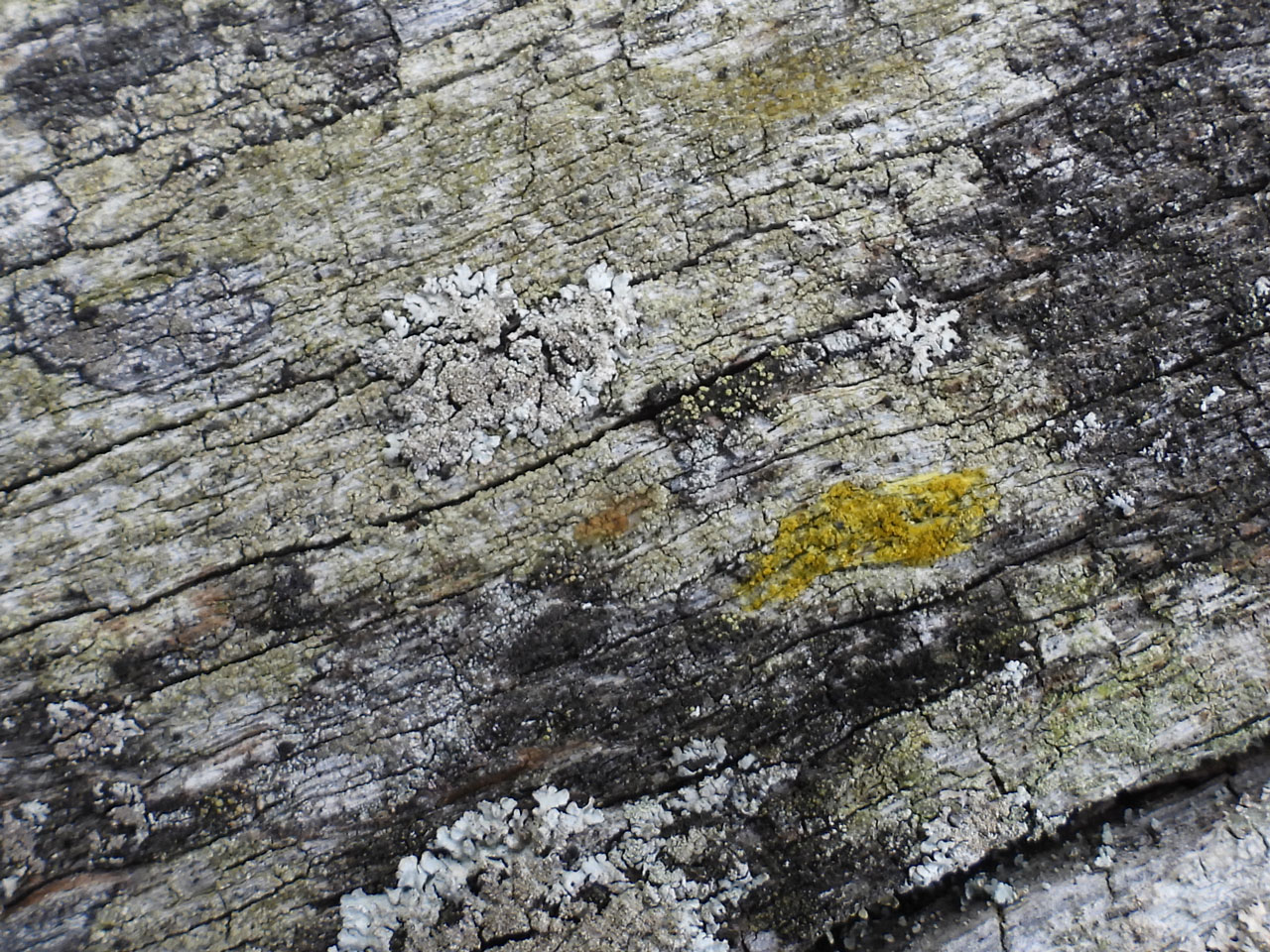
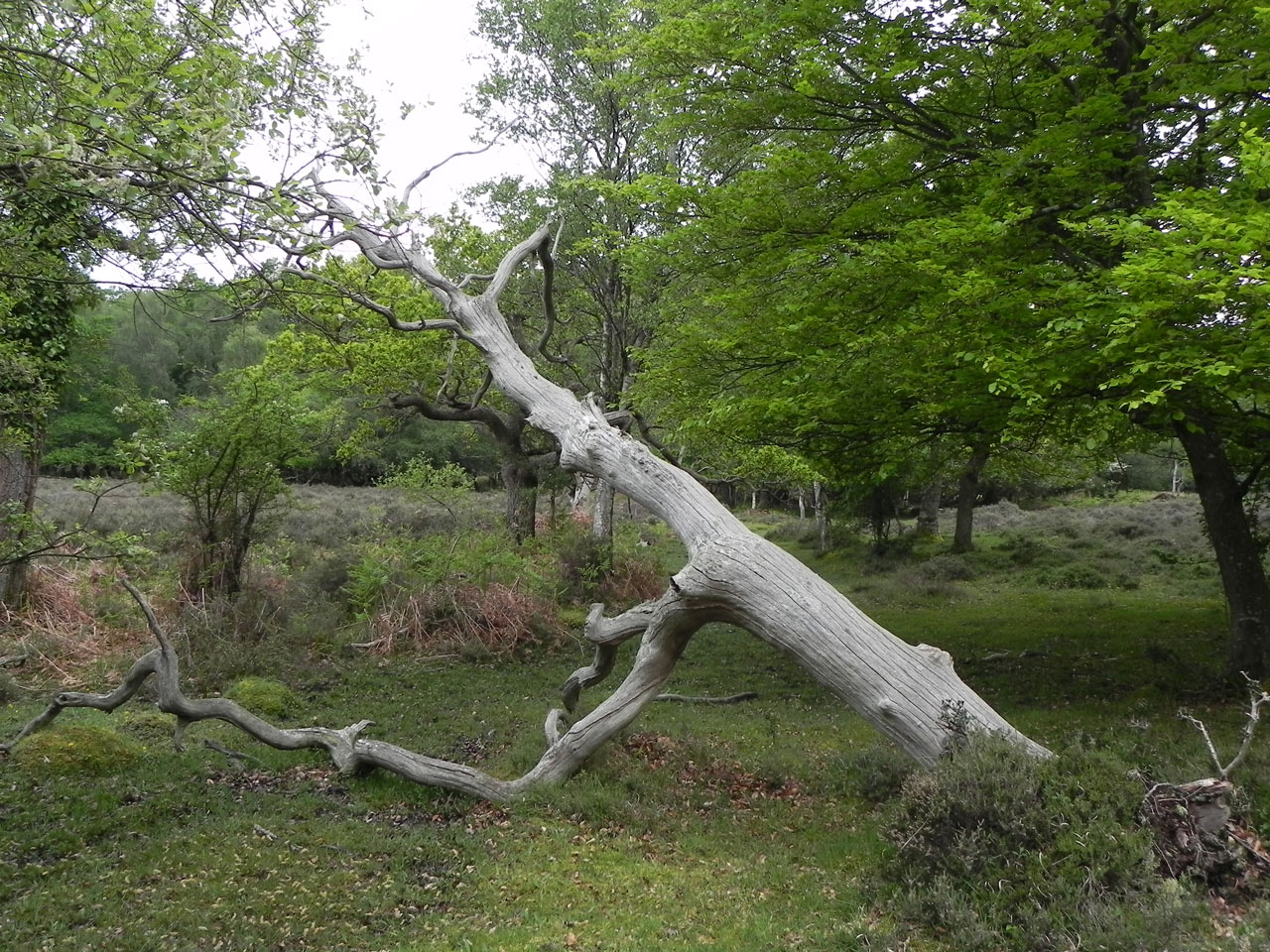
A areolate sorediate crust with a light grey thallus with yellowish farinose soredia. Easily overlooked, and needs concentration to find, but the Pd+ yellow and C+ red spot test combination is distinctive once spotted. Found on Scots Pine bark and weathered lignum in native pinewoods in the Highlands and on weathered Oak and Pine lignum in pasture woodlands and on old, untreated, Chestnut post and rail fencing in the south of England. Should be looked for on high quality old weathered lignum elsewhere.
Thallus crustose, areoles to 0.5 (–1) mm diam., weakly convex; upper surface dull, light grey or yellowish brown; soralia bursting from apices or more rarely, from margins of the areoles, yellowish brown; soredia farinose, 20–30 (–50) µm diam. Ascomata apothecia (not found in British material), to 0.6 (–0.8) mm diam., marginal or laminal, flat; disc black, not pruinose; margin remaining prominent, entire or flexuose; exciple of closely conglutinated hyphae, brown in the inner part, brownish black in the rim, not containing crystals, K+ violet, N–; hypothecium dark brown; epithecium dark brown, not containing crystals, K+ violet, N–; paraphyses without swelling or a pigment cap in the apical cell. Asci with a well-developed tholus containing an amyloid flank. Ascospores broadly to narrowly ellipsoidal, aseptate, 6–9 × 2.5–4.5 µm. Pycnidia sessile, black, attached to the areole or apparently directly to the substratum; conidia ellipsoidal to shortly bacilliform, 3.5–5 × 1.5–2.5 µm. Soralia C+ red, K+ yellow, KC+ red, P+ yellow, UV+ yellow (alectorialic acid).
Similar to Toensbergia leucococca, which has larger, prominent areoles and discrete soralia. When areoles are poorly formed, it resembles Myochroidea porphyrospoda (Lecanorales; see Cannon et al. 2024), which contains lobaric acid (C–, Pd–, UV–). Difficult to spot and needs concentration to find; look for whitish sorediate patches on lignum and acid bark and test with Pd & C. The combination of Pd+ yellow and C+ red spot tests on a sorediate crust is distinctive within the habitat. The UV fluorescence is brighter on old herbarium specimens but is strong enough on fresh specimens to be usefull in the field as a way of spotting thalli. The soredia darken to a reddish brown in the herbaium and stain the packet paper red-brown (alectorialic acid).
On bark and weathered lignum of old Scots Pines, weathered Oak lignum on standing or part fallen trees and Sweet Chestnut lignum on post and rail fencing.
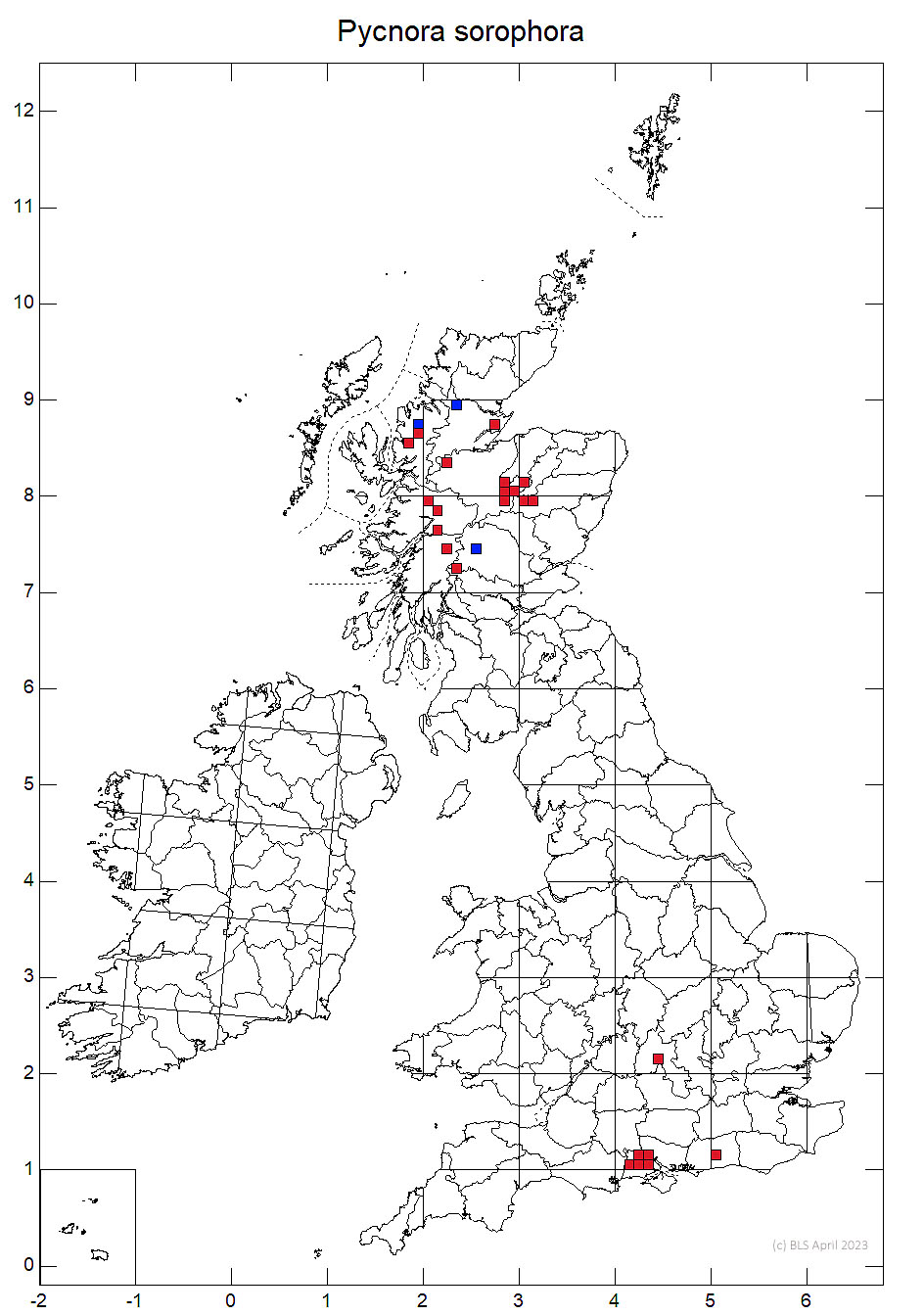

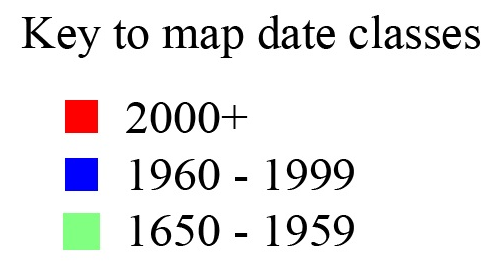
Rare, England (New Forest, Sussex, Oxfordshire) and Scotland (Highlands), where it is more widespread.
Although certainly overlooked, especially in Scotland, this lichen so far appears confined high quality habitats and possibly threatened by the decline in the use of untreated wood in fencing in the south and by increasing shade in woodland habitats elsewhere.
Britain: Notable
Cannon, P., Coppins, B., Aptroot, A., Sanderson, N. & Simkin, J. (2025). Miscellaneous lichens and lichenicolous fungi, including Aphanopsis and Steinia (Aphanopsidaceae), Arthrorhaphis (Arthrorhaphidaceae), Buelliella, Hemigrapha, Melaspileella, Stictographa and Taeniolella (Asterinales, family unassigned), Phylloblastia (Chaetothyriales, family unassigned) Cystocoleus (Cystocoleaceae), Sclerococcum (Dactylosporaceae), Eiglera (Eigleraceae), Epigloea(Epigloeaceae), Euopsis (Harpidiaceae), Lichenothelia (Lichenotheliaceae), Lichinodium(Lichinodiaceae), Melaspilea(Melaspileaceae), Epithamnolia and Mniaecia (Mniaeciaceae), Lichenostigma (Phaeococcomycetaceae), Pycnora (Pycnoraceae), Racodium (Racodiaceae), Chicitaea and Loxospora (Sarrameanaceae), Schaereria (Schaereriaceae), Strangospora (Strangosporaceae), Botryolepraria and Stigmidium (Verrucariales, family unassigned), and Biatoridium, Mycoglaena, Orphniospora, Piccolia, Psammina and Wadeana (order and family unassigned). Revisions of British and Irish Lichens 57: 1–78.
Text by Neil A Sanderson based on Cannon et al (2025)