An apparently rare species found on Scots Pine lignum from the Loch Maree to Coulin Forest native pinewoods in north west Scotland. Only found as a sterile crust in Britain, but does occur on bark in Scandinavia, and possibly overlooked in other old woods in the north. The more or less brownish, sorediate thallus containing lobaric acid (UV+ white) is diagnostic for sterile specimens.
Thallus forming a brownish crust that becomes greenish when growing in shade, indeterminate, areolate, sorediate; prothallus whitish, visible between the areoles and surrounding the thallus as a border; areoles indistinct or rarely discrete to contiguous, rounded, sometimes subsquamulose, to 0.4 mm diam., the cortex soon bursting to release soredia; soralia greyish brown or pale brown due to external pigmentation, greenish in shade, irregularly punctiform at first, soon becoming confluent to form an entirely leprose crust; soredia fine, 20–40 (–50) µm diam.; photobiont green, globose to broadly ellipsoidal, to 15 (–20) µm diam. Apothecia (not known in Britain) constricted at the base, to 1.2 mm diam., red-brown, glossy, the margin disappearing with age; disc flat to convex. Thallus C–, K–, KC–, Pd–, UV+ white (lobaric acid).
Sterile thalli could be mistaken for Pycnora sorophora, but this its C+ red, Pd+ yellow and UV+ yellow, The more or less brownish, sorediate thallus containing lobaric acid (UV+ white) is diagnostic for sterile specimens.
On lignum of standing old Scots Pine, in native pinewoods.
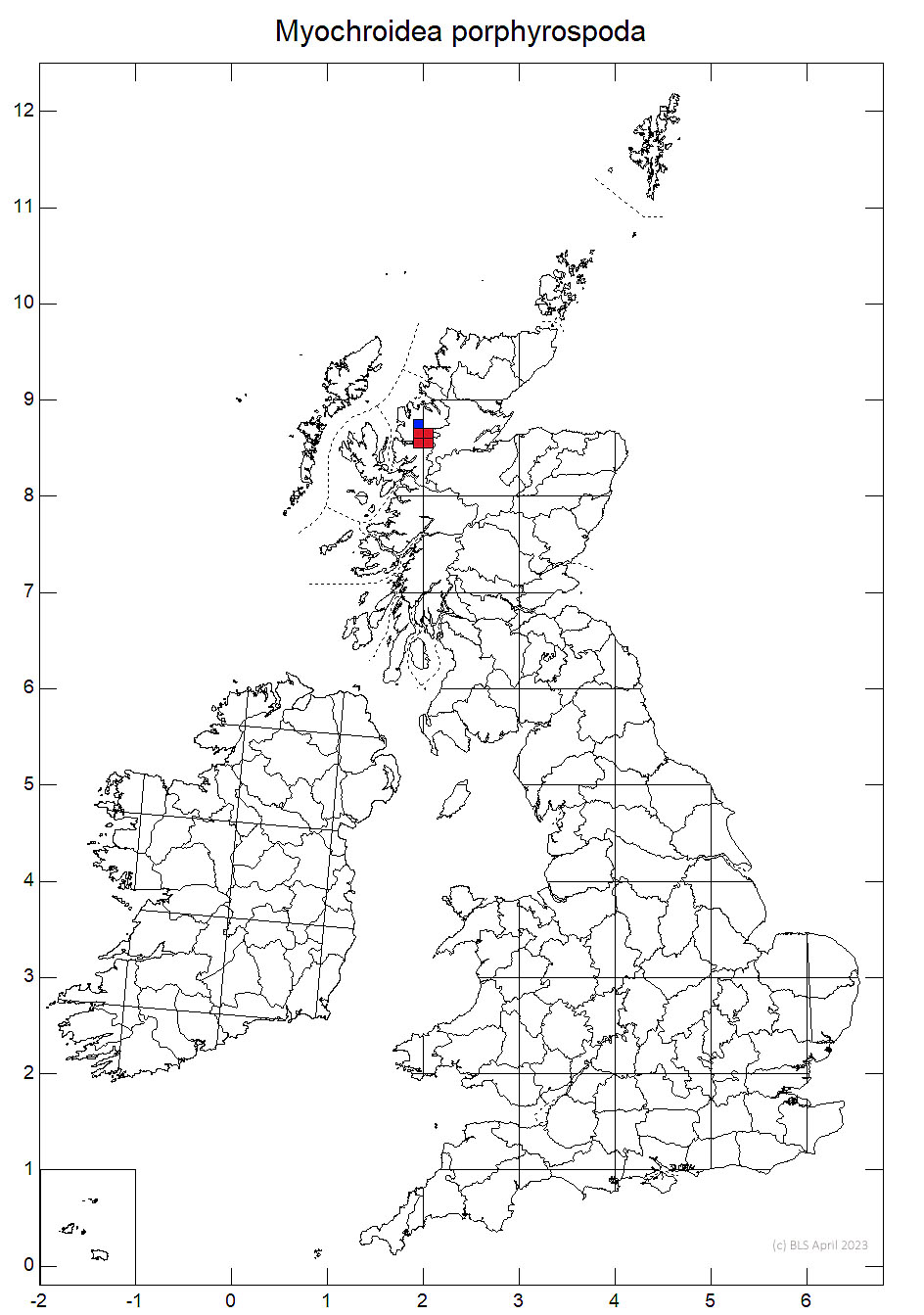


Rare, N.W. Scotland.
Recorded only from the Loch Maree to Coulin Forest native pinewoods. Potential overlooked elsewhere as a sterile crust but likely a rare species dependant on the maintenance of high quality weathered Pine lignum habitat. Overgrowth of the habitat by dense natural regeneration resulting from well intention reductions in grazing pressure is a threat. The conservation objectives for native pinewood sites need to take account of the biodiversity importance of the combination of open space and dead wood within this iconic habitat.
Britain: Near Threatened
Scotland: Priority Taxon for Biodiversity in Scotland
Cannon, P., Coppins, B., Aptroot, A., Fryday, A., Sanderson, N., Simkin, J. & Yahr, R. (2024). Miscellaneous Lecanorales including Biatorella (Biatorellaceae), Carbonicola (Carbonicolaceae), Haematomma (Haematommataceae), Psilolechia (Psilolechiaceae), Ramboldia (Ramboldiaceae), Scoliciosporum (Scoliciosporaceae), and Adelolecia, Catinaria, Frutidella, Herteliana, Lithocalla, Myochroidea, Puttea and Schadonia (of uncertain position). Revisions of British and Irish Lichens 42: 1–23.
Text by Neil A Sanderson based on Cannon et al (2024)