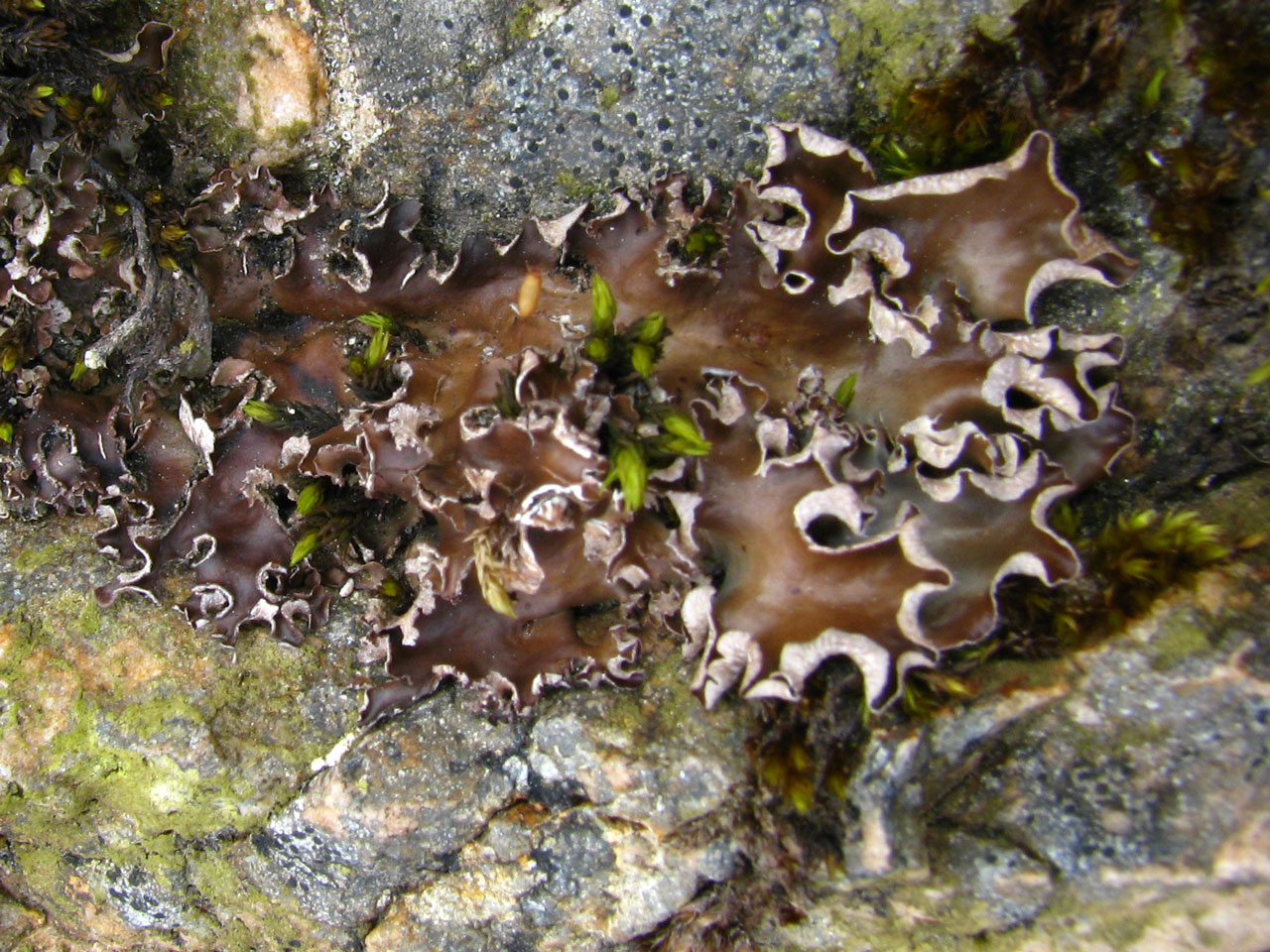
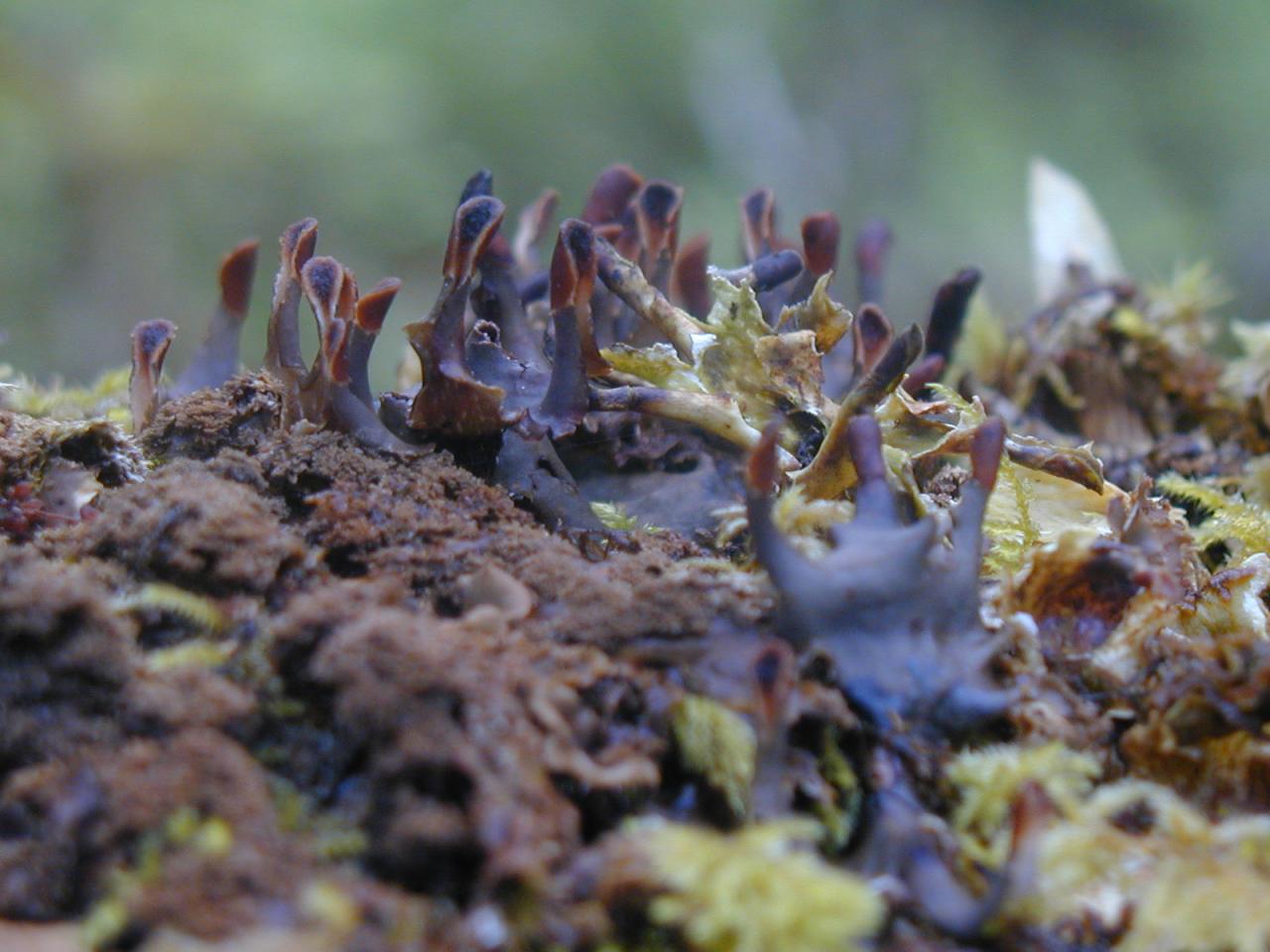
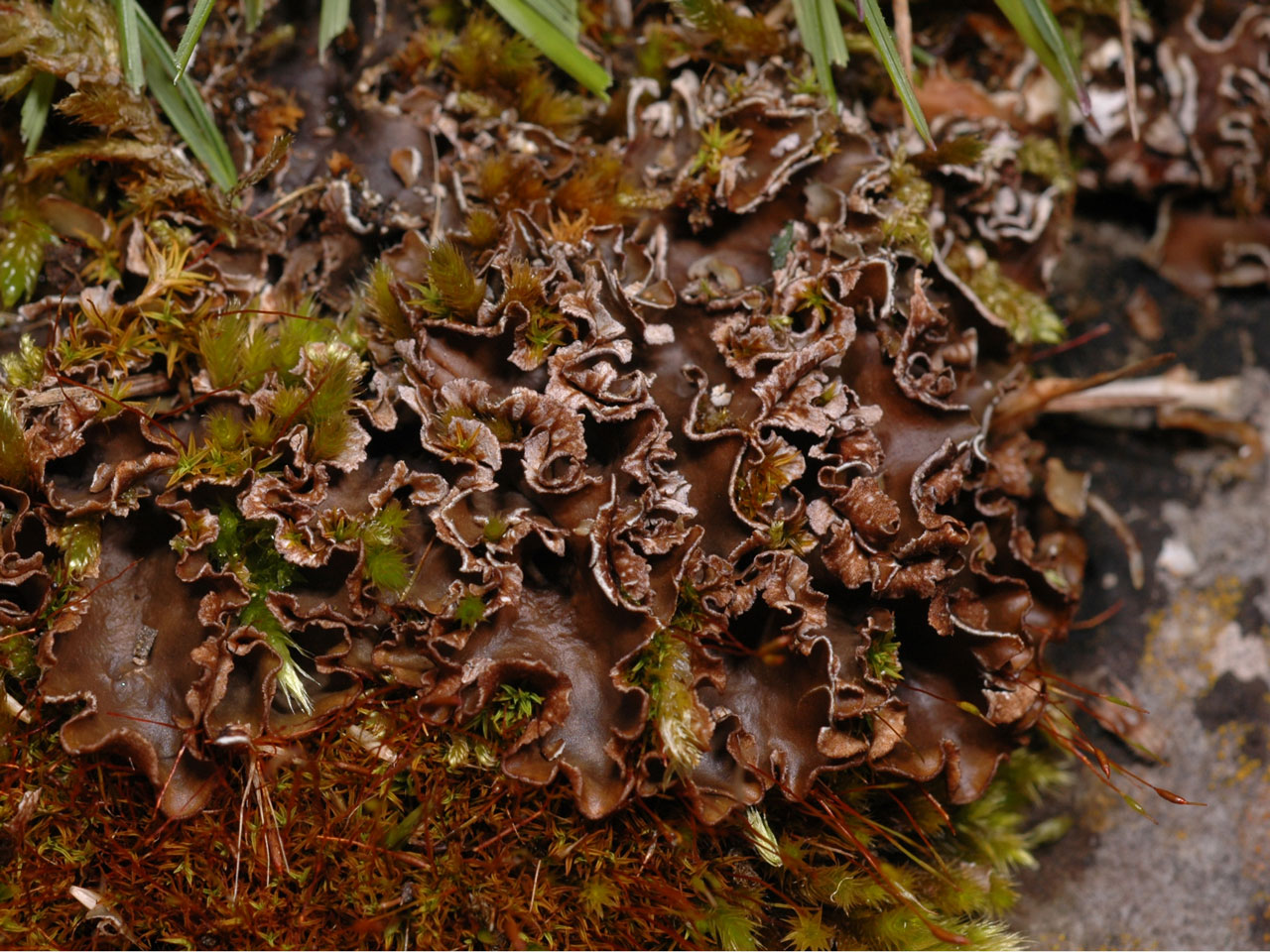
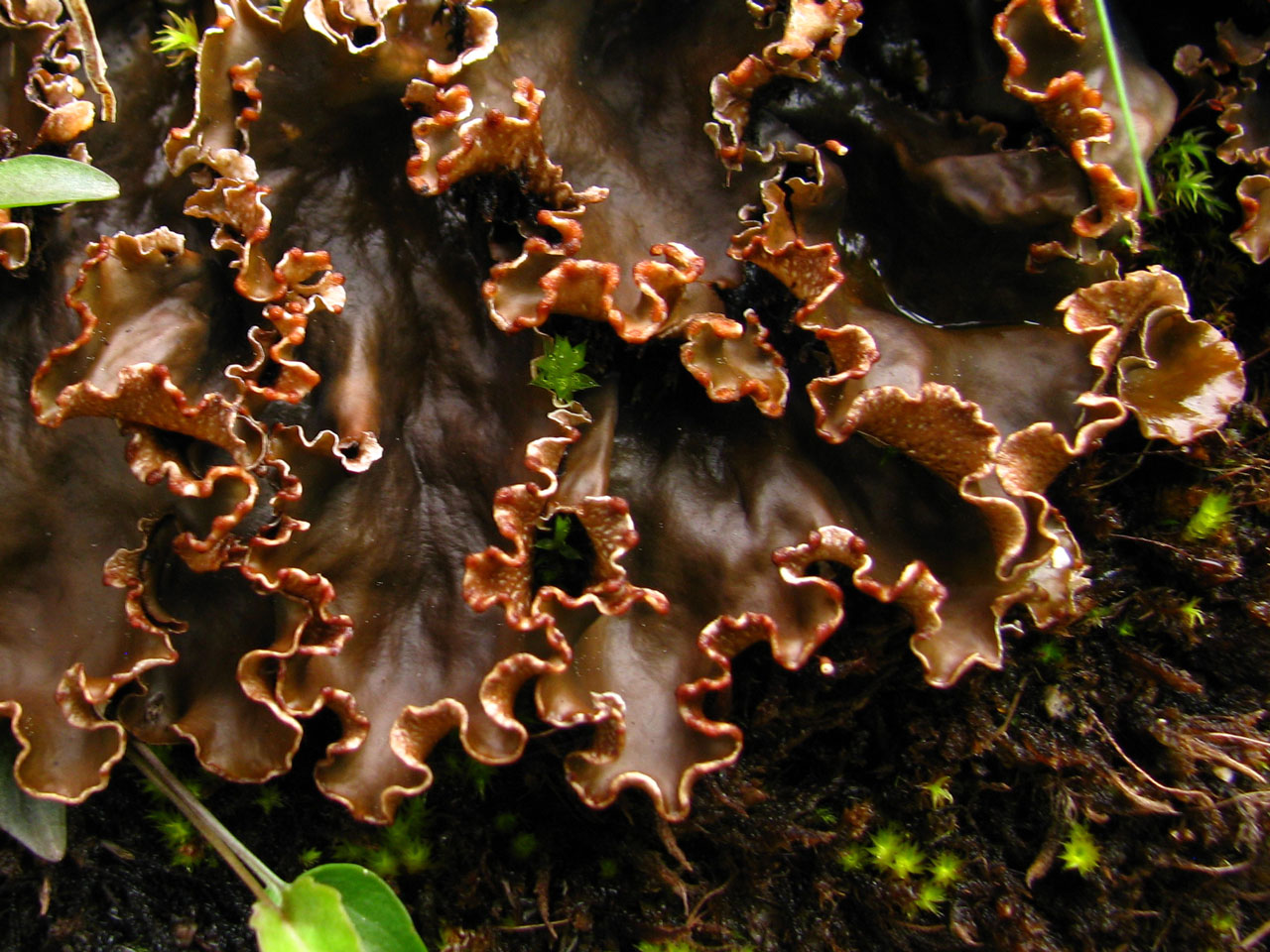
This Dogtooth, the Upland Dogtooth, was much confused with Peltigera hymenina in the past, but is distinct in the shining and dark brown upper surface and lower surface with very distinct dull to dark brown anastomosing broad low veins present to the margins. An upland species, most frequent in the Highlands.
Thallus to 20 (–30) cm diam., radiating or overlapping; lobes 1–1.5 cm broad and 4–5 (–12) cm long, ascending, markedly wavy and crisped-contorted, becoming squamulose; upper surface shining, dark brown; lower surface with very distinct dull to dark brown anastomosing broad low veins present to the margins with numerous rounded to ± elongated pale interstices; rhizines often confluent when young, pale to dark brown. Apothecia rectangular, pale to dark brown, on 0.5–2 cm stalks. Ascospores (40–) 50–68 (–73) × 2.5–5 µm, 3-septate. Thallus with tenuiorin, methyl gyrophorate, ± gyrophoric acid (C± red), T1, T2 and T3.
Three similar species need care to separate. Peltigera neckeri differs in the presence of an often sparse grey pruina on the upper surface, especially at the lobe margins; the rhizines ± confluent, pale, becoming blackened inwards and a few wide, dark veins; apothecia very dark brown. P. hymenina has the upper surface not pruinose; rhizines ± solitary, simple from the margin inwards, ± ochraceous, veins pale to ochre; apothecia red-brown. P. polydactylon has the upper surface not pruinose; rhizines ± confluent, brownish from the margin inwards, veins very distinct, brown to blackish; apothecia brown-red.
Peltigera seneca, morphologically similar to P. polydactylon but identifiable by TLC, was recently found in Norway and could be present in Britain and Ireland (Timdal & Rui, 2021), mostly likely in the east of Scotland as it has a sub-oceanic distribution in Norway.
Amongst mosses, on tree bases, rocks and in ravines also on quarry and mine waste.
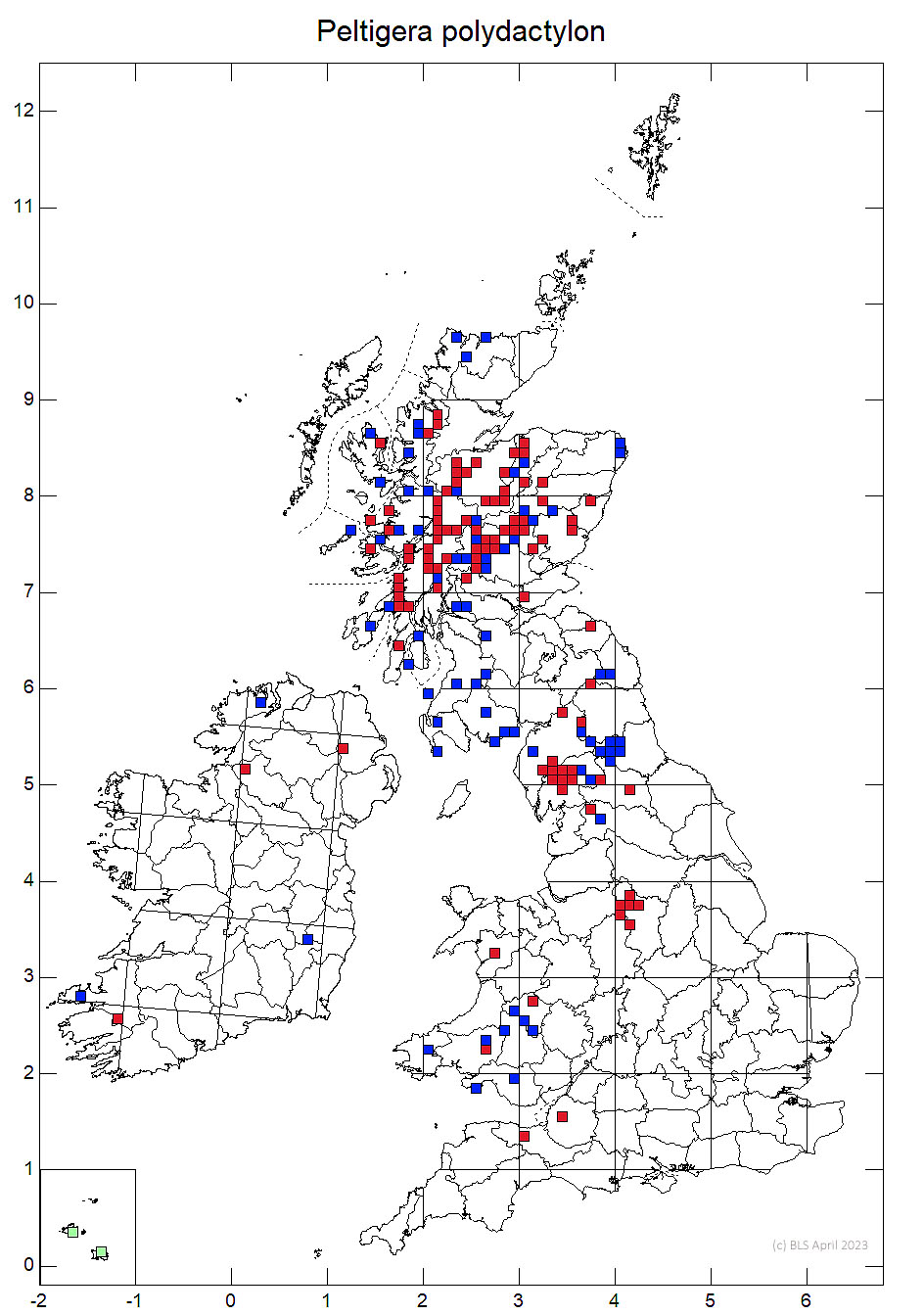


Local, was much over-recorded due to historic confusion with P. hymenina. Most frequent in the Scottish Highlands and the Lake District. Rather sparsely recorded in the uplands beyond. Rare in the south west (the Mendips, Exmoor and a Cornish mine site).
A mainly upland species which can be locally frequent in the Highlands, but scarce beyond.
Britain: Notable
Wales: Vulnerable
Cannon, P., Magain, N., Sérusiaux, E., Yahr, R., Coppins, B., Sanderson, N. & Simkin, J. (2021). Peltigerales: Peltigeraceae, including the genera Crocodia, Lobaria, Lobarina, Nephroma, Peltigera, Pseudocyphellaria, Ricasolia, Solorina and Sticta. Revisions of British and Irish Lichens 20: 1-34.
Timdal, E., & Rui, S. (2021). Peltigera seneca new to Europe. Graphis Scripta 33: 79–85.
Text by Neil A Sanderson based on Cannon et al (2021)