

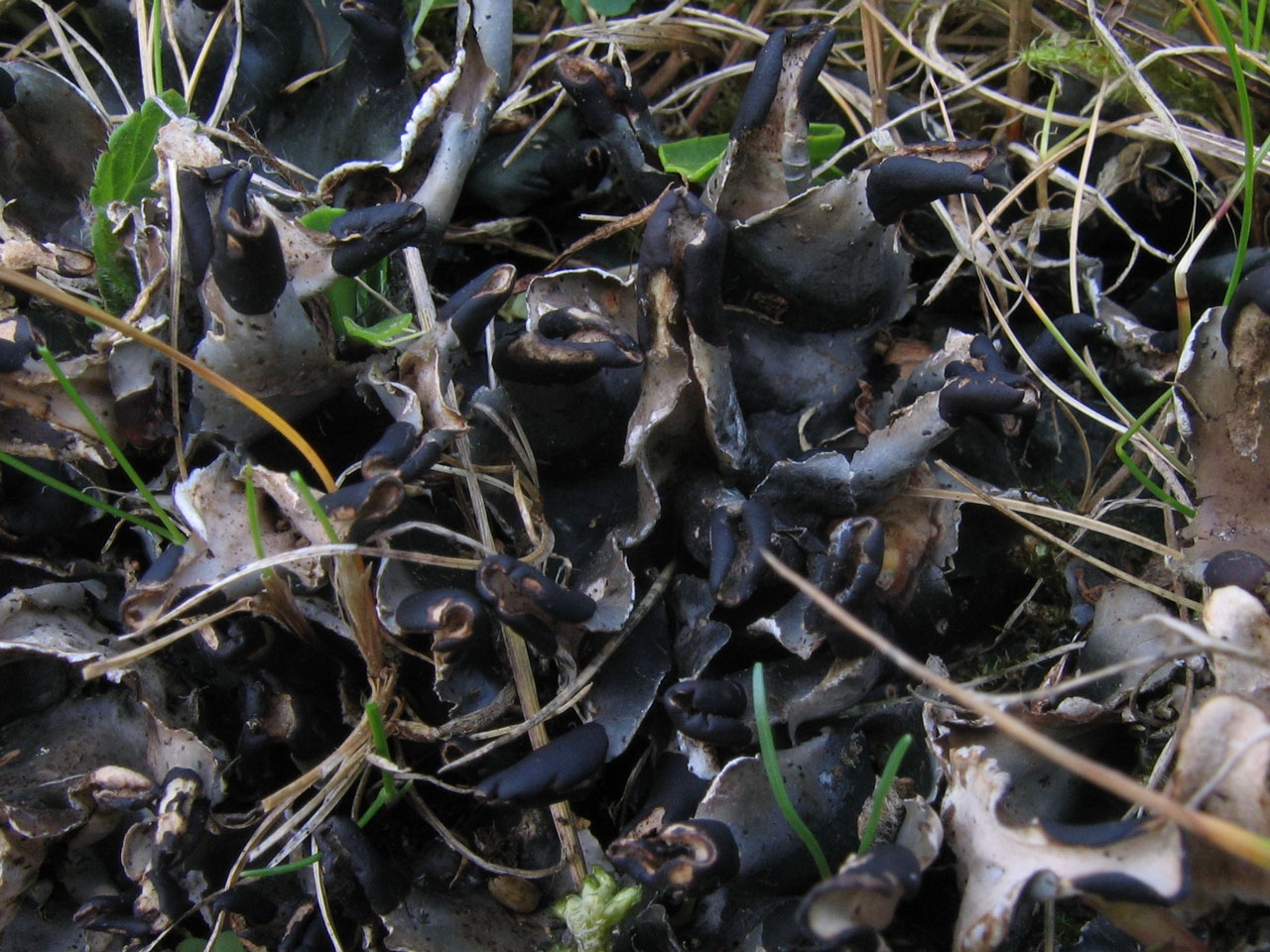

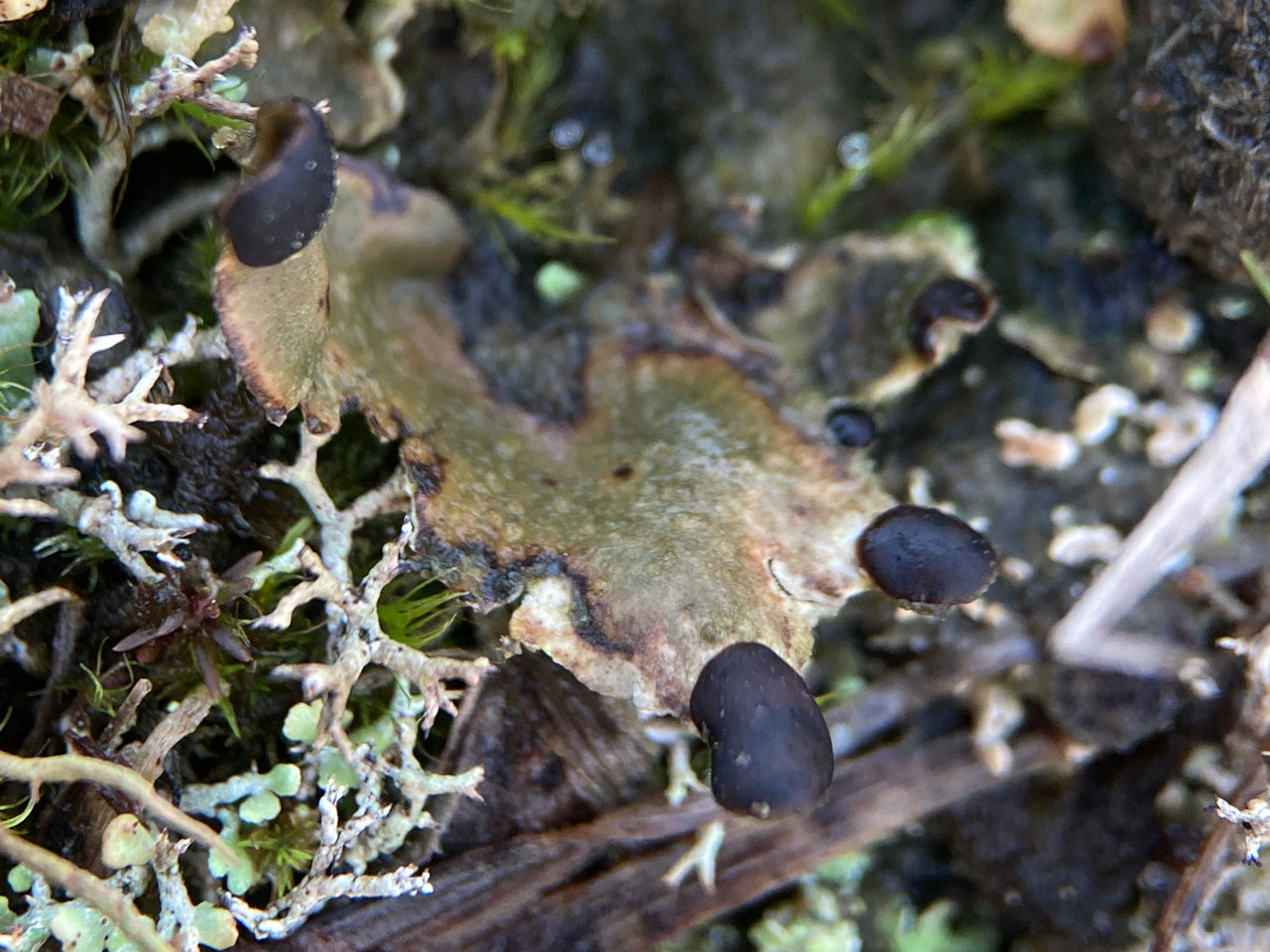
This Dogtooth, the Black Dogtooth, is a local colonist of somewhat base enriched disturbed ground. Similar to Peltigera hymenina, with the upper surface not tomentose, but differs in being thinly white-grey-pruinose at least at the edges and often cracked, along with diffuse dark veins on the lower surface. When fertile the apothecia are a distinctive dark brown-black, becoming bean-shaped.
Thallus small, to 10 (–20) cm diam., rather similar to Peltigera hymenina; lobes 0.7–1 (–1.5) cm broad and 3–4 cm long, with upturned margins; upper surface typically thinly white-grey-pruinose, often only towards the margins (×20 lens), shining, often with ±elongate pale slash-like cracks with ± raised edges exposing the white medulla; lower surface pale at the margins, black towards the centre, with a few wide mostly diffuse dark veins with white interstices, rhizines mostly few, diffuse, confluent. Apothecia mostly short-stalked, discs dark brown-black, reflexed, becoming bean-shaped. Ascospores 50–75 × 2.5–5 µm, 3-septate. Thallus with tenuiorin, methyl gyrophorate, ± gyrophoric acid (C+ red), T2, T3, T4 and two unidentified terpenoids.
The pruina is often only thinly present on a few lobes and should be carefully searched for; the unusual chemistry is diagnostic and the apothecia are usually darker than in related species. The dark veins separate this species from Peltigera hymenina where they are persistently ochre-coloured.
On mosses on soil, including lead-contaminated soil, or rocks, disturbed dry grassland and tennis courts, churchyards and ± basic dunes.
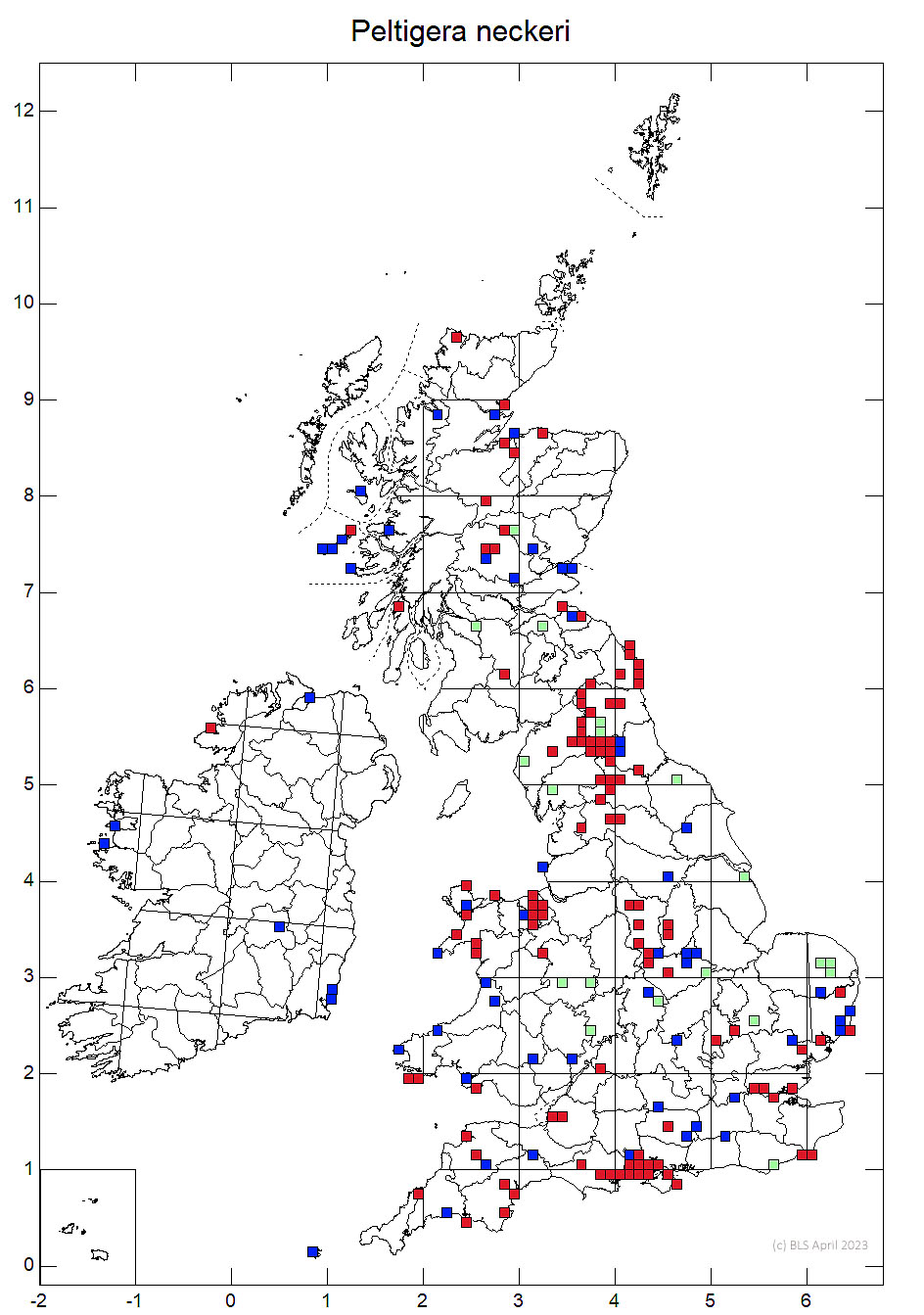


Local and infrequent but possibly overlooked; scattered throughout England, Scotland & Wales, rare in Ireland.
A local colonist of somewhat base enriched disturbed ground including post industrial and ruderal sites such as metal mines and gravel pits and natural dry grassland on the coast and in heaths.
Britain: Notable
Cannon, P., Magain, N., Sérusiaux, E., Yahr, R., Coppins, B., Sanderson, N. & Simkin, J. (2021). Peltigerales: Peltigeraceae, including the genera Crocodia, Lobaria, Lobarina, Nephroma, Peltigera, Pseudocyphellaria, Ricasolia, Solorina and Sticta. Revisions of British and Irish Lichens 20: 1-34.
Text by Neil A Sanderson based on Cannon et al (2021)