Lecanora subcarnea
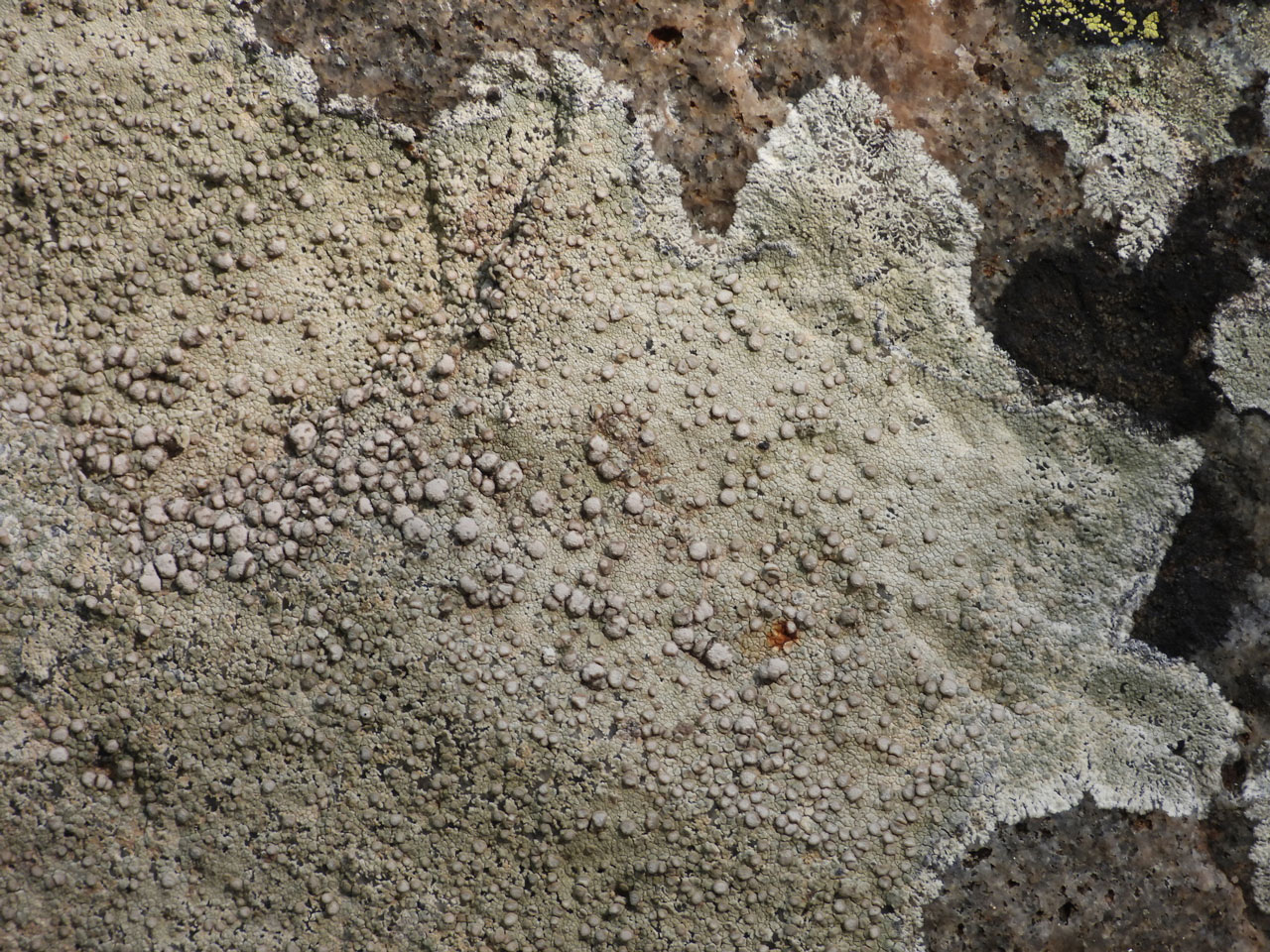
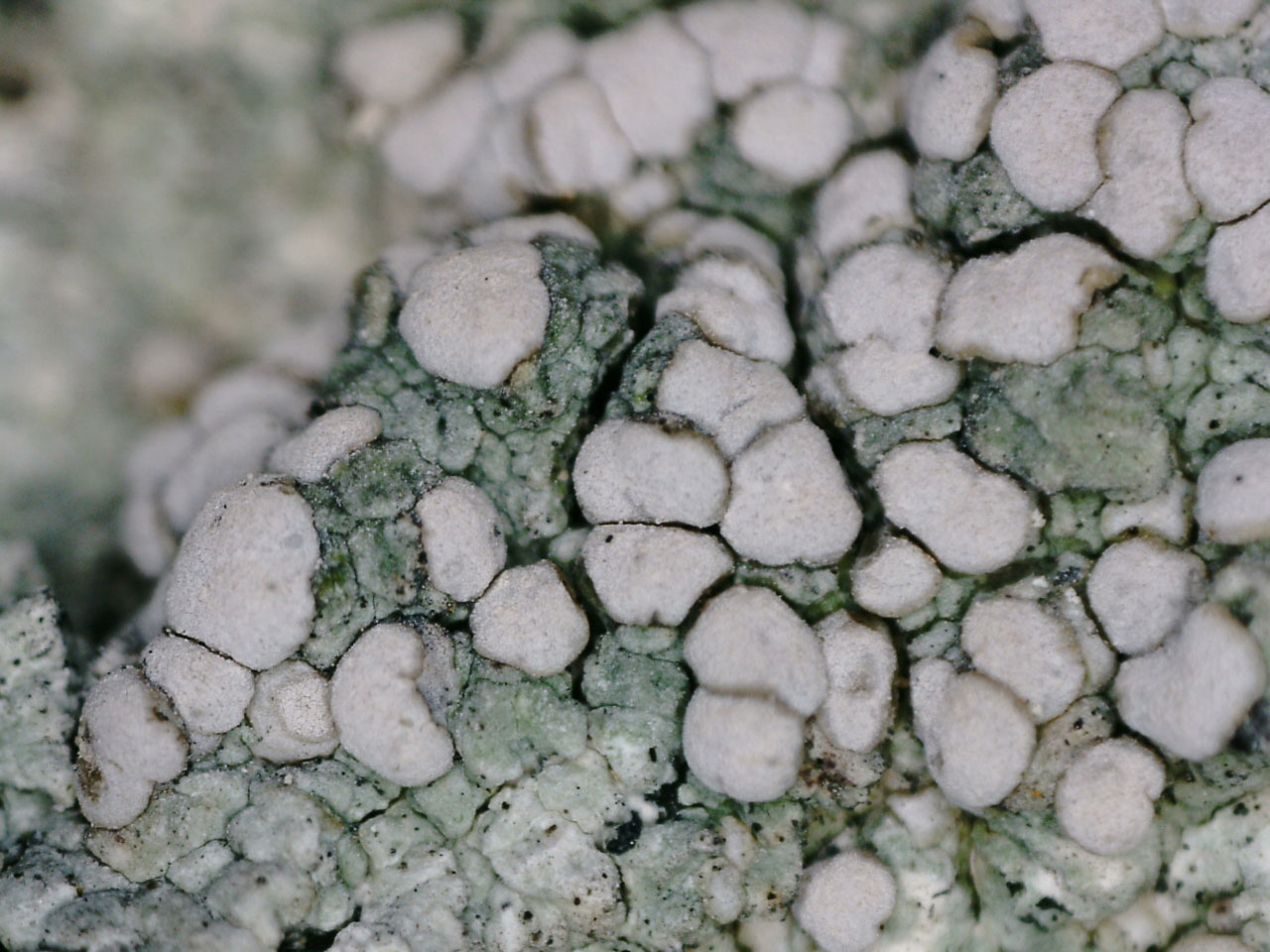
An attractive Lecanora with apothecia with densely white or blue-white pruinose discs, found in dry recesses of base-rich siliceous rocks in woodlands and by lakes and rather local. Separated from similar species sharing the same habitat by spot tests (K+ yellow, Pd+ orange→red).
Thallus continuous and finely cracked to areolate, clearly delimited, areoles often uneven in height, ± flat, margins crenulate, white or pale grey or pale yellow to yellowish grey, surface coarsely granular to warted; prothallus white, fibrous, generally well-developed. Apothecia (0.2–) 0.4–1 (–1.7) mm diam., aggregated, immersed to sessile and finally constricted below; thalline margin entire, concolorous with or tending to become paler than the thallus, excluded with age; disc pink- to pale grey-brown, convex to almost subglobose, usually densely white or blue-white pruinose; epithecium brown, granular; hymenium 35–55 µm tall; paraphyses 1.5–2 µm diam., unbranched or sparsely branched especially near the tips, apices to 3.5 µm diam., generally with the terminal cell subglobose. Ascospores (8–) 10–14 × (5–) 6–8 µm. Thallus C–, K+ yellow, Pd+ orange→red, UV– (atranorin, chloratranorin, protocetraric acid).
A member of the L. subfusca group in its broad sense, but in a separate clade from the L. subfusca group s. str. with Lecanora albella (Ivanovich-Hichins et al, 2025) but a new genus has not yet been named. Confused with Lecanora ochroidea, which differs in the K+ yellow-red (crystals) reaction due to presence of norstictic acid and the UV+ pale orange fluorescence and is mainly restricted to lowland coastal rocks, but can be found on rocks in oceanic woods. Also likely to be confused with Glaucomaria swartzii, which often shares the same habitat but is C+ orange.
In dry recesses of base-rich siliceous rocks, or rarely on calcareous rocks by lakes and in woodlands.
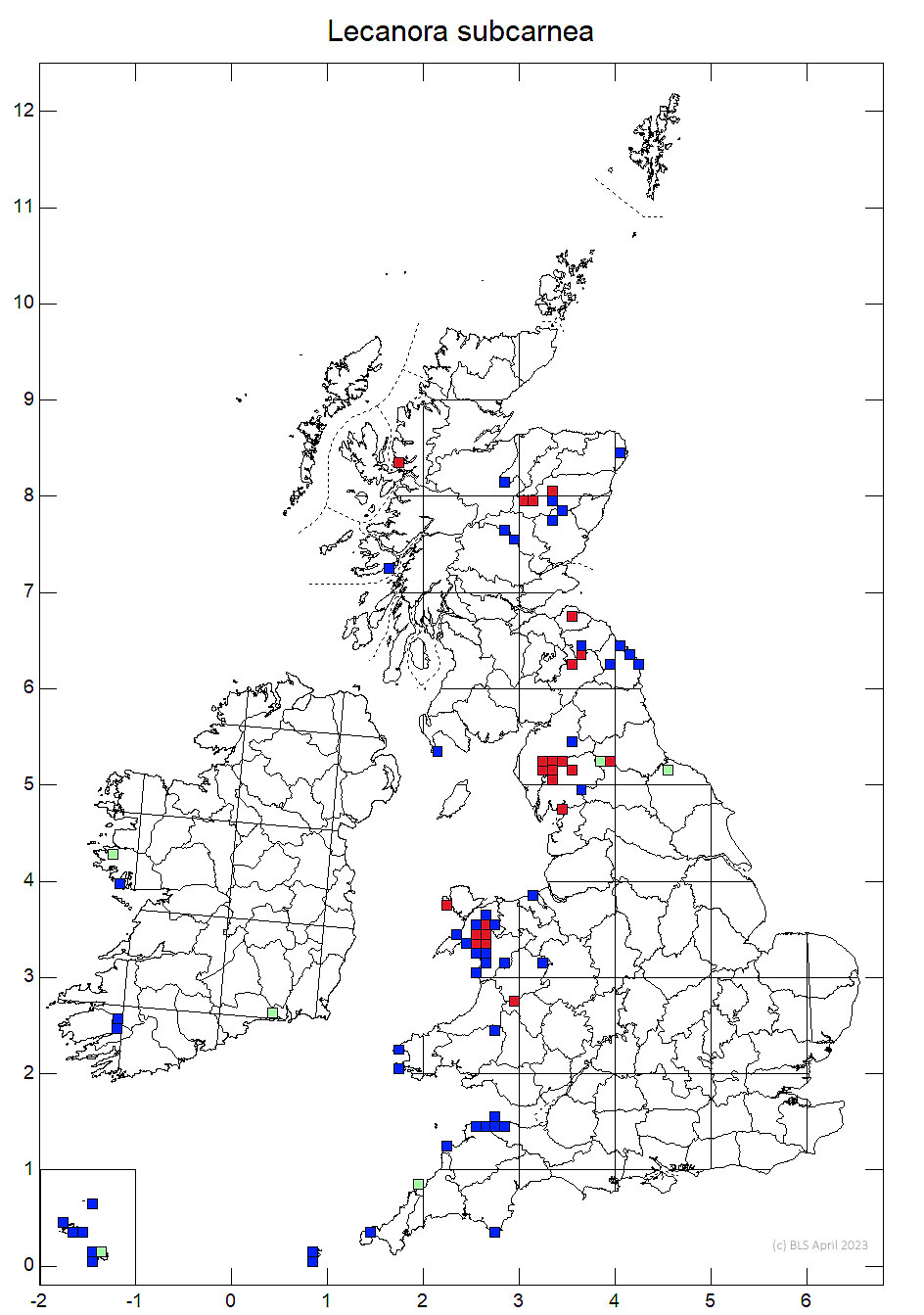


Local, England (Westmorland), N. Wales, C. & E. Scotland. Channel Isles. Records from S.W. England and Pembrokeshire were errors for L. ochroidea and have been removed from the map. The single Irish record also needs checking.
A very local species of dry mildly base rich siliceous rocks, in sheltered well-lit situations. Woodland locations potentially threatened by vegetation overgrowth.
Britain: Notable.
Cannon, P., Malíček, J., Ivanovich, C., Printzen, C., Aptroot, A., Coppins, B., Sanderson, N., Simkin, J. & Yahr, R. (2022). Lecanorales: Lecanoraceae, including the genera Ameliella, Bryonora, Carbonea, Claurouxia, Clauzadeana, Glaucomaria, Japewia, Japewiella, Lecanora, Lecidella, Miriquidica, Myriolecis, Palicella, Protoparmeliopsis, Pyrrhospora and Traponora. Revisions of British and Irish Lichens 25: 1-83.
Ivanovich-Hichins, C., Weber, L., Li L., Leavitt S. D., Muggia L., Palice Z., Pérez-Ortega S., Sohrabi M. and Printzen C. (2025) New phylogenetic insights into the lichen genus Lecanora s. lat. (Lecanoraceae, Ascomycota): resurrection of the genera Glaucomaria, Straminella and Zeora. Lichenologist 57, 278–303. Open Access
Text by Neil A Sanderson based on Cannon et al (2022)