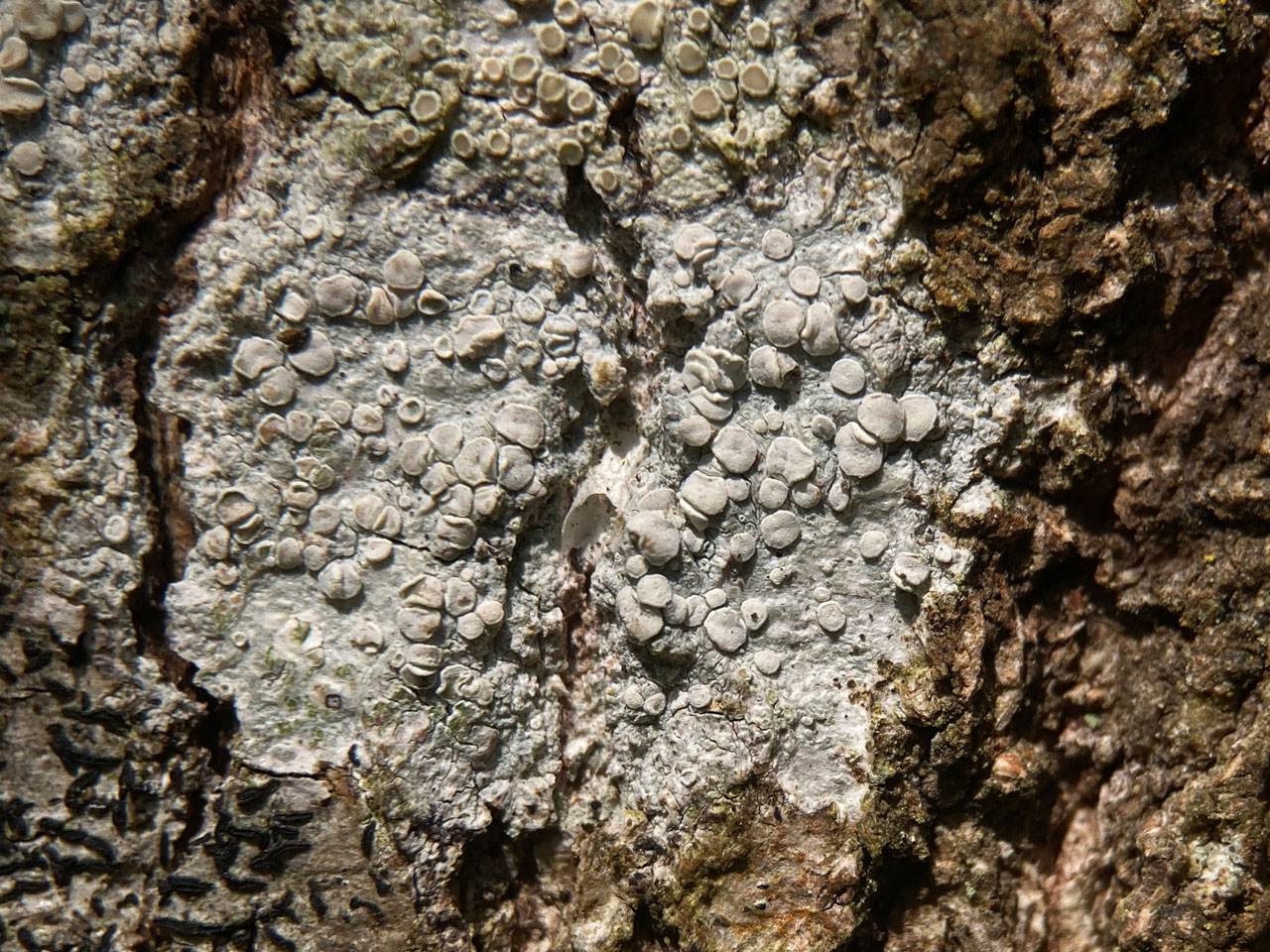
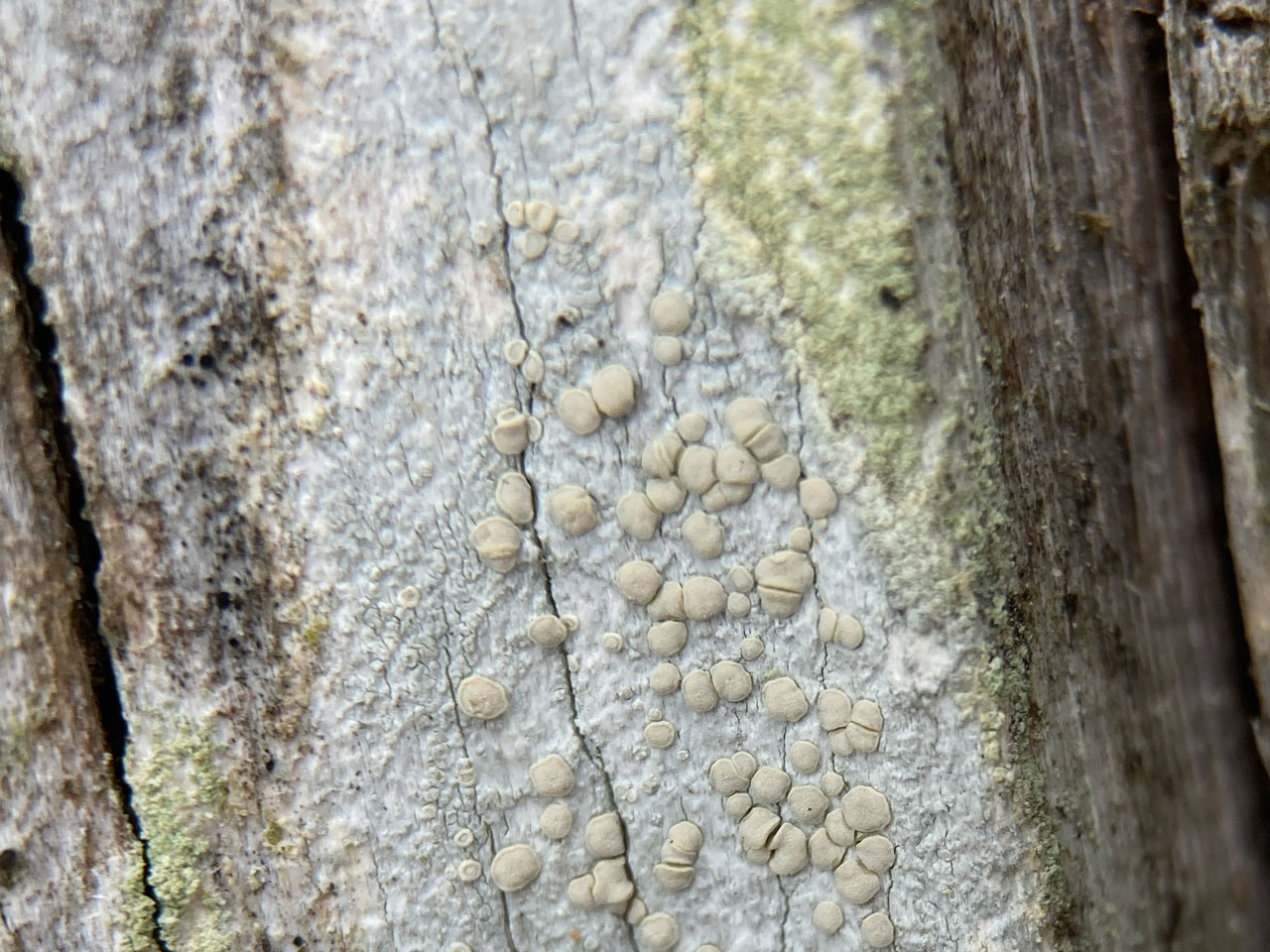
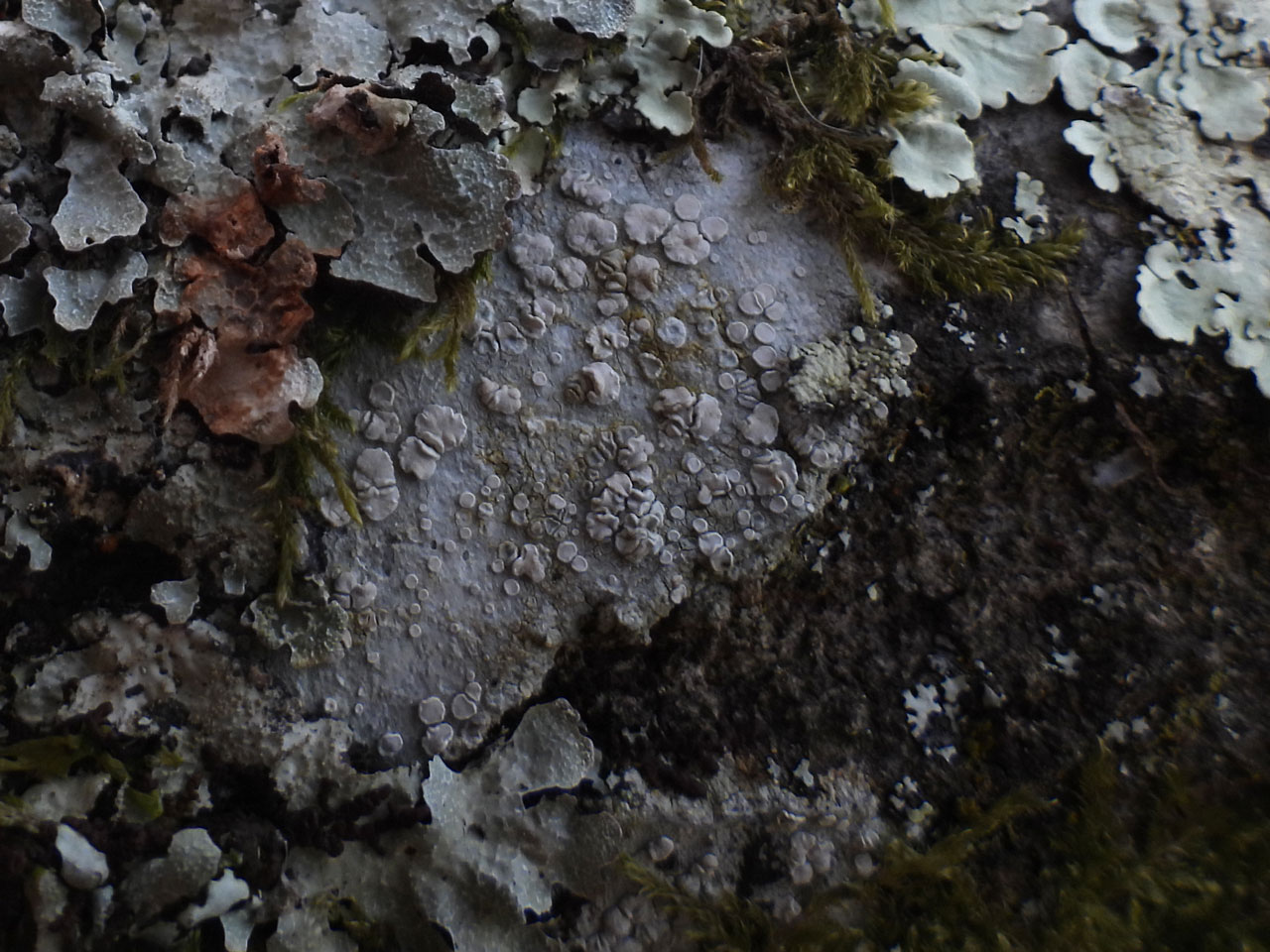
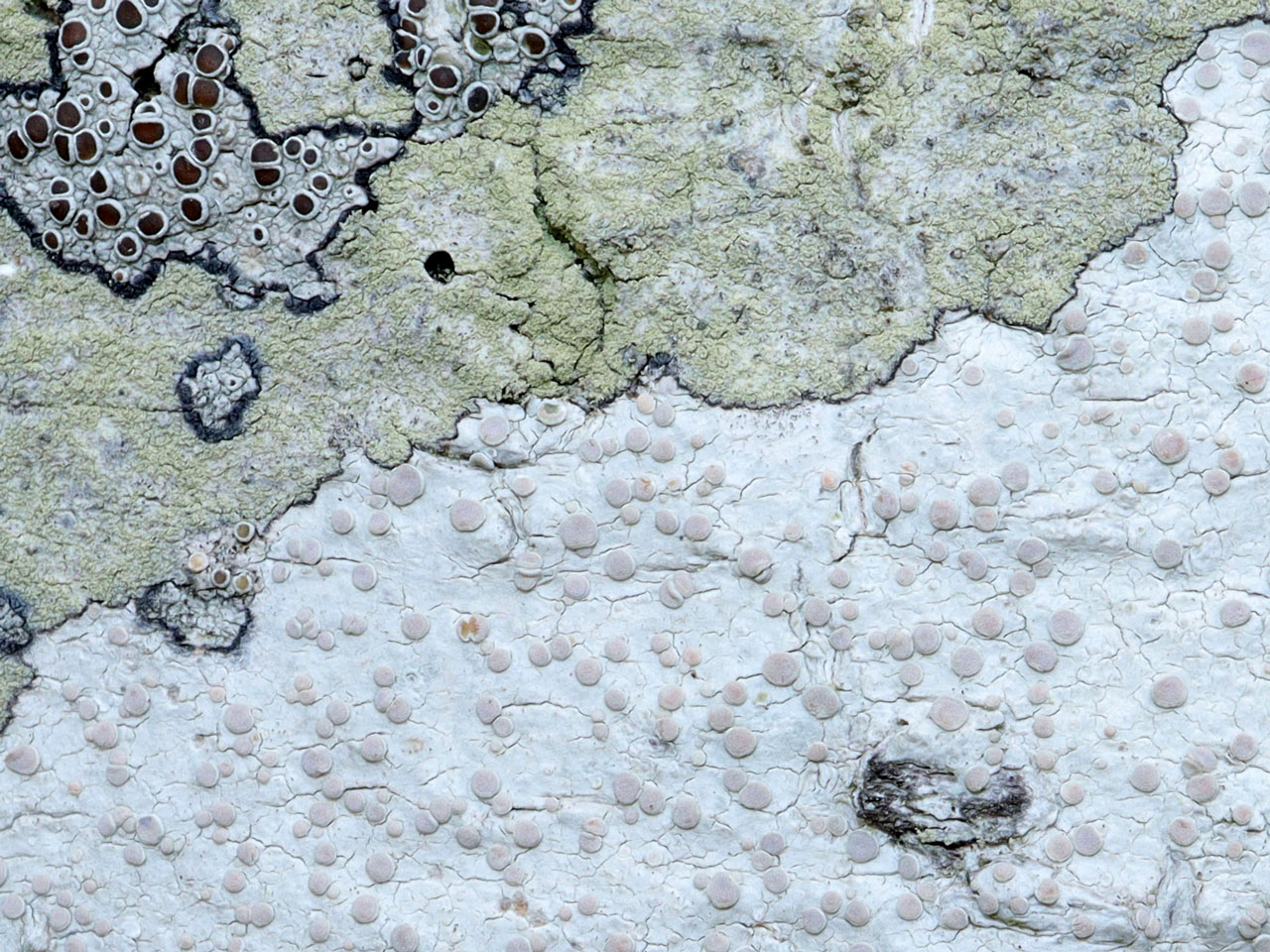
An epiphytic Lecanora resembling Glaucomaria carpinea, with densely white-pruinose disks, but found on more acidic bark in areas with low nitrogen deposition and has C– & Pd+ rust-red disks, while those of G. carpinea are C+ yellow & Pd± pale yellow. Locally frequent in southern England, scarce beyond.
Thallus ± continuous, becoming rimose in the centre, clearly delimited and forming small patches, pale to medium grey, surface smooth to slightly granular. Apothecia 0.5–1.5 mm diam., dispersed to closely aggregated, sessile, slightly constricted at the base; thalline margin well-developed, usually entire, conspicuous at first but becoming excluded, medulla with fine granular crystals dissolving in K; disc pink to rose or occasionally pale brown, flat to convex, densely white-pruinose; epithecium yellow-brown, interspersed with coarse granules dissolving in K; hymenium 60–85 µm tall; paraphyses 1.5–2.5 µm diam., sparsely branched and anastomosed, apices not or only slightly swollen. Ascospores (9–) 10–13 (–15) × (5–) 6–8 (–9) µm, broadly ellipsoidal. Thallus C–, K+ yellow; exciple and discs Pd+ yellow to red, UV+ pale orange (atranorin, chloratranorin, protocetraric acid, nephrosteranic acid).
A member of the L. subfusca group in its broad sense, but in a separate clade from the L. subfusca group s. str. with Lecanora subcarnea (Ivanovich-Hichins et al, 2025) but a new genus has not yet been named. Glaucomaria carpinea looks similar but has apothecial discs that react C+ yellow or orange & Pd± pale yellow and it occurs in more nutrient-enriched habitats. Myriolecis populicola is confined to Aspen and differs in its chemistry (Pd–).
On acid bark of deciduous trees, particularly twigs, in areas with low ammonia deposition.
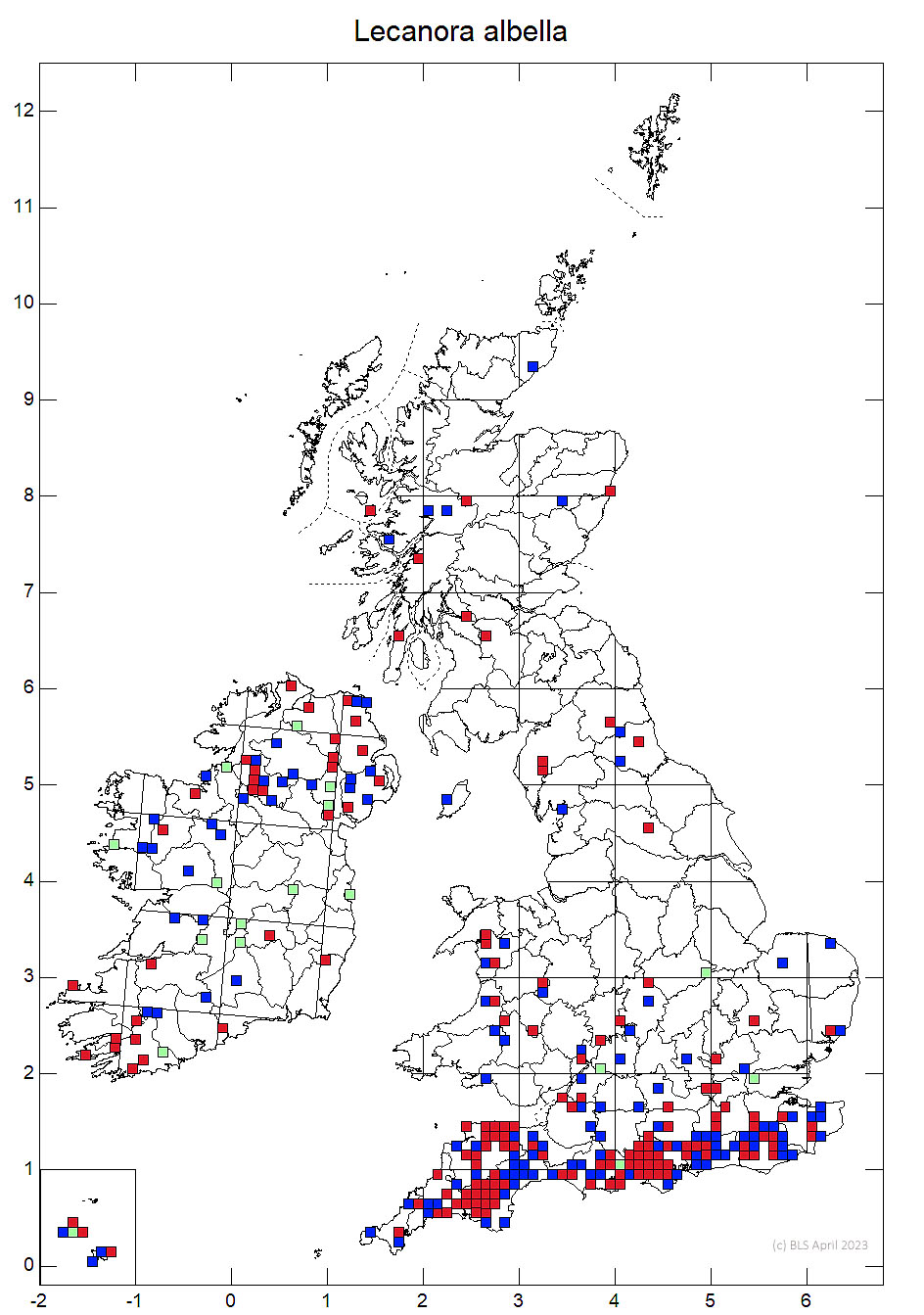


Frequent in S. England but becoming scarce northwards, very rare in Scotland (Highlands), scattered in Ireland.
Cannon, P., Malíček, J., Ivanovich, C., Printzen, C., Aptroot, A., Coppins, B., Sanderson, N., Simkin, J. & Yahr, R. (2022). Lecanorales: Lecanoraceae, including the genera Ameliella, Bryonora, Carbonea, Claurouxia, Clauzadeana, Glaucomaria, Japewia, Japewiella, Lecanora, Lecidella, Miriquidica, Myriolecis, Palicella, Protoparmeliopsis, Pyrrhospora and Traponora. Revisions of British and Irish Lichens 25: 1-83.
Ivanovich-Hichins, C., Weber, L., Li L., Leavitt S. D., Muggia L., Palice Z., Pérez-Ortega S., Sohrabi M. and Printzen C. (2025) New phylogenetic insights into the lichen genus Lecanora s. lat. (Lecanoraceae, Ascomycota): resurrection of the genera Glaucomaria, Straminella and Zeora. Lichenologist 57, 278–303. Open Access
Text by Neil A Sanderson based on Cannon et al (2022)