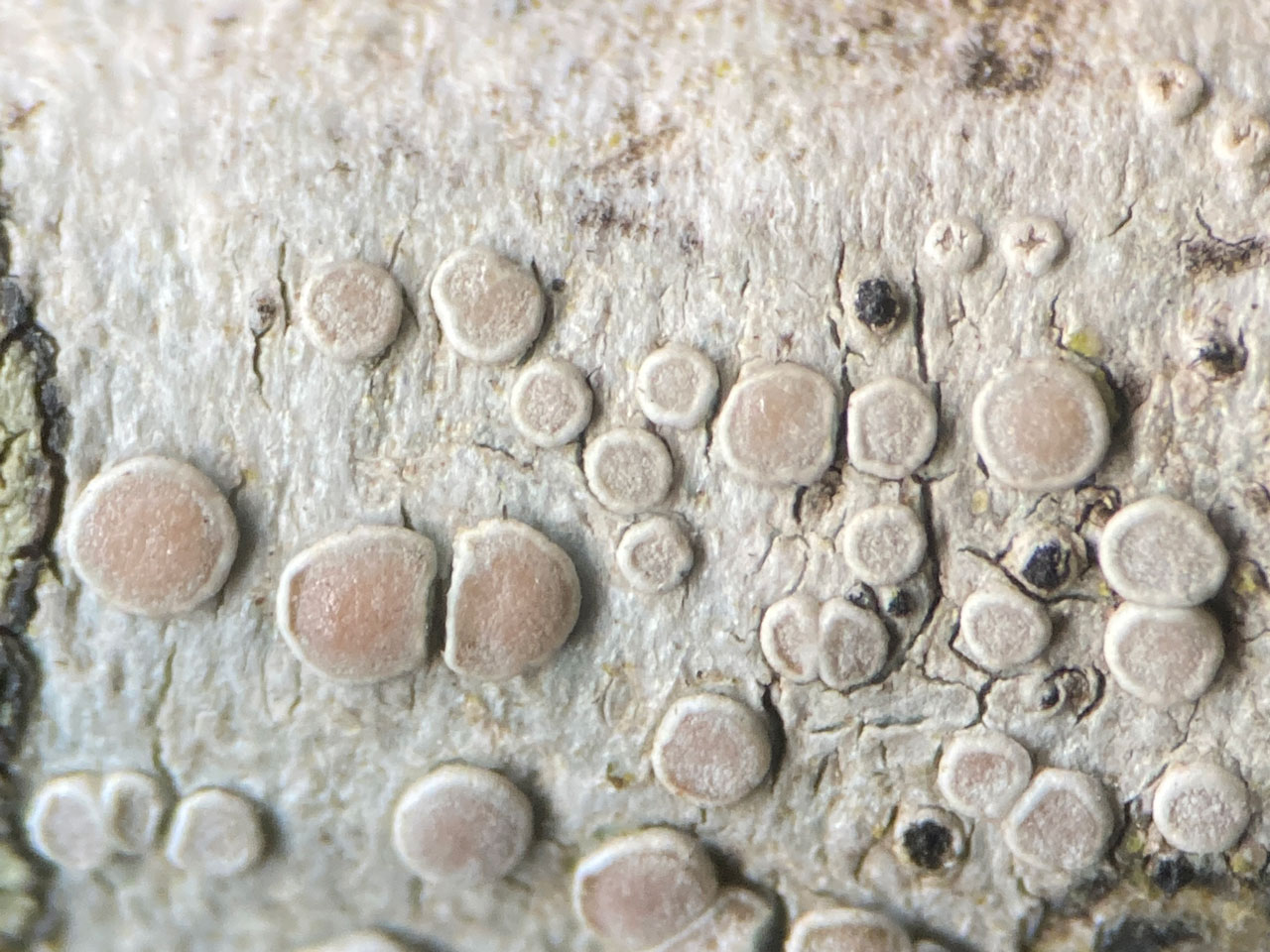
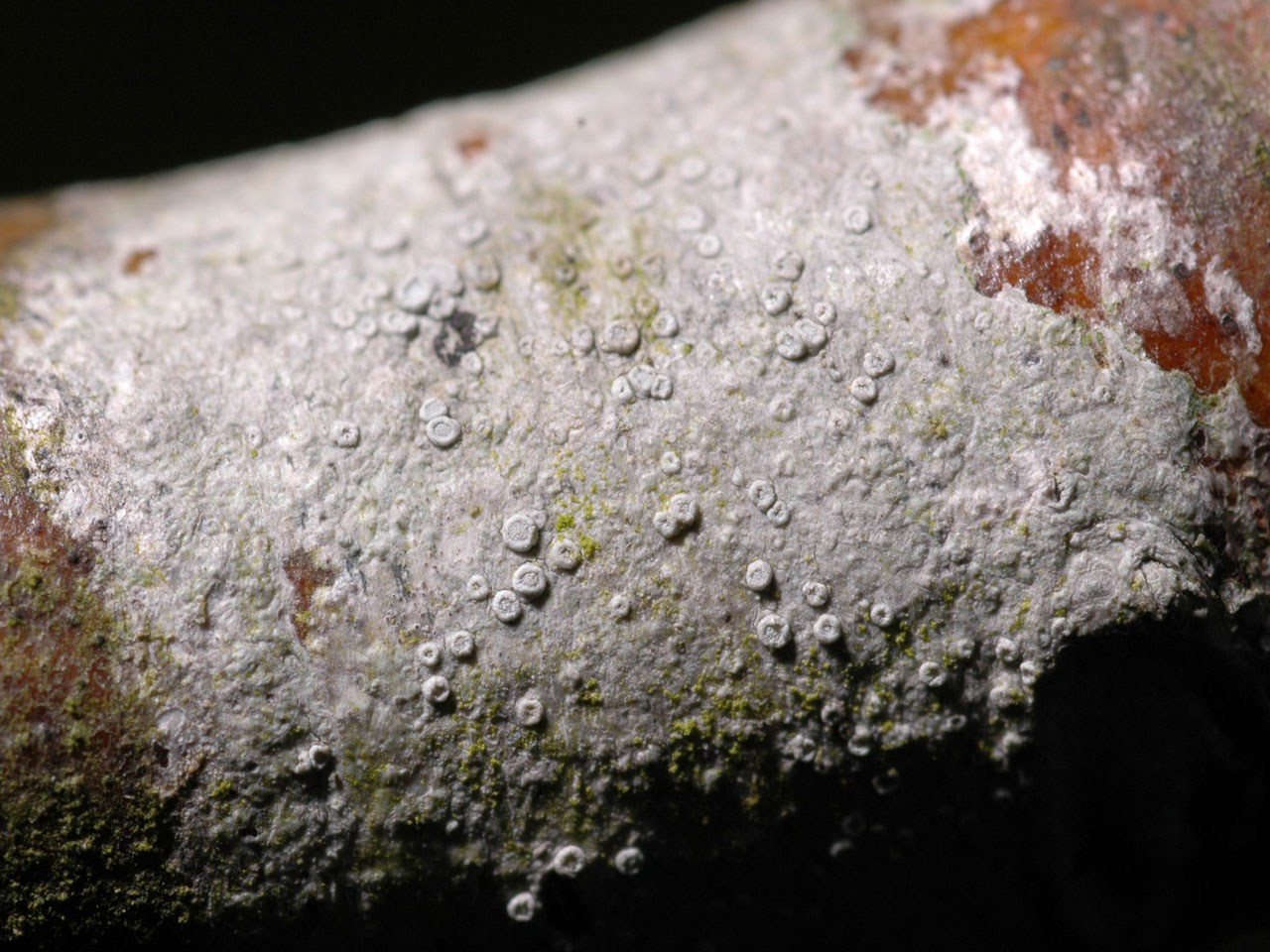
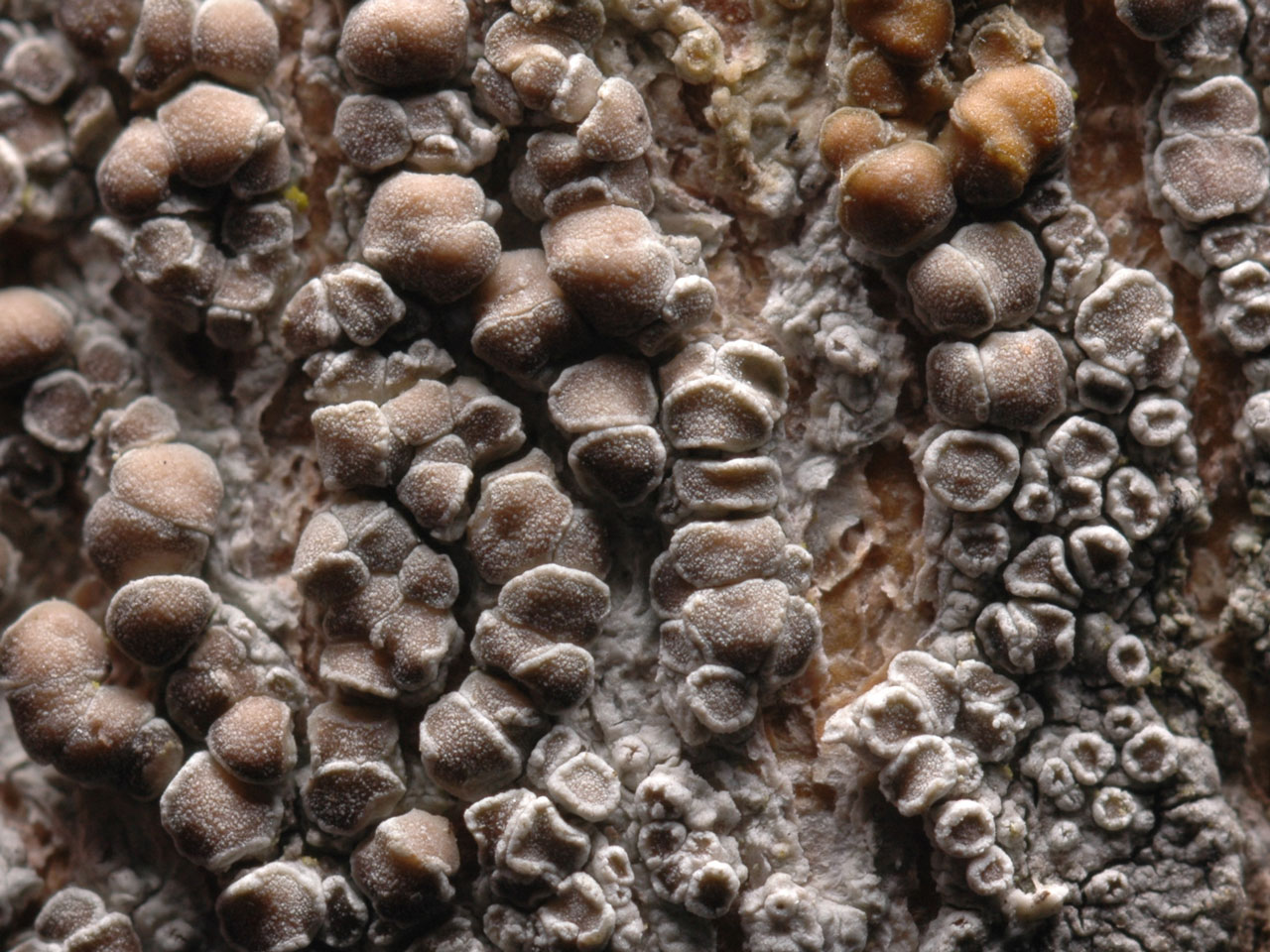
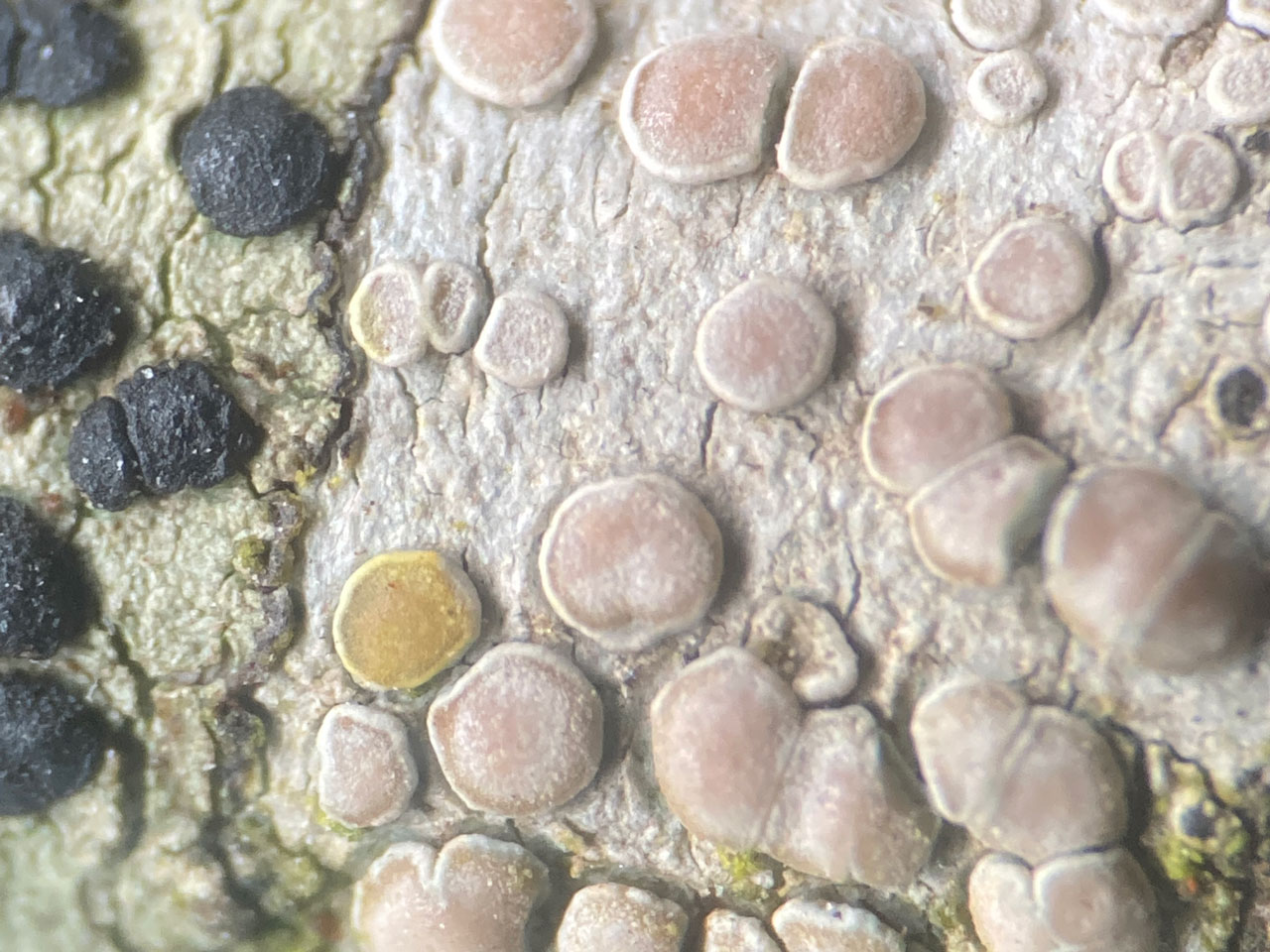
A common Lecanora species characterised by the densely white-grey pruinose discs which react C+ yellow. Found mainly small branches and young trunks and frequent in nutrient-enriched habitats throughout Britain and Ireland. The similar Lecanora albella has apothecial discs that react C–, Pd+ rust-red and it occurs on acid bark in less nutrient-enriched habitats.
Thallus forming discrete patches, generally continuous and smooth, thin, pale grey to white, tending to become darker and somewhat cracked in the centre with age; prothallus white. Apothecia 0.5–1 (–1.5) mm diam., sessile, constricted at the base, often crowded; thalline margin well-developed with fine crystals readily soluble in K, entire, persistent though sometimes becoming almost excluded with age; disc pale red-brown to cream or purple, flat to somewhat convex, densely white-grey pruinose; epithecium granular, pale yellow-brown, the granules dissolving in K; hymenium 45– 65 µm tall; paraphyses 1–2 µm diam., sparsely branched and anastomosed, apices not or slightly swollen. Asci 55–70 × 14–18 µm, clavate, stalked. Ascospores (9–) 10–12.5 (–14) × (5–) 6–8 µm., subglobose to ellipsoidal. Conidia 15–16 × ca 1 µm, thread-like to curved. Thallus C–, K+ yellow, Pd± pale yellow, UV–; apothecial disc (epithecium in section) C+ yellow or orange, UV+ pale orange (atranorin, chloratranorin, sordidone, roccellic acid).
Lecanora albella has a similarly pale coloured thallus, densely white-pruinose apothecia but the apothecial discs react C–, Pd+ rust-red and it occurs on acid bark in less nutrient-enriched habitats.
Glaucomaria subcarpinea (Szatala) S.Y. Kondr., L. Lőkös & Farkas (2019) differs by larger apothecia and a more pronounced white thallus with a strong Pd+ yellow reaction (psoromic acid); it was suggested by Edwards et al. (2009) that some specimens on Acer from Scotland (East Lothian) might be referable to this species, but no confirmed collections exist. Additionally, some populations assigned to G. carpinea in GBI have crystals within the thalline margin that do not dissolve in K, and these may be referable to G. leptyrodes (G.B.F. Nilsson) S.Y. Kondr., Lőkös & Farkas (2019). More work is needed to distinguish these two species. See also Myriolecis populicola.
On smooth bark of deciduous trees, particularly on twigs, small branches and young trunks, exceptionally on stonework; frequent in nutrient-enriched habitats.
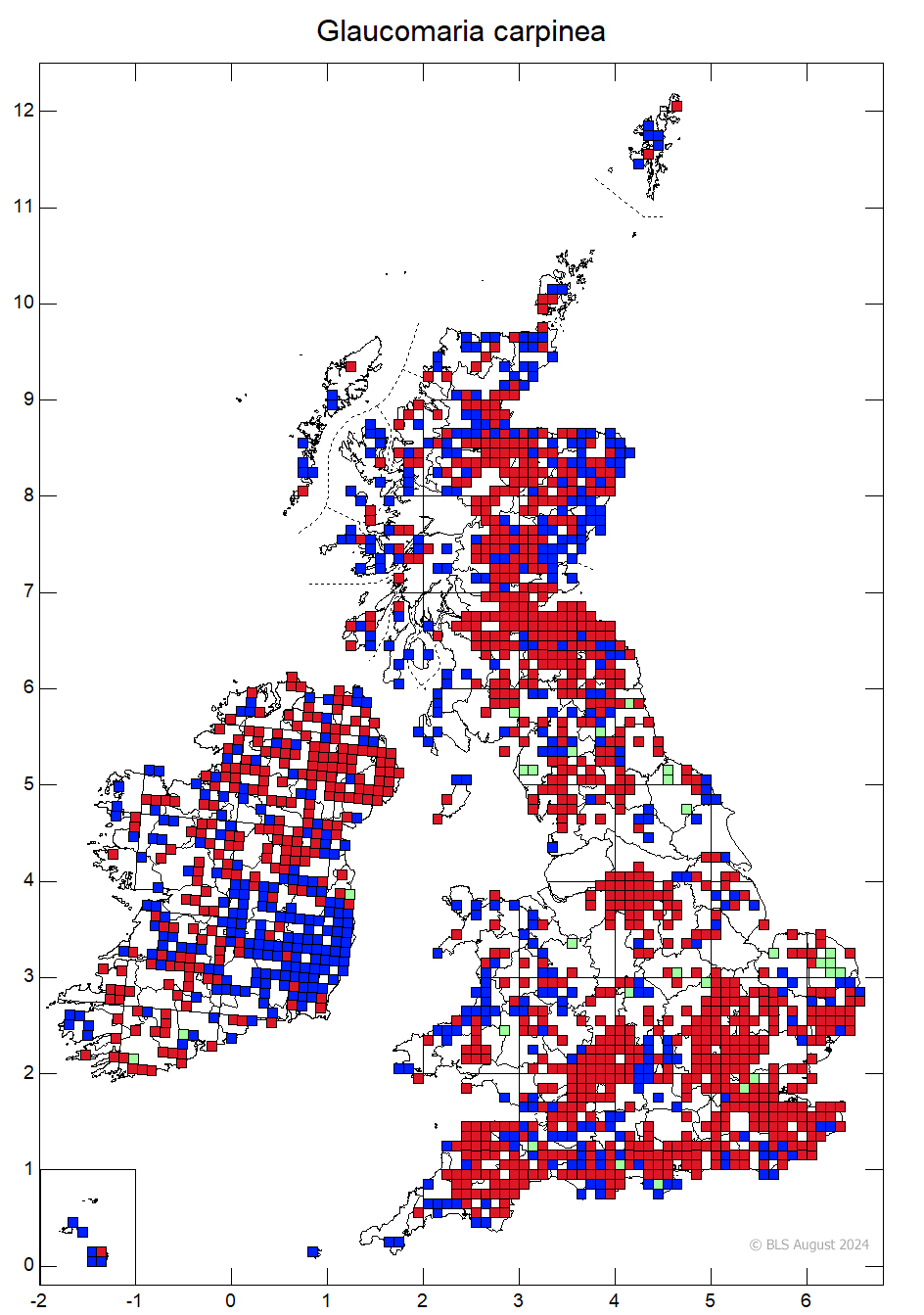


Throughout Britain and Ireland.
Cannon, P., Malíček, J., Ivanovich, C., Printzen, C., Aptroot, A., Coppins, B., Sanderson, N., Simkin, J. & Yahr, R. (2022). Lecanorales: Lecanoraceae, including the genera Ameliella, Bryonora, Carbonea, Claurouxia, Clauzadeana, Glaucomaria, Japewia, Japewiella, Lecanora, Lecidella, Miriquidica, Myriolecis, Palicella, Protoparmeliopsis, Pyrrhospora and Traponora. Revisions of British and Irish Lichens 25: 1-83.
Edwards, B., Aptroot, A., Hawksworth, D.L. & James, P.W. (2009). Lecanora. In Lichens of Great Britain and Ireland (Smith, C.W., Aptroot, A., Coppins, B.J., Fletcher, A., Gilbert, O.L., James, P.W. & Wolseley, P.A. eds): 465–502. London: British Lichen Society.
Text by Neil A Sanderson based on Cannon et al (2022)