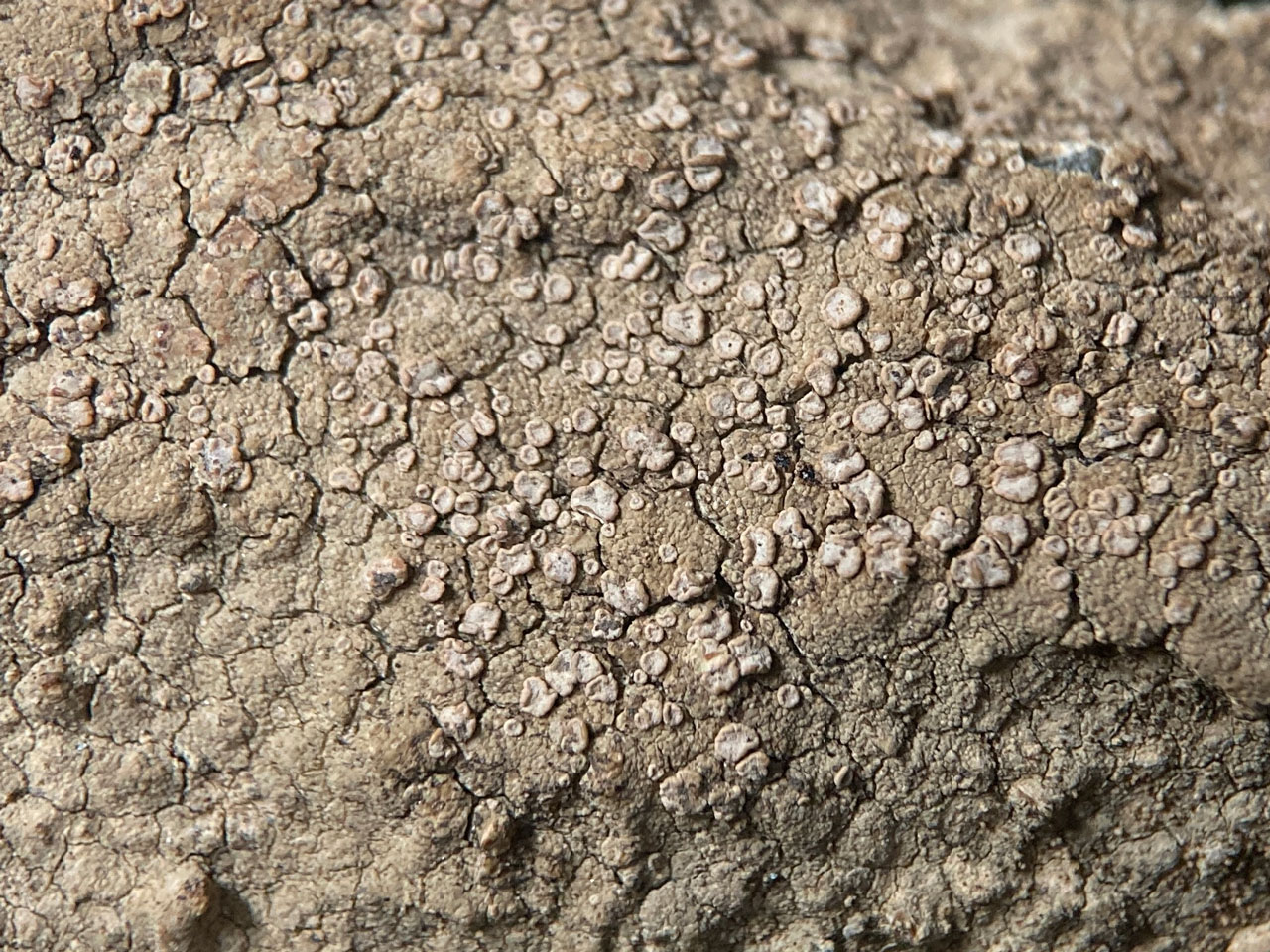
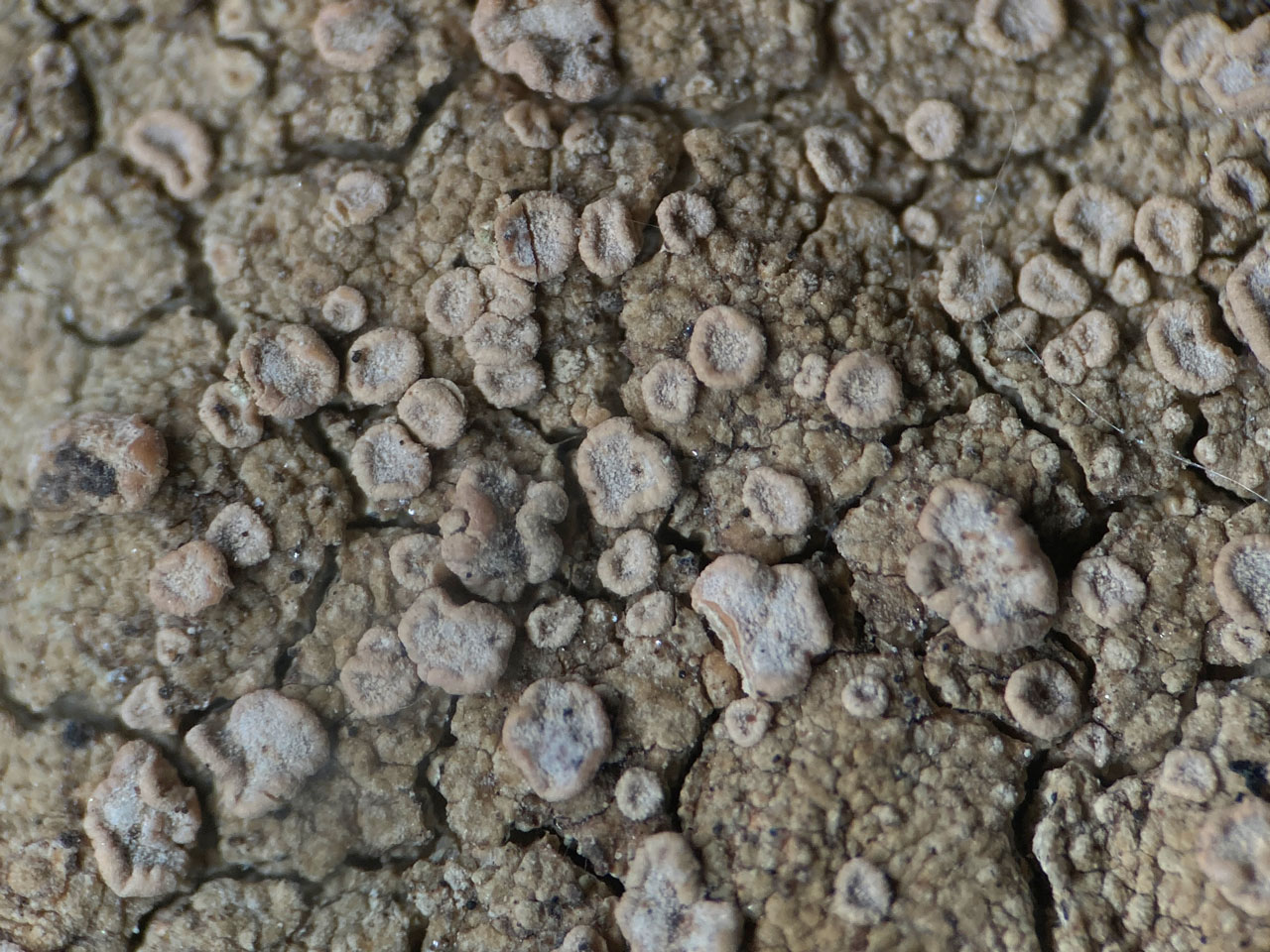
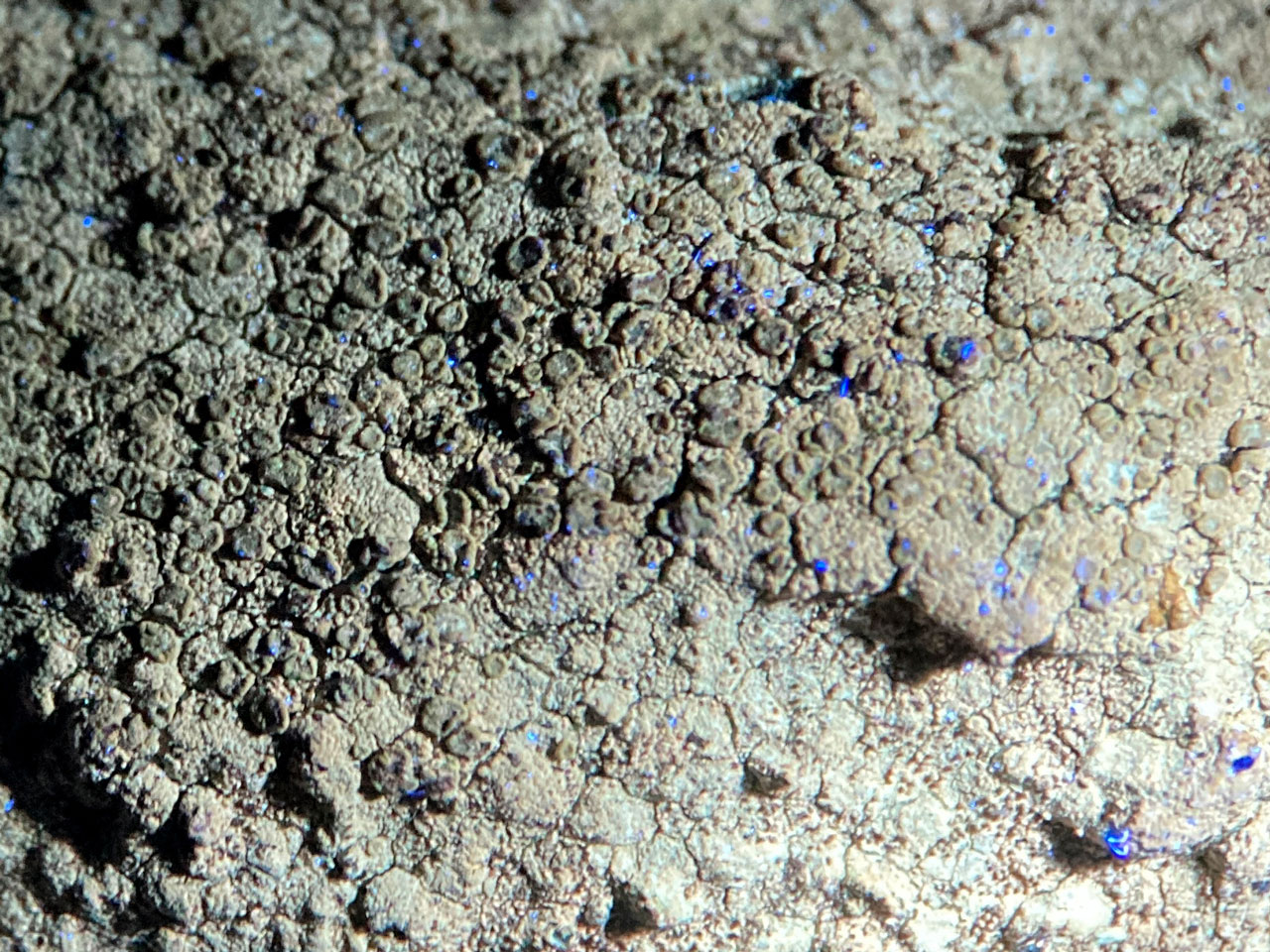
A very similar lichen to Lecanora subcarnea. It also has densely white-pruinose discs and is found on sheltered, vertical faces or below overhangs. It differs in its chemistry (K+ yellow→red reaction & UV+ pale orange) and is much more southern and mainly found on coastal rocks, but has also been found on woodland rocks but in more southern oceanic areas than L. subcarnea.
Thallus continuous and finely cracked to areolate, clearly delimited, areoles often uneven in height, ± flat, margins crenulate, white or pale grey, surface coarsely granular to warted; prothallus white, fibrous, generally well-developed. Apothecia 0.7–2 mm diam., scattered or aggregated, sessile and finally constricted below; thalline margin entire, tending to be paler than the thallus, becoming excluded; disc pink- to pale grey-brown, convex to almost subglobose, usually densely white-pruinose; epithecium brown, granular, K+ red (with needle-like crystals); hymenium 60–80 (–100) µm tall; paraphyses 1.5–2 µm diam., unbranched or sparsely branched, especially above, apices to 3.5 µm diam., generally with the terminal cell subglobose. Ascospores (8–) 10–14 × (5–) 6–8.5 µm. Thallus C–, K+ yellow→red, Pd+ orange to red, UV± pale orange (atranorin, chloratranorin, protocetraric, norstictic and connorstictic acids).
Lecanora ochroidea was confused with L. subcarnea but is distinguished by its K+ yellow→red reaction (norstictic acid) and its pale UV fluorescence. L. subcarnea is largely confined to inland upland rocks, but L. ochroidea has been found inland in oceanic woodland in Ireland and habitat should not be taken as a guide, especially in more oceanic areas. Glaucomaria rupicola also has white pruinose discs that are C+ yellow, immersed and flat, and grows in exposed situations.
On sheltered, ± vertical faces or below overhangs, on siliceous coastal rocks in the xeric-supralittoral zone, also on woodland rocks inland in Ireland.
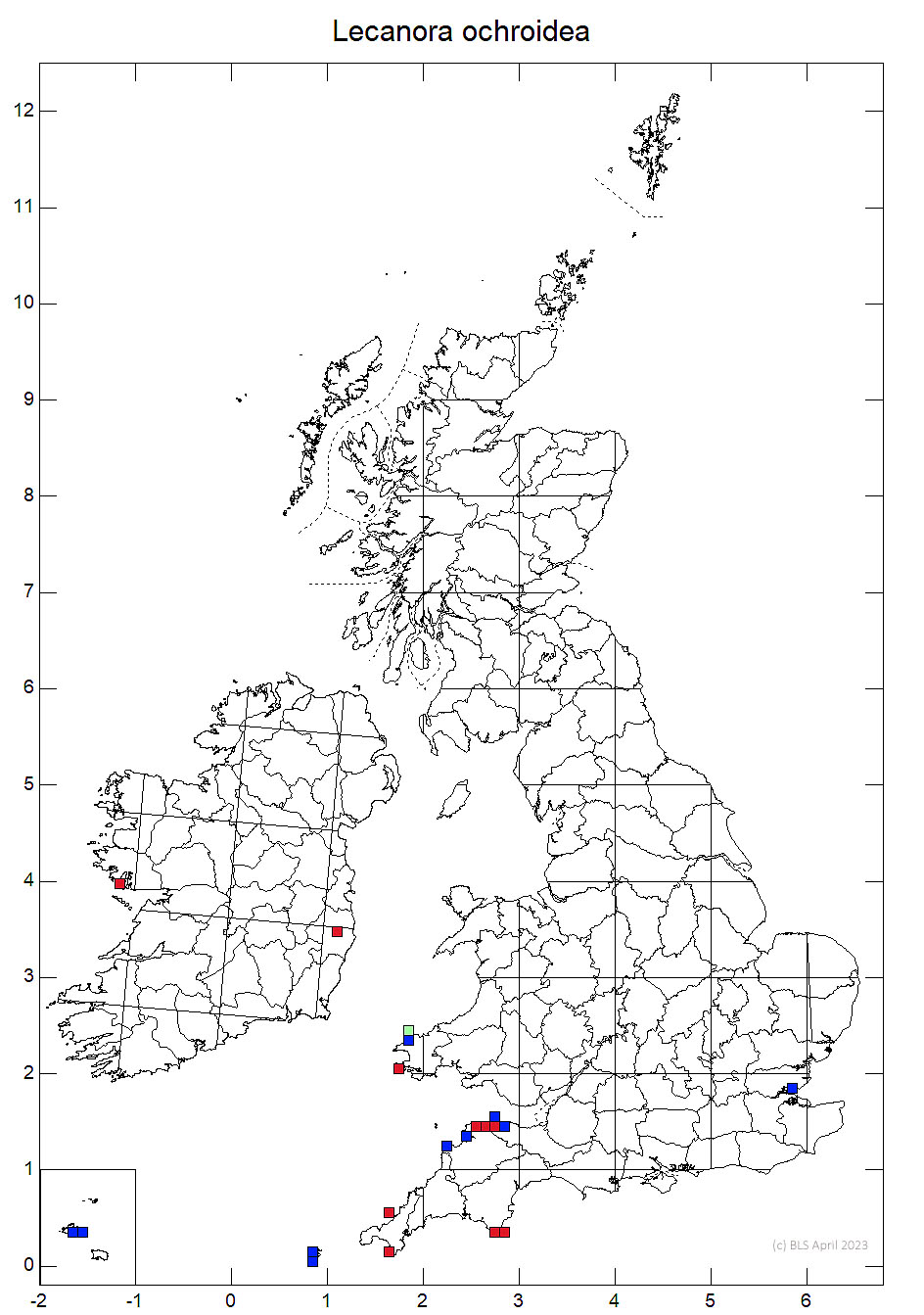

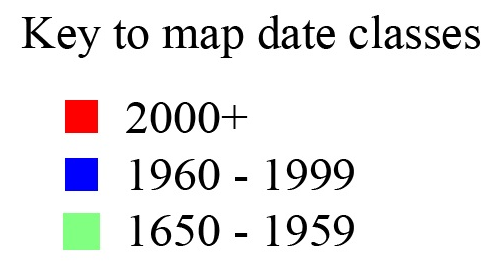
Rare, S.W. England, W. Wales (Pembroke), Ireland (Wicklow & W. Galway), Channel Islands.
A very localised species of siliceous coastal rocks and rocks in oceanic woodlands.
Britain: Notable
Wales: Data Deficient
Cannon, P., Malíček, J., Ivanovich, C., Printzen, C., Aptroot, A., Coppins, B., Sanderson, N., Simkin, J. & Yahr, R. (2022). Lecanorales: Lecanoraceae, including the genera Ameliella, Bryonora, Carbonea, Claurouxia, Clauzadeana, Glaucomaria, Japewia, Japewiella, Lecanora, Lecidella, Miriquidica, Myriolecis, Palicella, Protoparmeliopsis, Pyrrhospora and Traponora. Revisions of British and Irish Lichens 25: 1-83.
Text by Neil A Sanderson based on Cannon et al (2022)