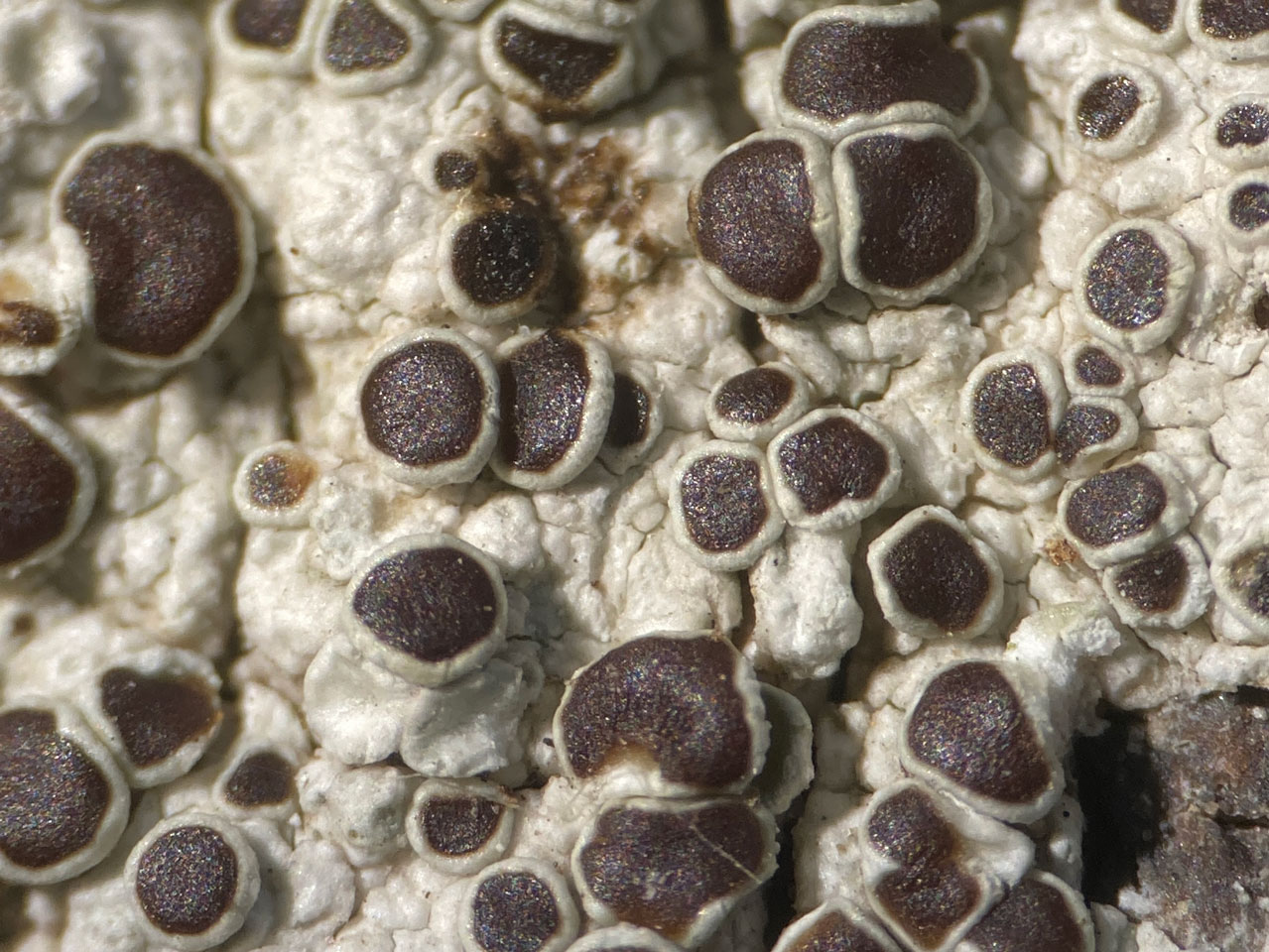
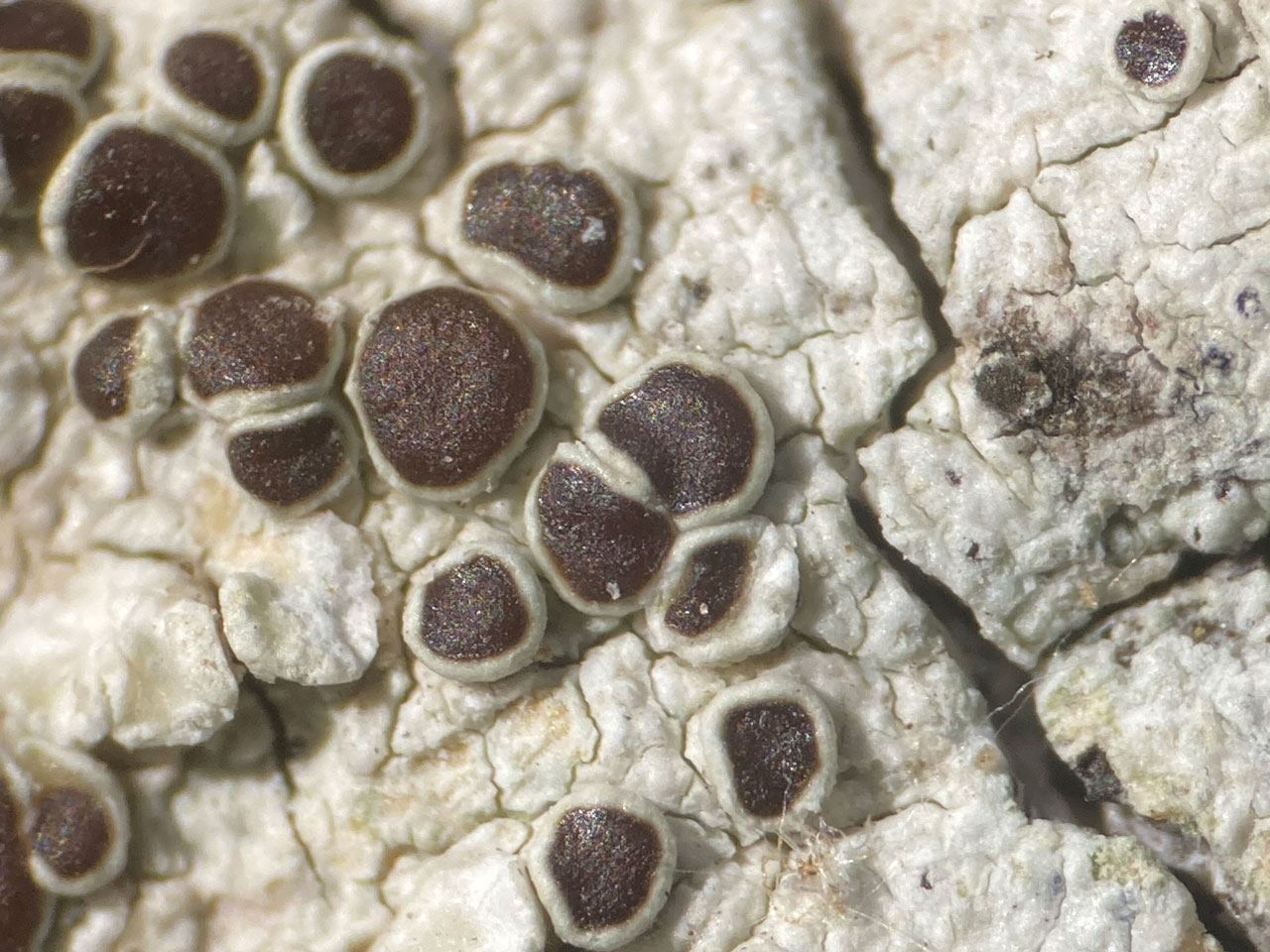
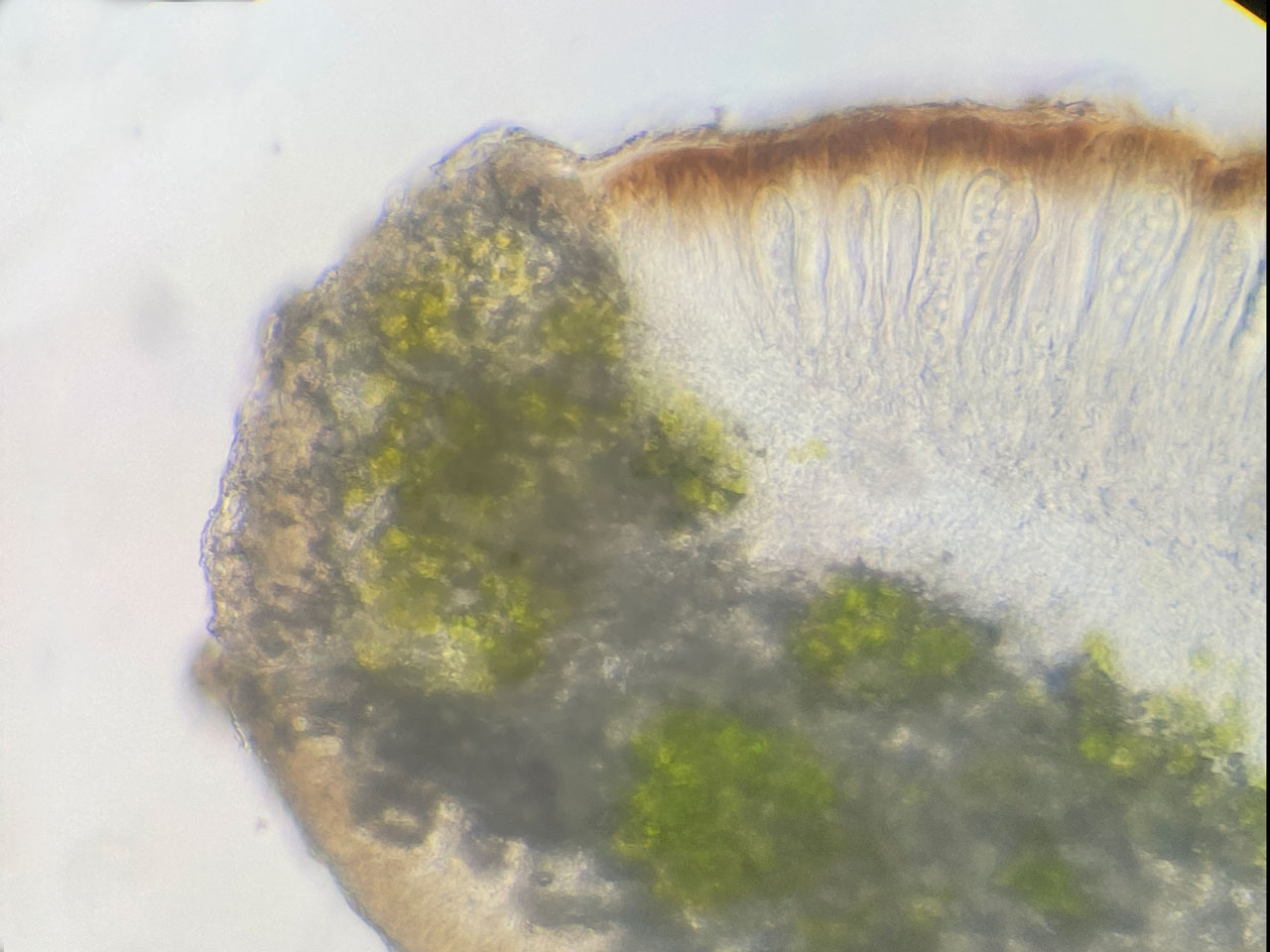
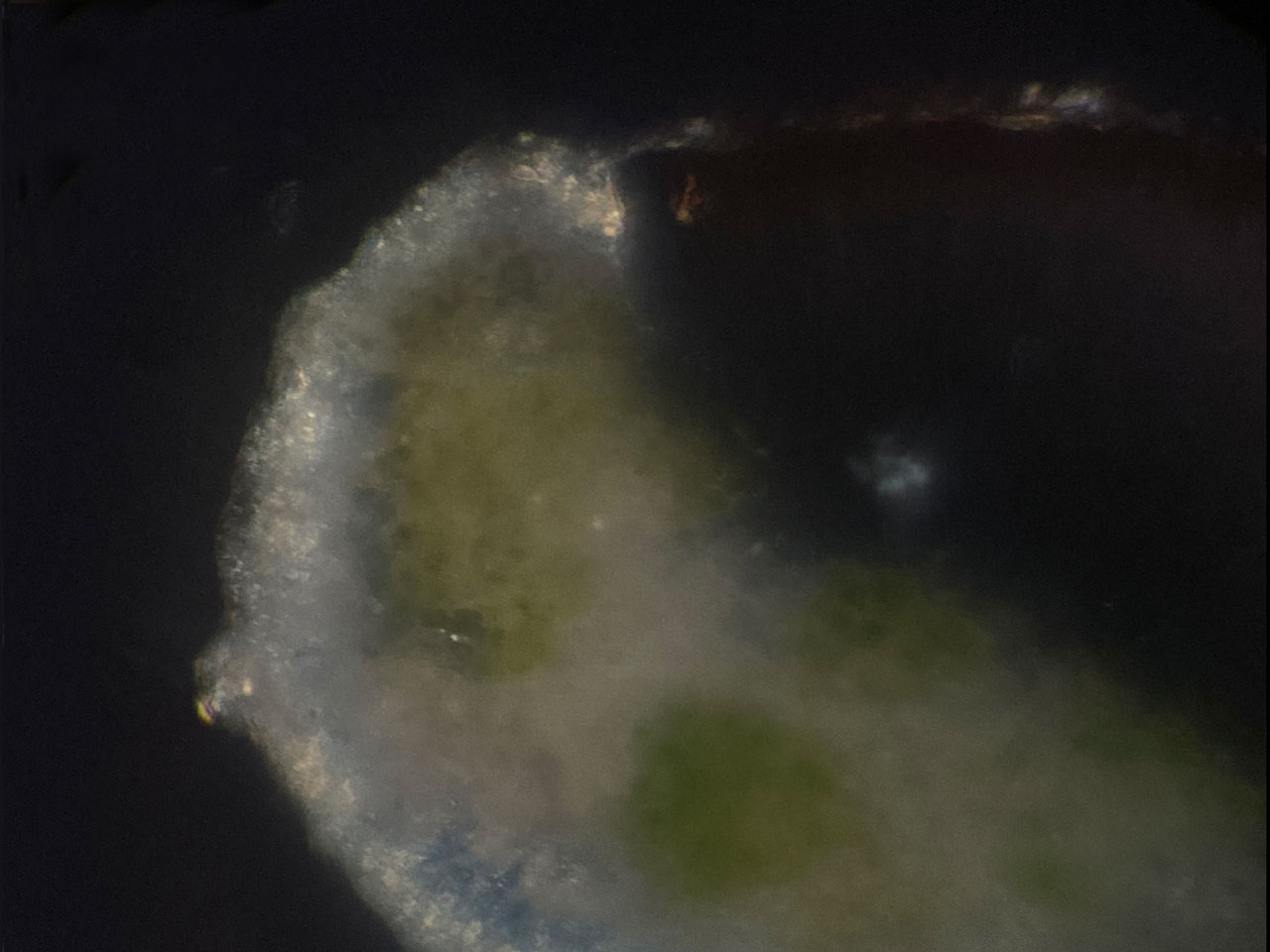
A handsome Lecanora found mainly in the south and east. Rather mis-recorded and overlooked in the past, and now found to likely be more frequent on mildly base rich rock than on trees. Can be spotted by the combination of a smooth margin and a shiny brown to blackish brown disks and confirmed by there only being small crystals in the thalline margin. Care is needed to separate it from the similar Lecanora campestris.
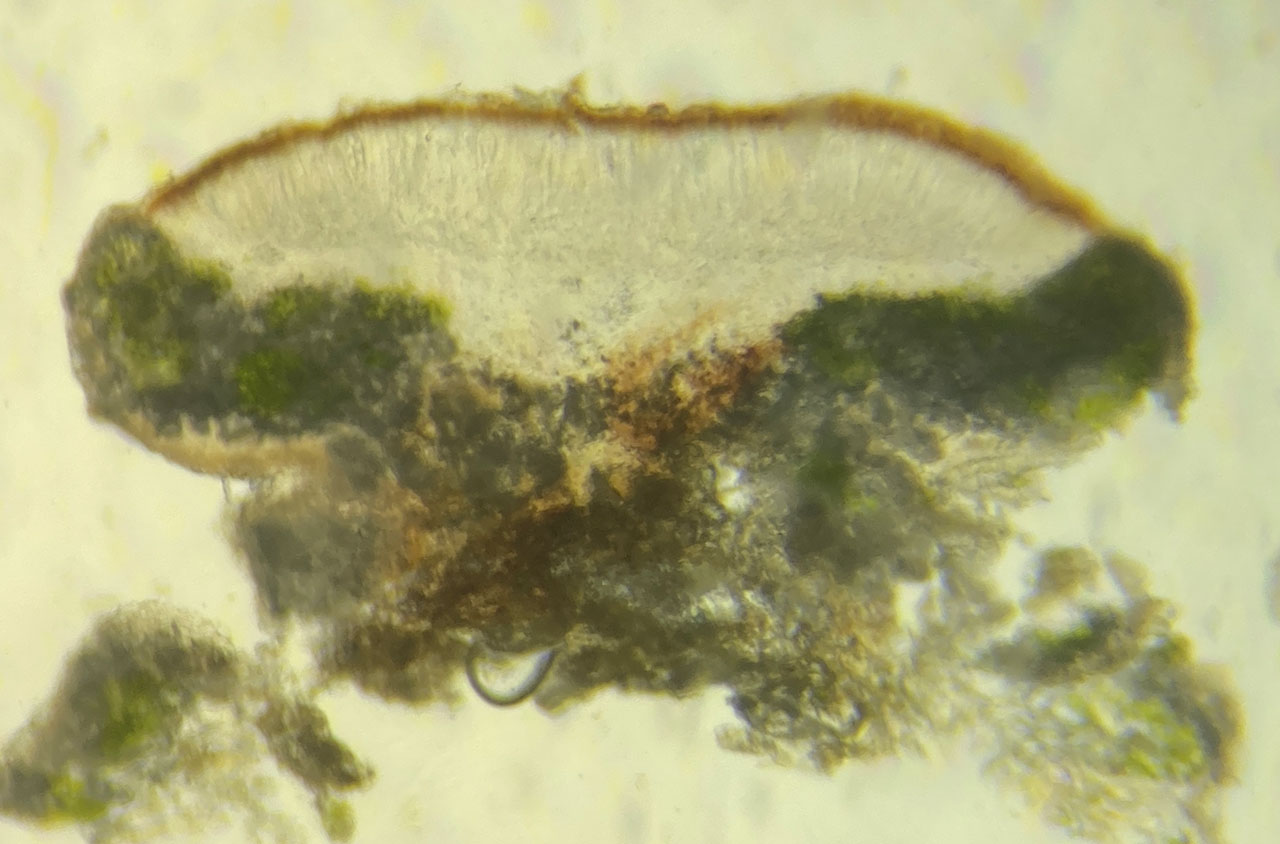
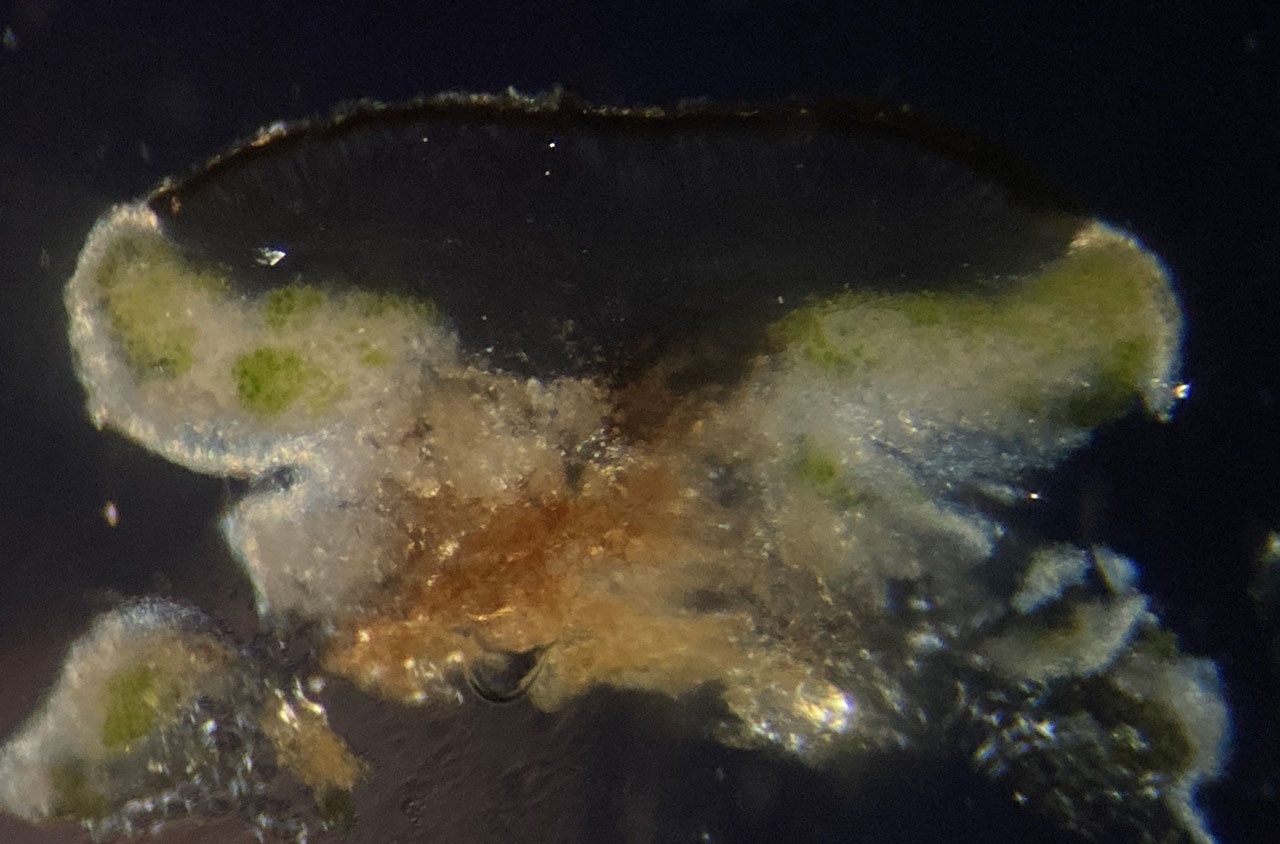
Thallus continuous, in small patches, white, thick, rough to slightly warted, rarely smooth; prothallus poorly developed or absent. Apothecia 0.8–1.5 (–2) mm diam., sessile, strongly constricted at the base, often densely crowded; thalline margin well-developed, persistent, entire or sometimes flexuose, raised, medulla with small irregular crystals not dissolving in K, cortex usually distinctly delimited (better seen in KOH), 10–25 µm thick, at the base expanding to 40–60 (–80) µm, composed of branched hyphae 2–3 µm diam. with fine granules soluble in KOH; disc brown to blackish brown, not pruinose, shiny especially when young; epithecium red-brown, without granules; hymenium 65–80 µm tall; paraphyses 1.5–2.5 µm diam., unbranched or sparsely branched, rarely anastomosed, apices 2.5–4 µm diam., yellow-brown, slightly swollen. Ascospores (11–) 12–15 (–17) × (4.5–) 6.5–8.5 (–9.5) µm. Thallus C–, K+ yellow, Pd–, UV+ pale orange (atranorin, ± chloratranorin, unidentified triterpenoids).
A member of the L. subfusca group. Frequently overlooked for L. chlarotera s. lat. or Lecanora argentata on trees, both of which have particularly large crystal clusters in the medulla of the exciple, crenulate apothecial margin, and usually paler and less glossy apothecial discs. The smooth apothecial margin with a dark shiny disk is a good field indication, but Lecanora argentata can also have smooth margins and relatively dark disks but can be separated by the apothecial crystal distribution. Can be confused with L. campestris, which differs in having more inset apothecia 0.6–0.8 mm diam, reddish brown, matt to slightly shiny discs, a greyish-white to grey thallus, and usually a medium thick, white, fimbriate prothallus.
On bark of deciduous trees, especially mature Sycamore, Ash and Elm; also on mildly base rich rock especially vertical gravestones and brick of churches, where it may be more frequent than on trees. Overlooked and miss-recorded in the past but more frequently and accurately recorded now.
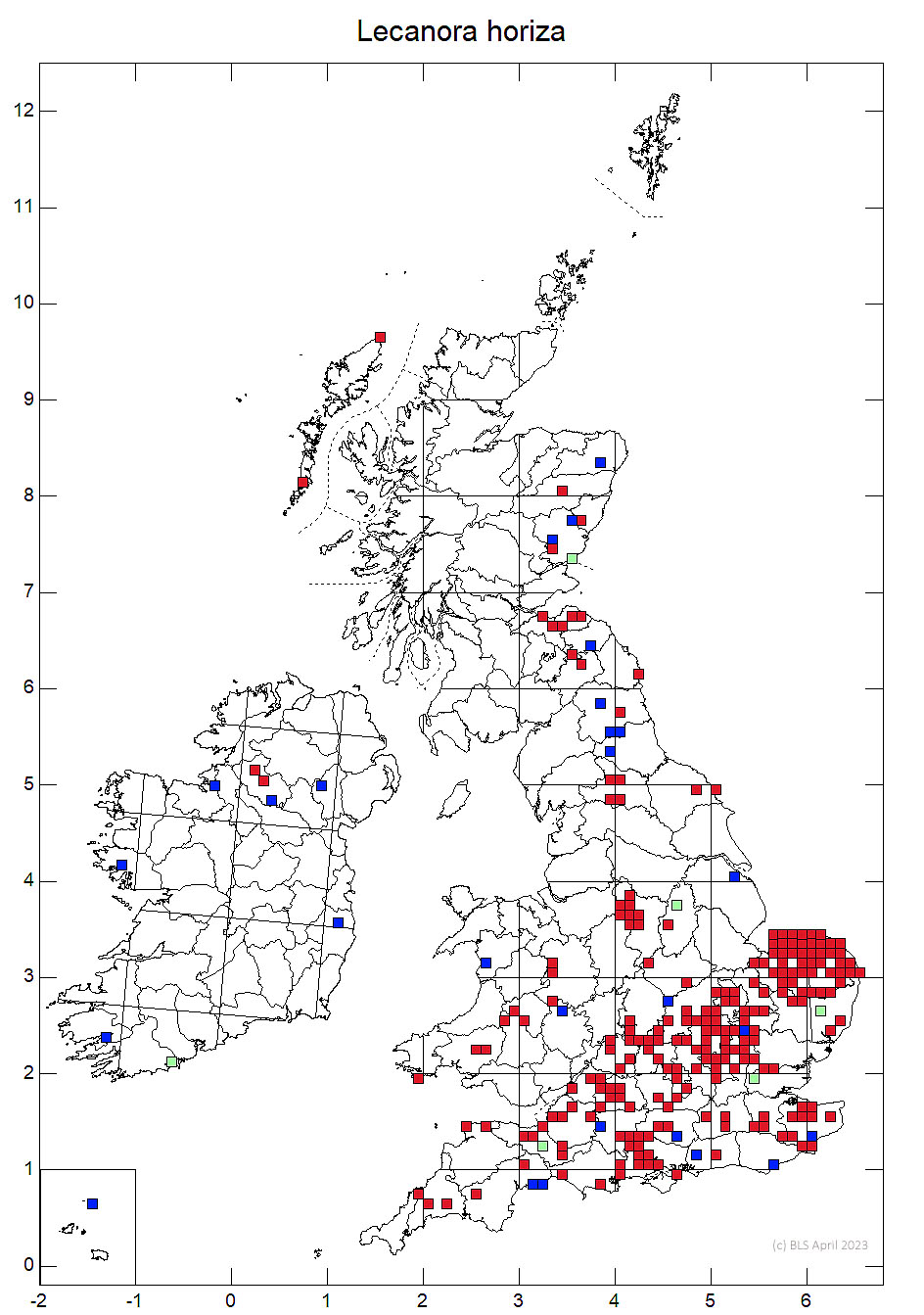


Mainly in S. & E. England, extending north into eastern Scotland. Apparently rare in Wales and Ireland
This lichen was assessed as Near Threatened in 2012, but recent better recording makes this assessment unsustainable, and it should be regarded as Least Concern now. Also assessed as Vulnerable D2 in Wales in 2010; this will also need reassessment.
Cannon, P., Malíček, J., Ivanovich, C., Printzen, C., Aptroot, A., Coppins, B., Sanderson, N., Simkin, J. & Yahr, R. (2022). Lecanorales: Lecanoraceae, including the genera Ameliella, Bryonora, Carbonea, Claurouxia, Clauzadeana, Glaucomaria, Japewia, Japewiella, Lecanora, Lecidella, Miriquidica, Myriolecis, Palicella, Protoparmeliopsis, Pyrrhospora and Traponora. Revisions of British and Irish Lichens 25: 1-83.
Text by Neil A Sanderson based on Cannon et al (2022)