Pycnora praestabilis
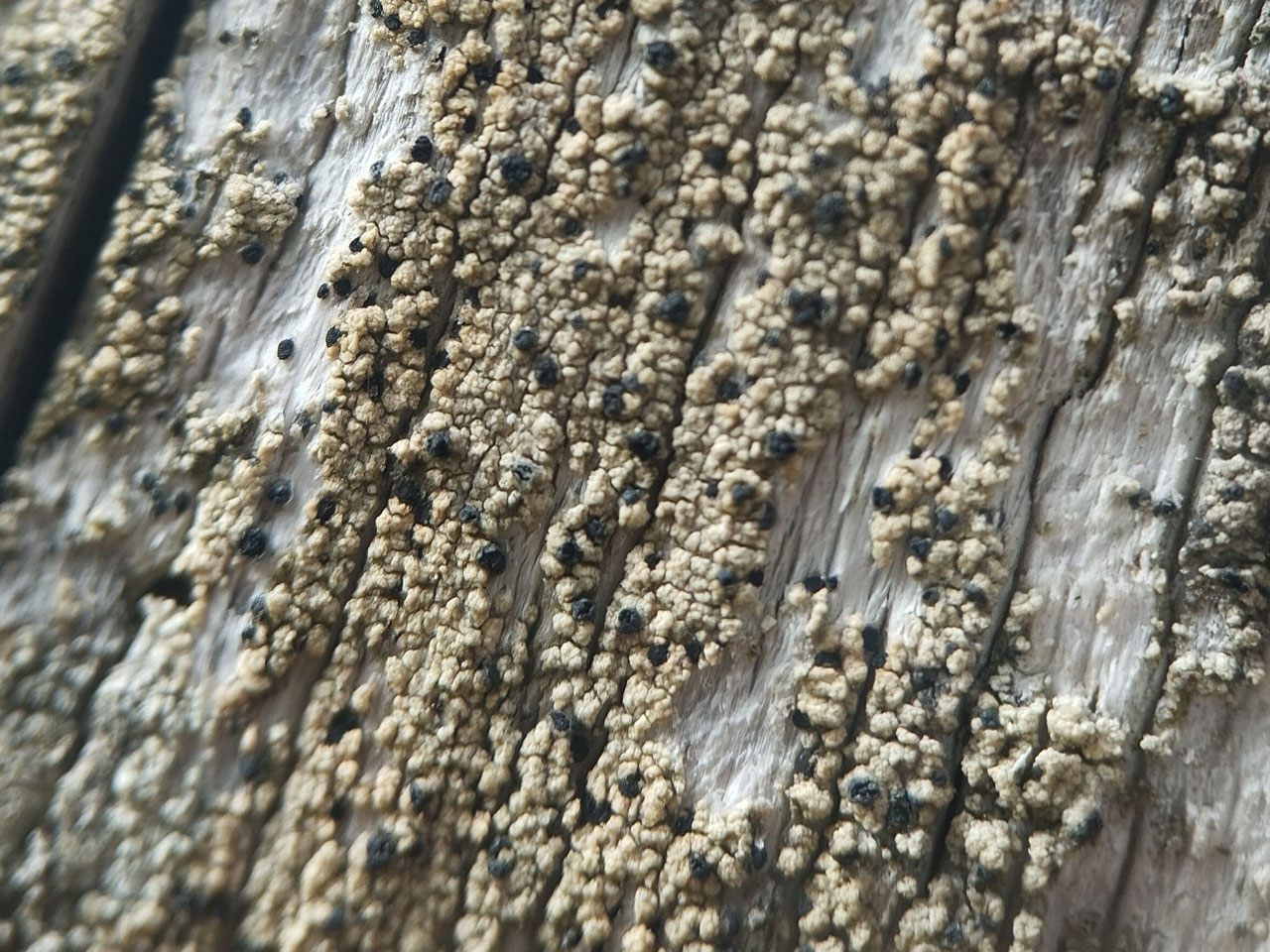
First discovered in 2010 in south east Scotland, with a second record from south east England in 2014. Mainly a species of old weathered and untreated work timber, both here and northern Europe, but also on natural conifer snags (standing dead trees) in open or even exposed stands in central Europe. Threatened elsewhere in Europe, as in Sweden, due to the decline in the use of untreated timber for fencing etc. and probably also so threatened here. Distinctive in the areolate thallus which is C+ red and Pd+ yellow, combined with flat, black apothecia with a persistent raised exciple and the habitat. Separated from the very similar boreal Pycnora xanthococca by conidial characteristics.
Thallus crustose; areoles to 1.0 (–1.5) mm diam., not sorediate, pale grey to yellowish brown, not glossy. Apothecia rare, to 0.8 (–1.1) mm diam., attached to the areoles or apparently directly on the substratum, persistently flat and marginate, black, not pruinose; disc rarely becoming ± gyrose, margin becoming slightly flexuose; exciple of conglutinated ± thin-walled hyphae with ellipsoidal to shortly cylindrical lumina, inner part and rim blackish brown; hypothecium brown; epithecium green, containing a blackish brown amorphous substance which dissolves in K with a violet effusion, N+ violet; hymenium 55-70 µm tall. Paraphyses with apical cells hardly swollen, not pigmented. Ascus clavate, without an apical cap; tholus well-developed, I+ blue and KI+ deep blue, with a parietal I+ blue and KI+ deep blue area. Ascospores ellipsoidal, aseptate, 7–11.5 × 3– 4.5 µm. Pycnidia normally abundant, to 0.3 mm diam., the wall dirty green, K–, N+ violet. Conidia ellipsoidal, 3–5.5 × 1.5–2.5 µm. Chemistry: alectorialic acid and xanthococca unknown. Cortex and medulla PD+ yellow, K+ yellow, C+ red, KC+ red, UV–
Similar to Pycnora xanthococca but with ellipsoidal rather than subglobose conidia and slightly thicker areoles, and it tends to occur on worked timber rather than standing stumps. The description has been largely abstracted from Timdal (1984).
On worked lignum, fence post Scotland (E. Lothian) and chestnut post and rail fencing, England (Kent). Likely to have been overlooked elsewhere.
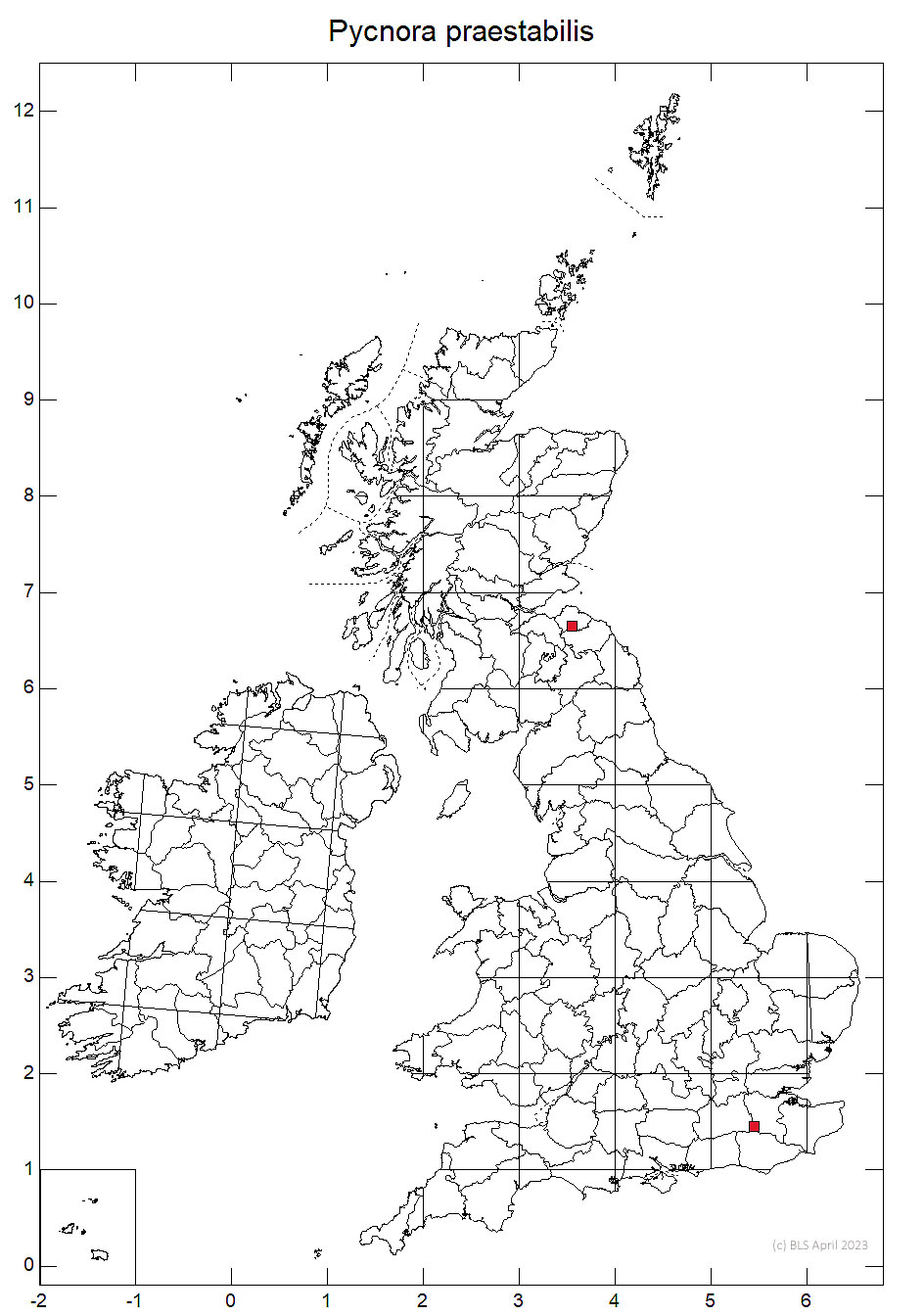

Recorded from single locations in south east Scotland (E. Lothian) and England (Kent) but likely over looked elsewhere.
Not evaluated but the weathered worked untreateted timber habitat is declining due to replacement by treated timber and increasing ammonia pollution and the species may be threatened.
Cannon, P., Coppins, B., Aptroot, A., Sanderson, N. & Simkin, J. (2025). Miscellaneous lichens and lichenicolous fungi, including Aphanopsis and Steinia (Aphanopsidaceae), Arthrorhaphis (Arthrorhaphidaceae), Buelliella, Hemigrapha, Melaspileella, Stictographa and Taeniolella (Asterinales, family unassigned), Phylloblastia (Chaetothyriales, family unassigned) Cystocoleus (Cystocoleaceae), Sclerococcum (Dactylosporaceae), Eiglera (Eigleraceae), Epigloea(Epigloeaceae), Euopsis (Harpidiaceae), Lichenothelia (Lichenotheliaceae), Lichinodium(Lichinodiaceae), Melaspilea(Melaspileaceae), Epithamnolia and Mniaecia (Mniaeciaceae), Lichenostigma (Phaeococcomycetaceae), Pycnora (Pycnoraceae), Racodium (Racodiaceae), Chicitaea and Loxospora (Sarrameanaceae), Schaereria (Schaereriaceae), Strangospora (Strangosporaceae), Botryolepraria and Stigmidium (Verrucariales, family unassigned), and Biatoridium, Mycoglaena, Orphniospora, Piccolia, Psammina and Wadeana (order and family unassigned). Revisions of British and Irish Lichens 57: 1–78.
Timdal, E. (1984). The genus Hypocenomyce (Lecanorales, Lecideaceae) with special emphasis on the Norwegian and Swedish species. Nordic Journal of Botany 4: 83–108.
Text by Neil A Sanderson based on Cannon et al (2025)