


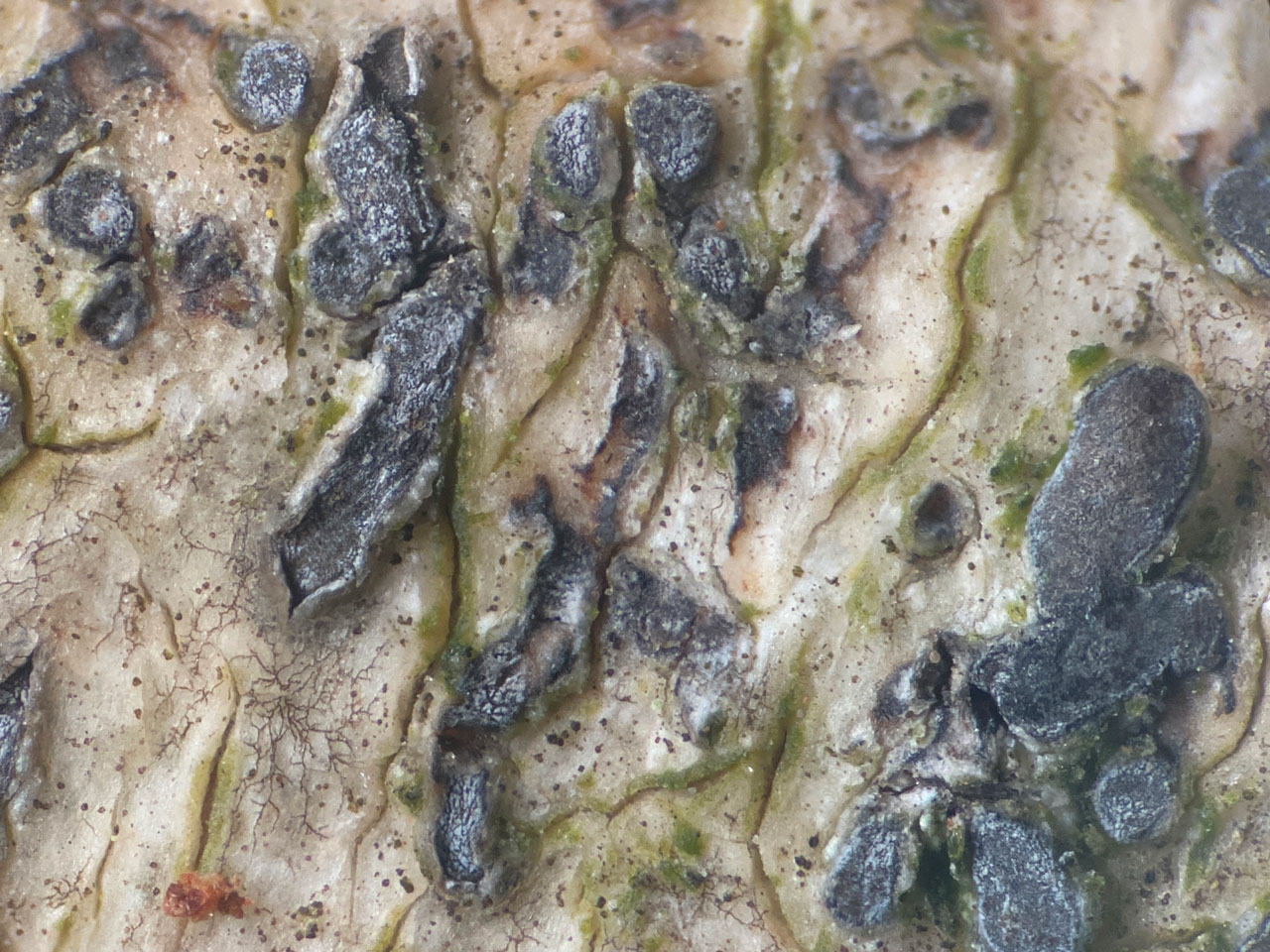
Similar to Phaeographis inusta, but with a yellow-green-olive, waxy thallus and flat but raised apothecia, with clear white powdery margins on older apothecia and raised thalline margins around young ones. The apothecia are typically arranged in parallel and less branched and stellate than P. inusta. Restricted to the far south west where in can be found on both old trees, young trees and increasingly twigs in humid locations.
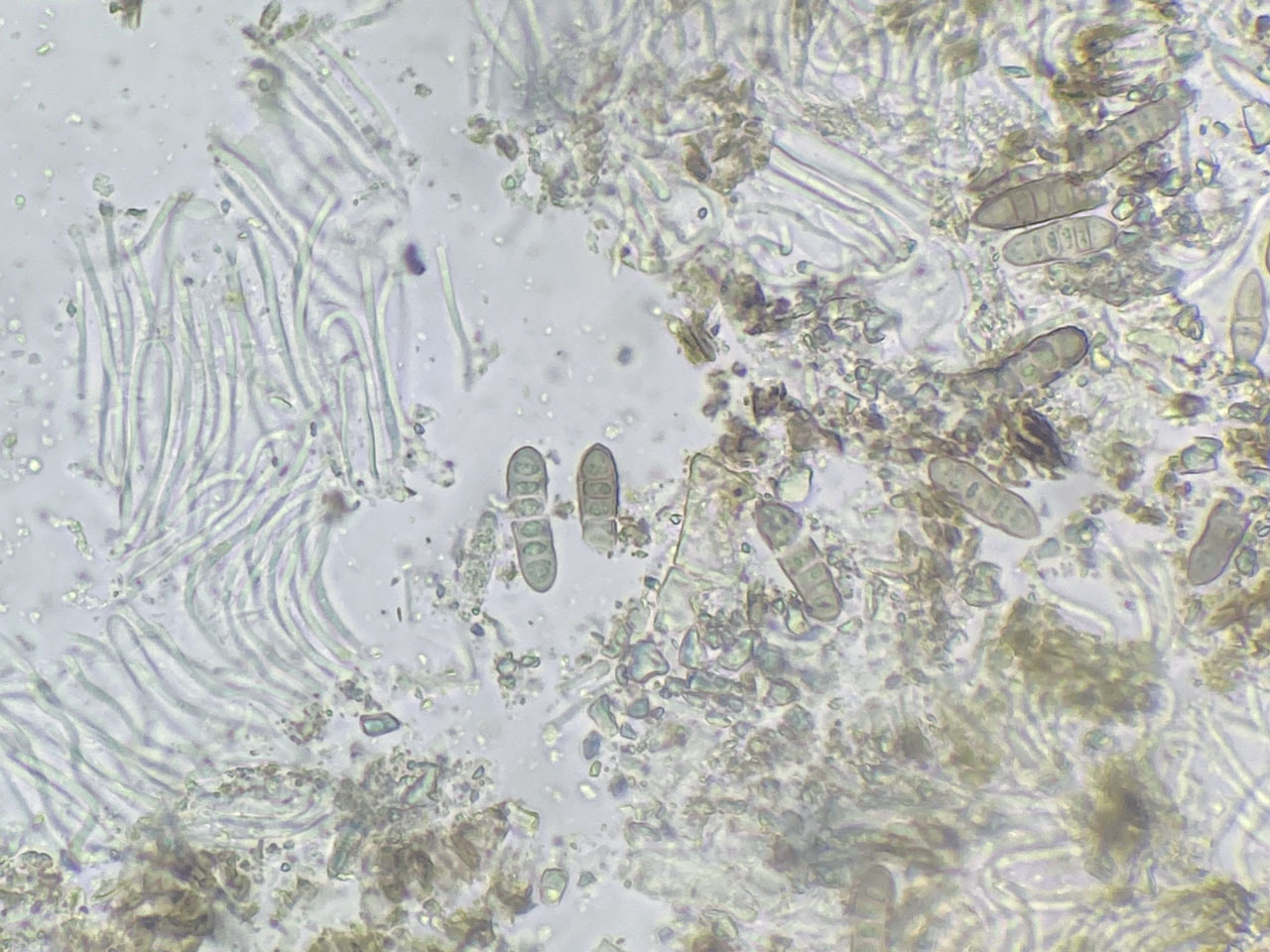
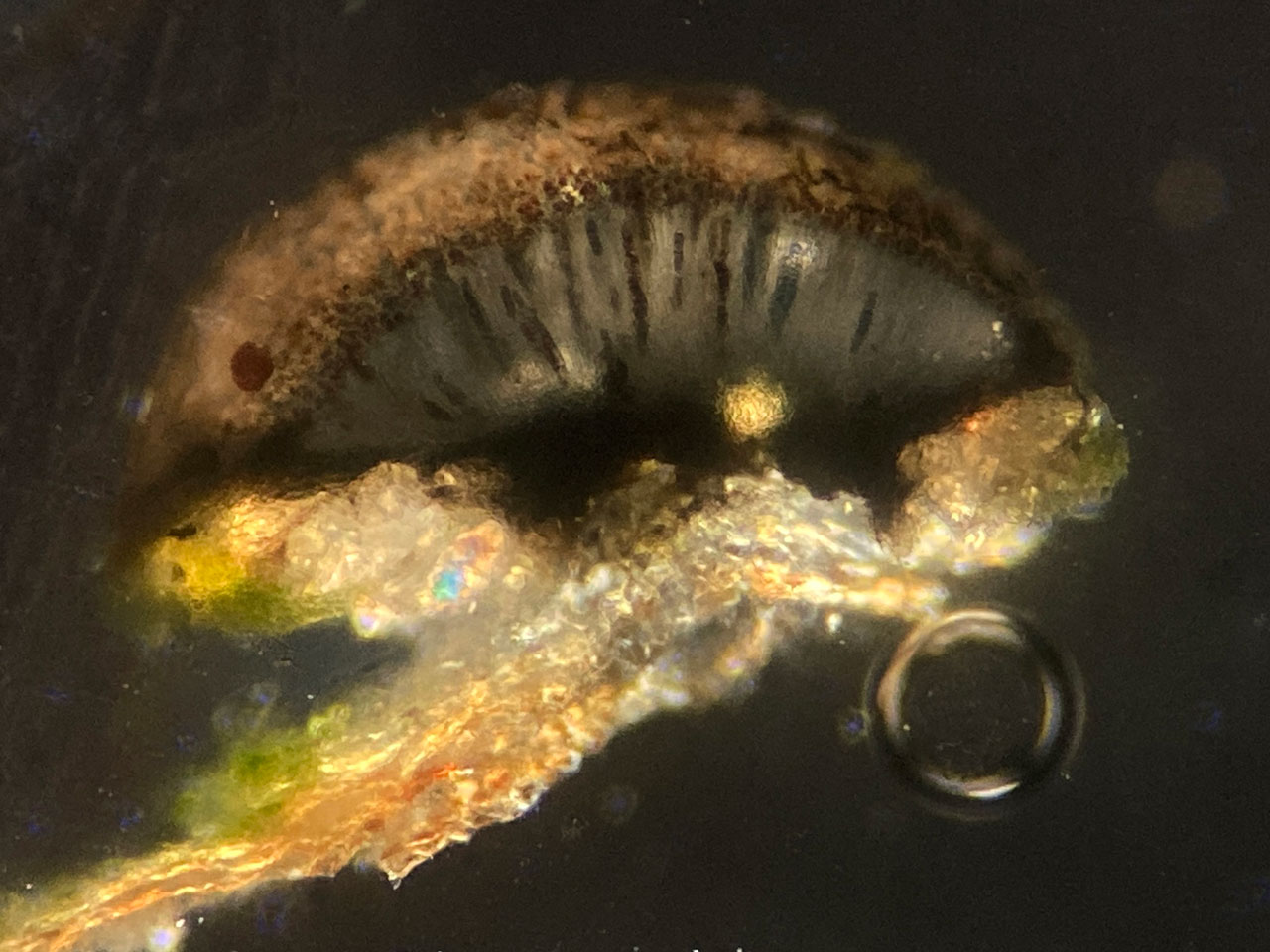
Thallus thin, in patches or mosaics, yellow-brown to dark olive-green, waxy or glossy, smooth or sparingly cracked, occasionally white-pruinose in parts. Apothecia black- brown, ± emergent, broad, flat, elongate, flexuose, unbranched, branched or stellate; thalline margin conspicuous, raised in young apothecia, later eroding down to a white-powdery margin, mainly comprising of large crystals on older apothecia; true exciple entire, dark brown, lateral walls 25–35 μm thick, broadening to ca 60 μm above; disc 0.15–0.5 mm wide, broadly expanded, ± finely pruinose; hymenium 90–120 μm tall. Ascospores (20–) 24–35 × 7–9 μm, (3-)5- septate. Conidia 8–10 × ca 4.5 μm, ellipsoidal, straight or slightly curved. No lichen products detected by TLC.
Recognised by the yellow-green-olive, waxy thallus and flat but raised apothecia, with clear white powdery margins on older apothecia and raised thalline margins around young ones. Can be host to Tremella phaeographidis Diederich et al. (1996), which produces brown, gall-like basidiomata on the thallus.
On ± shaded, smooth bark of deciduous trees, especially saplings and young trees, in humid situations in old woods, rare on wayside trees. Until recently more often found on trunks than twigs, both older trees and sheltered young trees, but may be increasing in twig habitats. Recently noted as a component of a striking community on sheltered twigs in humid locations in the New Forest with abundant Lecanora pseudargentata and Pertusaria pustulata.


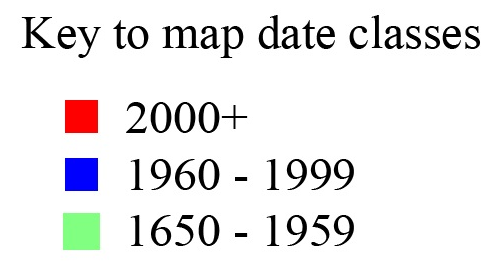
Rare to locally occasional, S.W. England, W. Wales, S.W. Ireland.
Assessed as Near Threatened in 2012, but although rather restricted geographical in England, it does readily colonise young trees in sheltered locations, and may be spreading to an extent locally, however it is very rare in Wales. During a 2026 survey of twigs in the New Forest it was noted that the lichen was much more frequent as young colonist thalli on Oak twigs than had been noticed before and it appeared to have increased considerably in frequency in this habitat. This may herald a wider range expansion. Quite widespread and colonising young Beech plantations near the south coast of Ireland.
Britain: Near Threatened, International Responsibility species
Wales: Vulnerable
Aptroot, A., Weerakoon, G., Cannon, P., Coppins, B., Sanderson, N. & Simkin, J. (2023). Ostropales: Graphidaceae, including the genera Allographa, Clandestinotrema, Crutarndina, Diploschistes, Fissurina, Graphis, Leucodecton, Phaeographis, Schizotrema, Thelotrema and Topeliopsis. Revisions of British and Irish Lichens 36: 1-23.
Text by Neil A Sanderson based on Aptroot et al (2023)