Micarea coppinsii
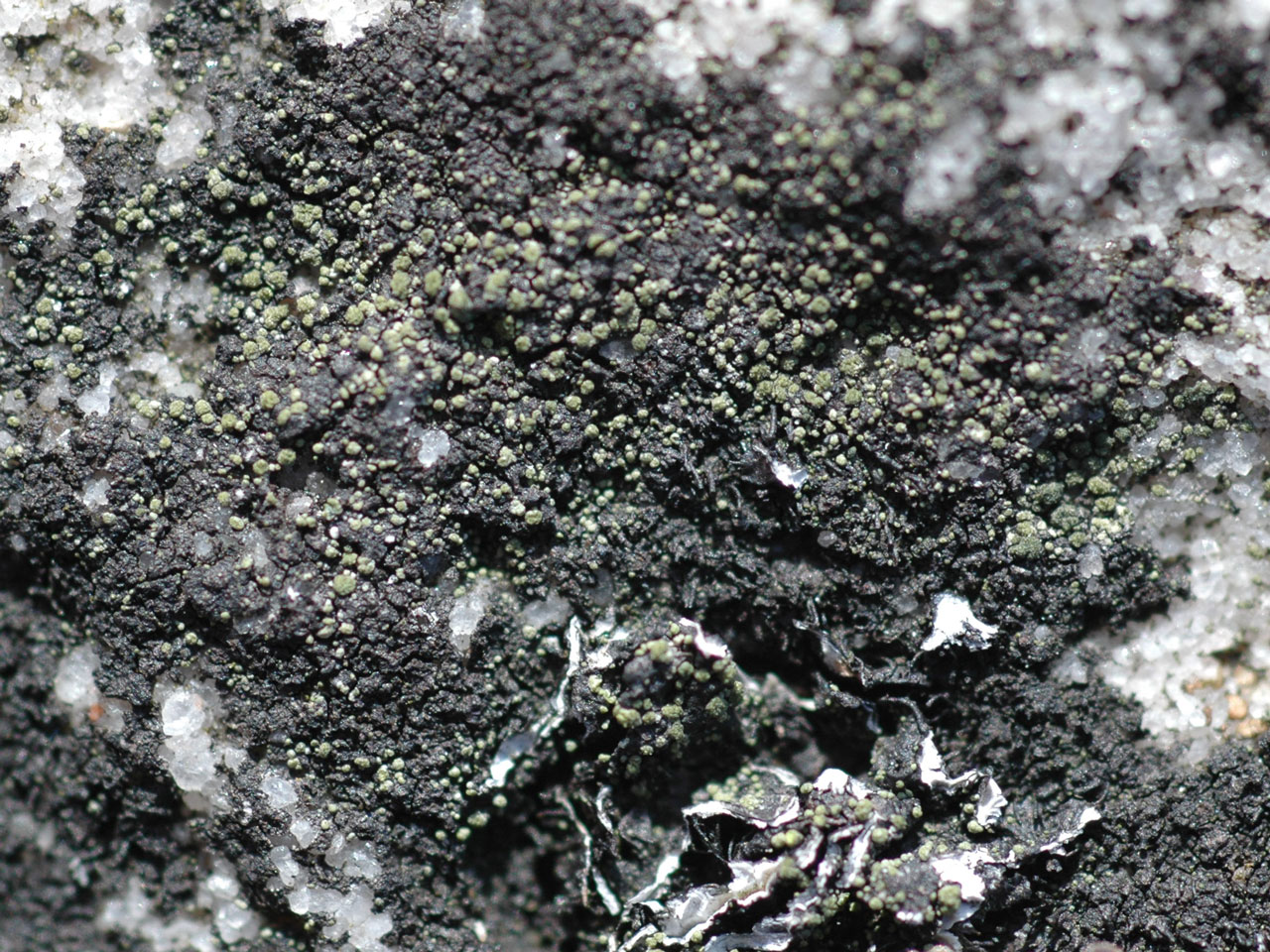
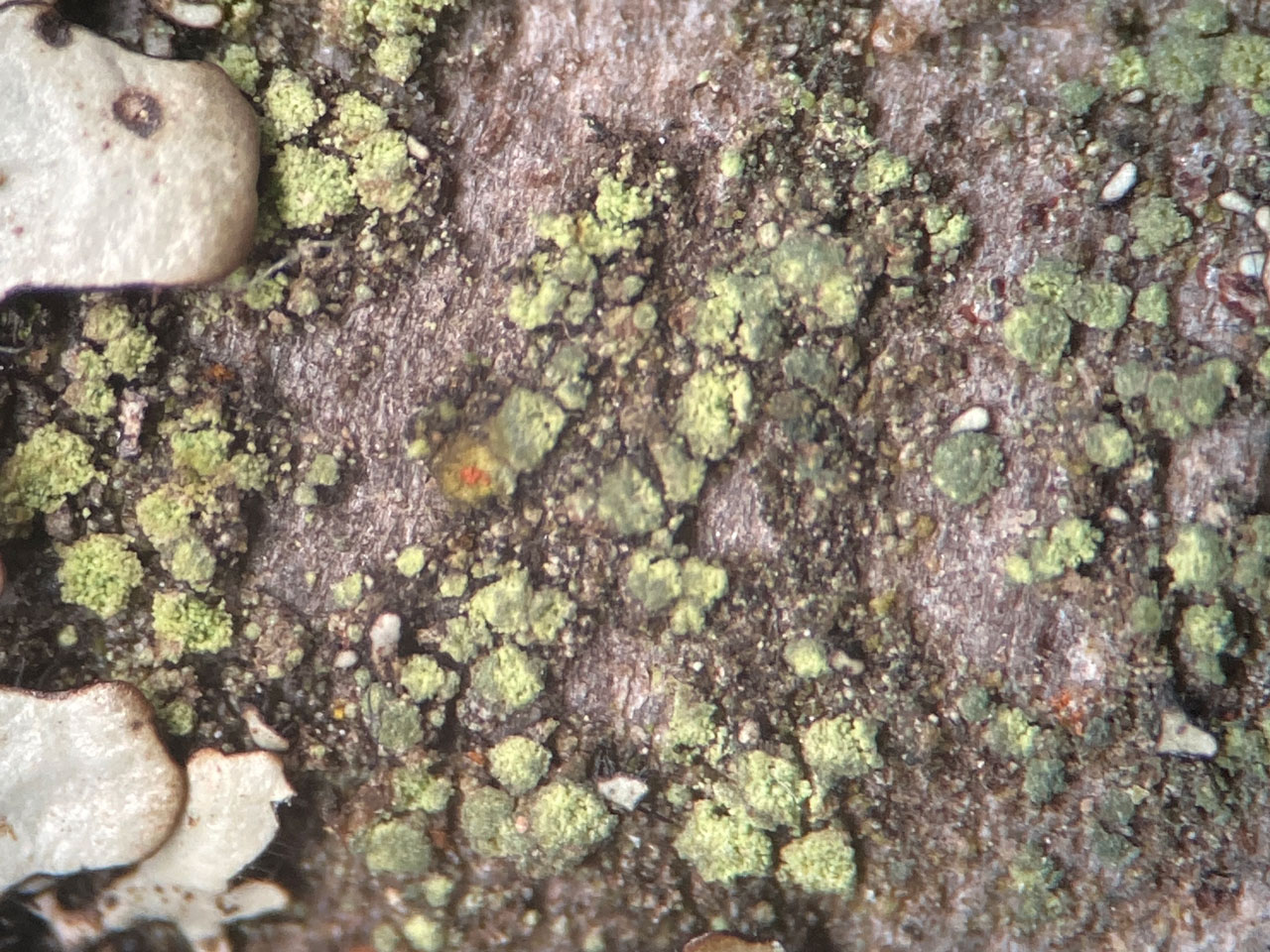
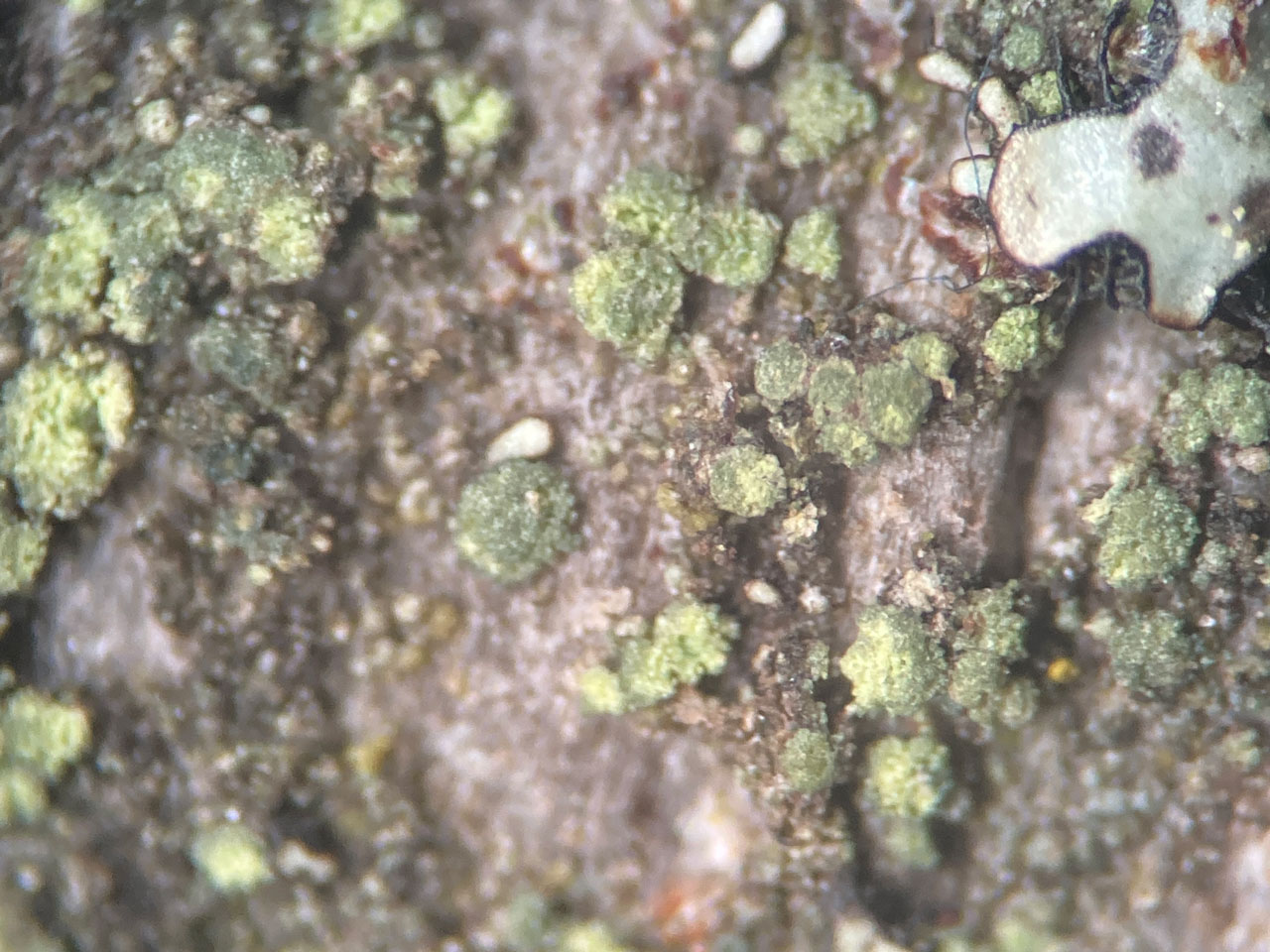
A crust forming lichen with a grey-green thallus suporrting rounded green to blue-grey soralia, which react weekly C+ red and strongly KC+ red. Widespread and found on acidic rocks and twigs, mainly in the uplands, but probably rather overlooked.
Thallus forming small rounded patches to 2 cm diam., sometimes wide-spreading, of discrete rounded grey-green to grey areoles 40–220 (–300) µm diam., many bursting apically to produce soralia; soralia green to blue-grey, 0.1–0.2 mm diam., with farinose soredia 12–25 (–30) µm diam., some with blue-green (K–, N+ red) pigmented hyphae; prothallus not evident; photobiont cells 4–7 µm diam. Apothecia very rare, similar to those of M. peliocarpa, to 0.2 mm diam., pallid to blue-grey, at first adnate and weakly marginate but becoming convex and constricted below and sometimes shortly stalked; hymenium 45–70 µm tall, colourless or partly greenish, K–, N+ red; asci 30–44 × 12–20 µm; ascospores 20–28 (–31) × 4 (–5) µm, fusiform to clavate-fusiform, ± curved, 3-septate. Pycnidia occasional, 60–70 µm diam., emergent, pallid, with microconidia 4.5–6 × 0.6–0.8 µm, narrowly fusiform-cylindrical. Thallus, soralia and apothecia C+ reddish (often faint), KC+ red, K–, Pd–, UV– (5-O-methylhiasic acid [major], gyrophoric acid [trace], ± lecanoric acid [trace]).
When soralia are blue-grey, the species is easily confused with diminutive forms of Trapeliopsis flexuosa or (when the soralia are pale) with Trapelia corticola; both these species have different, ± larger-celled photobiont cells and the major lichen product (TLC) is gyrophoric acid; also, the blue-green pigment in T. flexuosa is K+ brown, N–. On twigs, Halecania viridescens can look similar, but is C–, Pd+ red (argopsin). Sterile M. viridileprosa is distinguished by its light green ± leprose thallus without areoles.
On a variety of acidic substrata, including twigs of trees and shrubs (including Calluna and Myrica), less often on tree boles, siliceous rocks and gravestones, sometimes on stones and wood fragments on the ground in heathland or mine sites, or on fence rails.
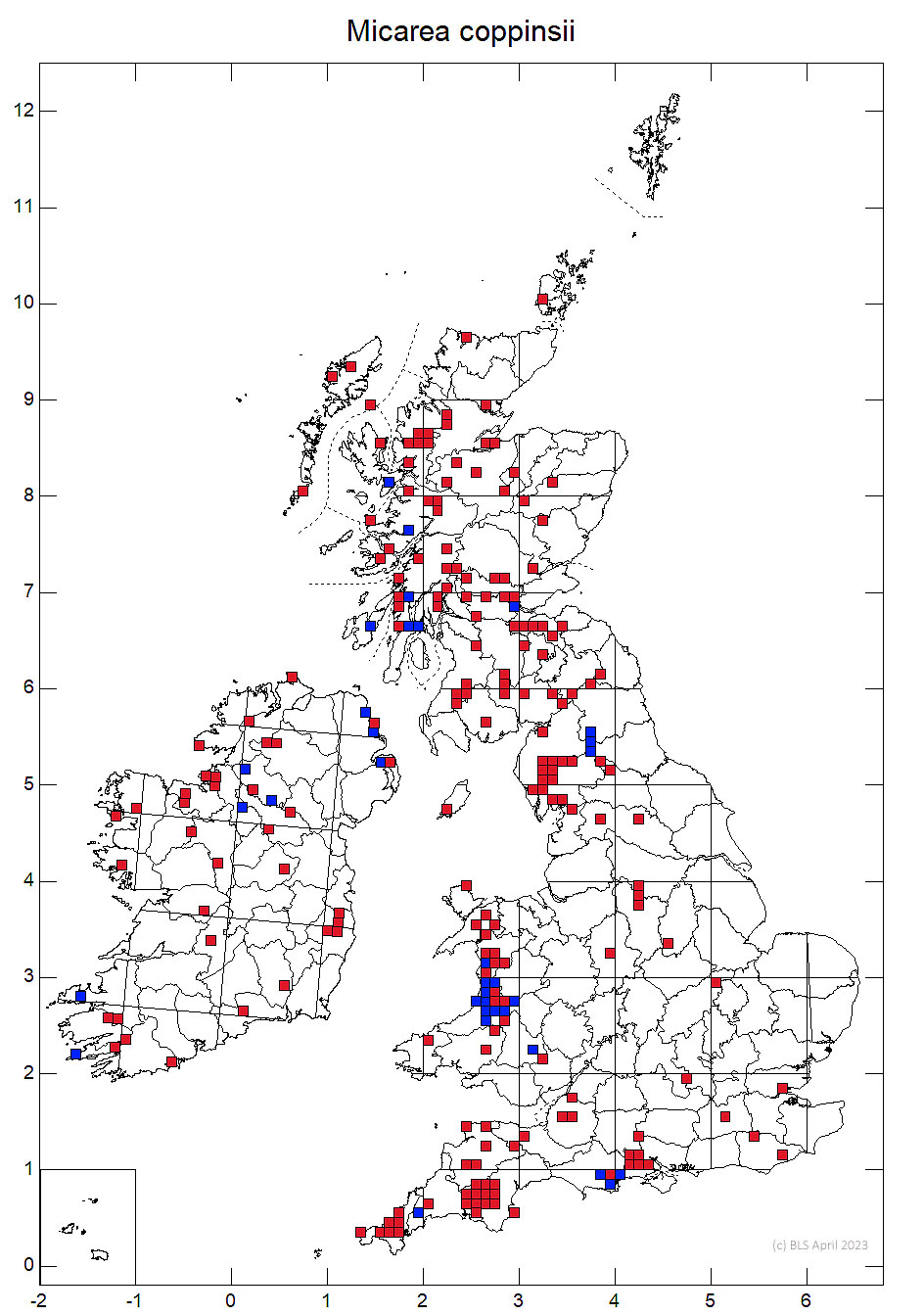


Widespread but previously much overlooked. Mainly upland areas of Britain and Ireland, with scattered records from lowland areas.
Cannon, P., Orange, A., Aptroot, A., Sanderson, N., Coppins, B. & Simkin, J. (2022). Lecanorales: Pilocarpaceae, including the genera Aquacidia, Byssoloma, Fellhanera, Fellhaneropsis, Leimonis and Micarea. Revisions of British and Irish Lichens 27: 1-48.
Text by Neil A Sanderson based on Canon et al (2022).