Fellhaneropsis myrtillicola
Fellhanera myrtillicola
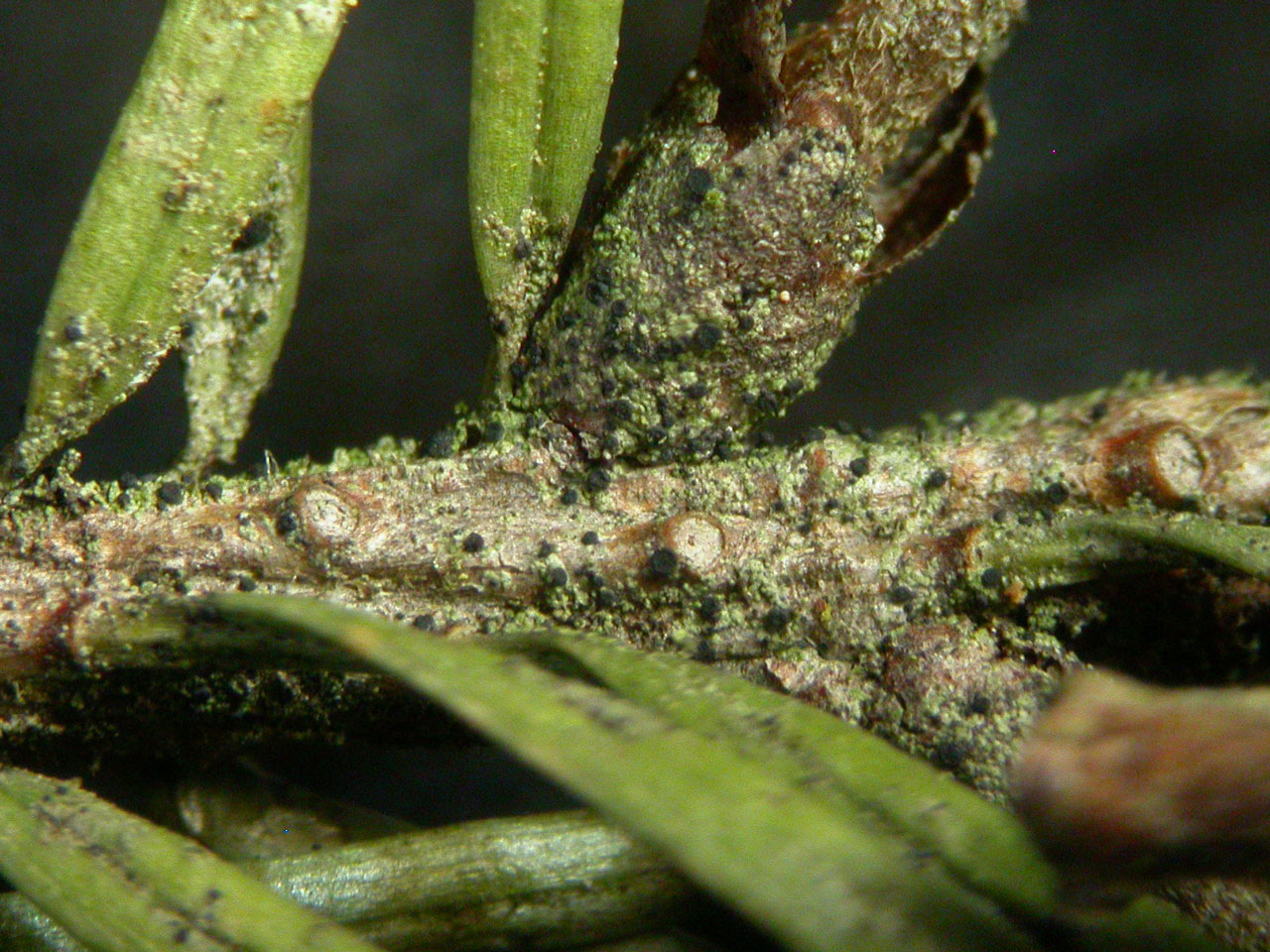
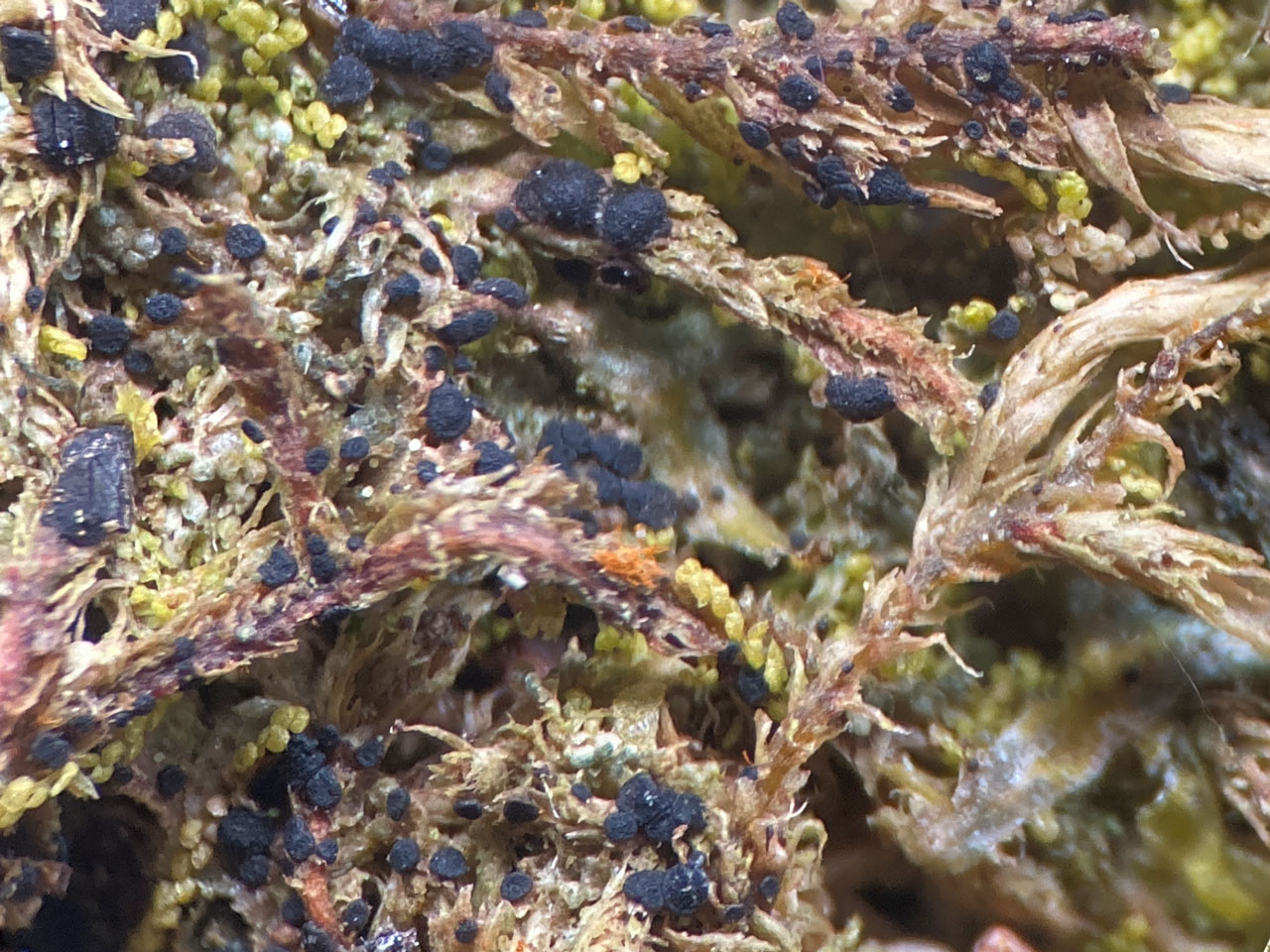
A probably widespread but easily overlooked lichen found on leaves and on moss. Comes in three morphs, one with abundant blue-grey to blue-black apothecia and ones with mainly macroconidia or microconidia, all on a green-grey to blue-grey thallus.
Thallus of small rounded patches that eventually merge to form a continuous thallus to several cm diam., mostly shiny, thin and smooth or slightly verrucose, or formed of ± agglutinated granules, green-grey to blue-grey (typical specimens have a distinct bluish tinge), usually with a bluish pellucid prothallus; photobiont cells 5–12 µm diam. Apothecia usually numerous, circular, distinctly constricted at the base, never tuberculate, 0.1–0.2 (–0.3) mm diam., less than 0.1 mm in height, at first ± flat and with a thin and pale but nevertheless distinct margin, soon convex and immarginate; disc pale brown or more usually blue-grey to blue-black, sometimes almost mauve; true exciple thin but distinct, colourless, pale brownish or greenish adjacent to the hymenium; hypothecium less than 10 µm thick, dark brown, K+ green-brown to aeruginose, usually with the K+ reaction restricted to the central and basal parts; paraphyses 1–1.5 µm diam.; asci 30–40 × 12–16 µm; ascospores cylindric-fusiform, straight or slightly curved, sometimes with a thin perispore, 3- (to 5-) septate, 16–28 (–34) × 3–4 µm. Pycnidia blue-grey to blue-black, of two types: macroconidia usually present, 100–150 µm diam., formed on the apothecia, producing long filiform conidia 20–45 × 1–1.5 µm.; and microconidia either abundant or totally absent, 50–80 µm diam., not on apothecia, producing small
cylindrical conidia 4–8 (–13) × 0.5–1 µm.
This species occurs in three very different morphs: a) with (only or nearly only) numerous apothecia, b) with (only or nearly only) macroconidia or c) with (only or nearly only) microconidia. It is most easily confused with certain morphs of Bacidina saxenii, which differs by the large exciple cells, the ascus type and the simpler conidiomata (not arising from apothecial tissue), although the conidia are otherwise indistinguishable. Poorly developed specimens of Byssoloma marginatum with numerous small apothecia can be distinguished by the structure of the true exciple. Byssoloma llimonae is also similar, but has a reddish brown (K± purplish) hypothecium.
The hyphal structure of the pycnidial wall is diagnostic for the genus, with vertically aligned fimbriate hair-like hyphae surrounding the ostiole; see the account of Bacidia vezdae in Coppins & James (1978).
On siliceous boulders in streams, in woodland on leaves of Box, Ivy, Yew, Skimmia and Rhododendron, bamboo and Hazel stems, on bryophytes, and twigs and needles of Douglas Fir.
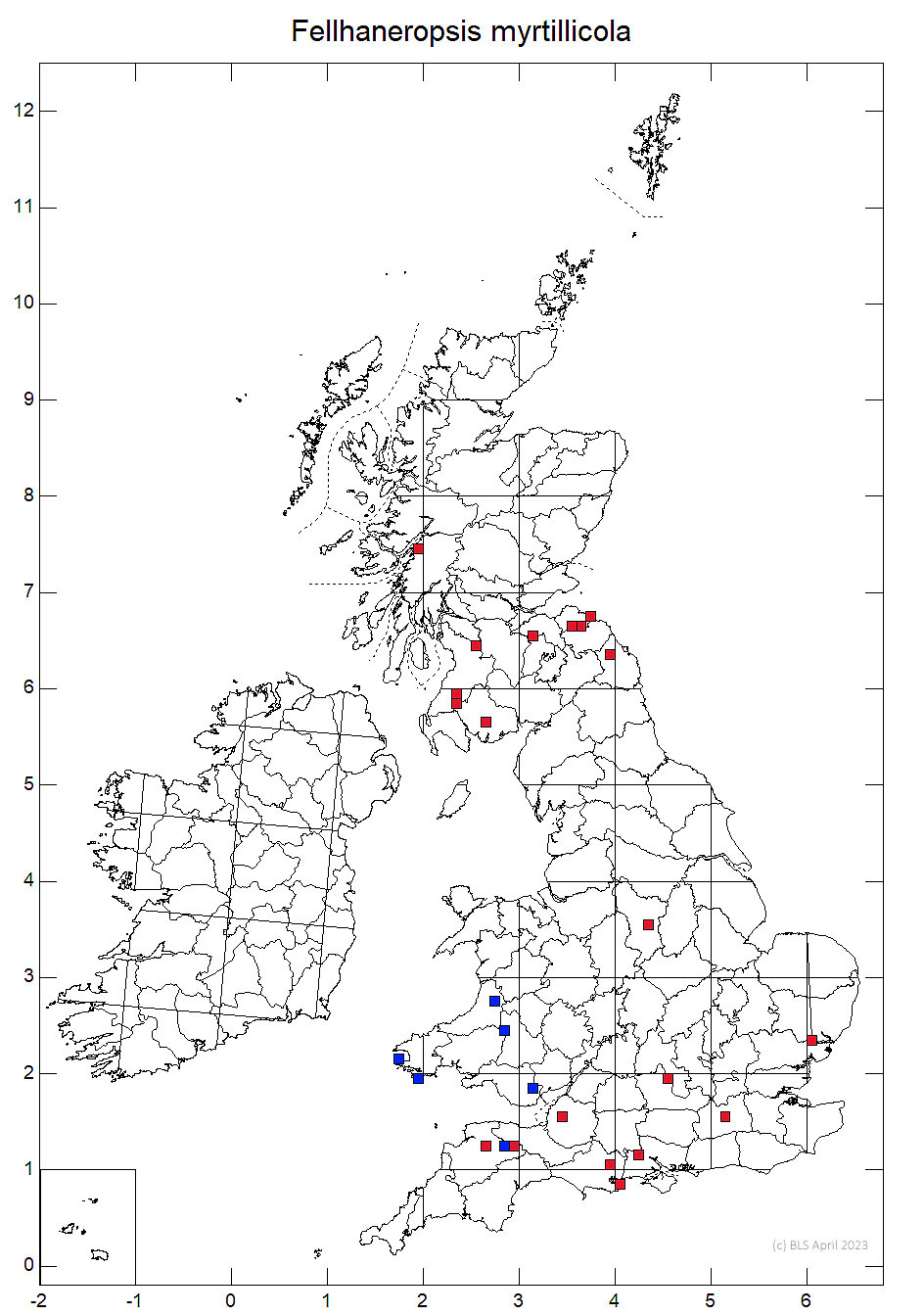


Probably widely distributed in Britain and potentially also Ireland, but much overlooked; currently recorded from southern England and Wales and from southern Scotland.
Cannon, P., Orange, A., Aptroot, A., Sanderson, N., Coppins, B. & Simkin, J. (2022). Lecanorales: Pilocarpaceae, including the genera Aquacidia, Byssoloma, Fellhanera, Fellhaneropsis, Leimonis and Micarea. Revisions of British and Irish Lichens 27: 1-48.
Coppins, B.J. & James, P.W. (1978). New or interesting British lichens II. Lichenologist 10: 179–207.
Text by Neil A Sanderson based on Canon et al (2022)