Byssoloma maderense
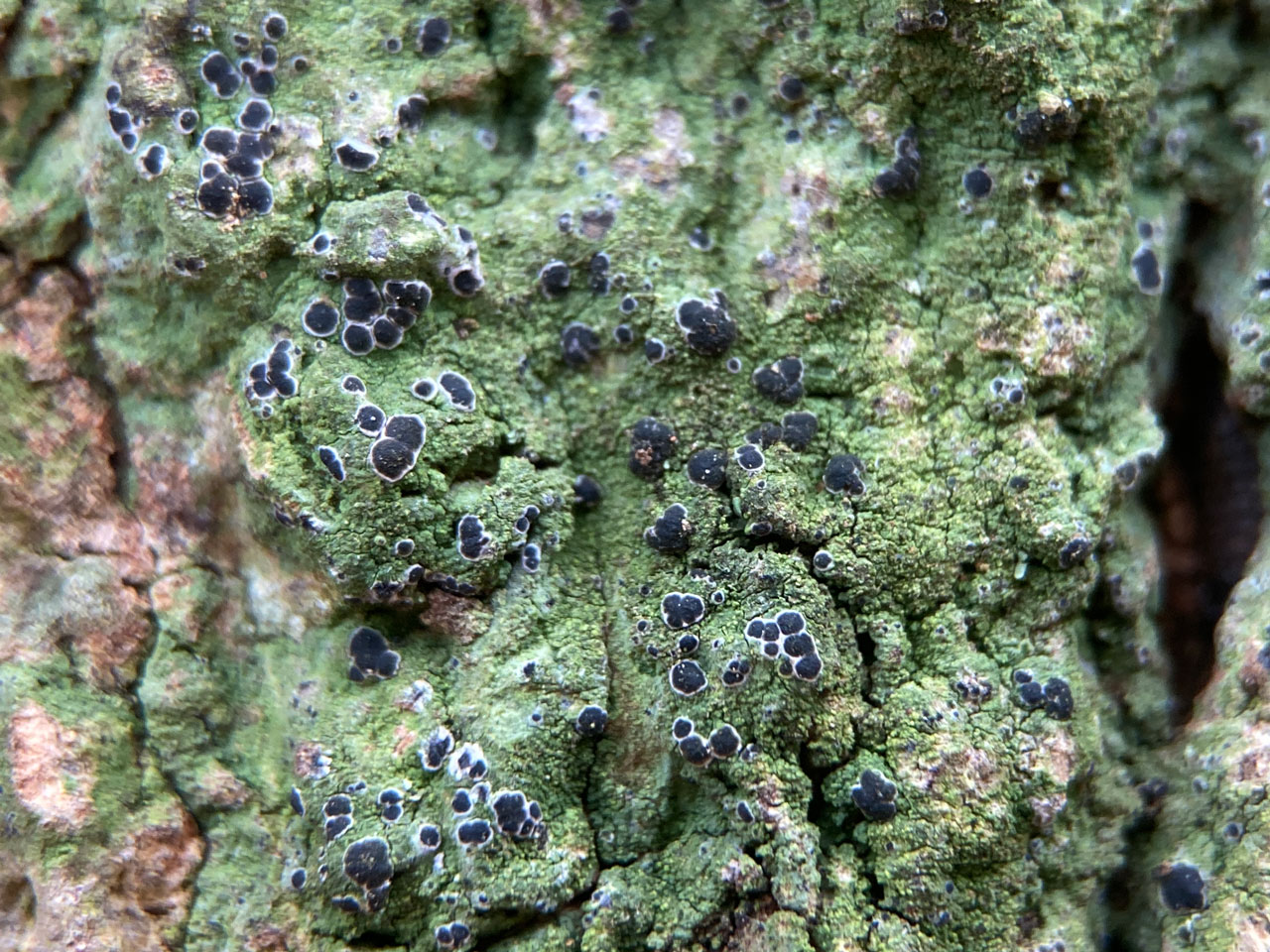
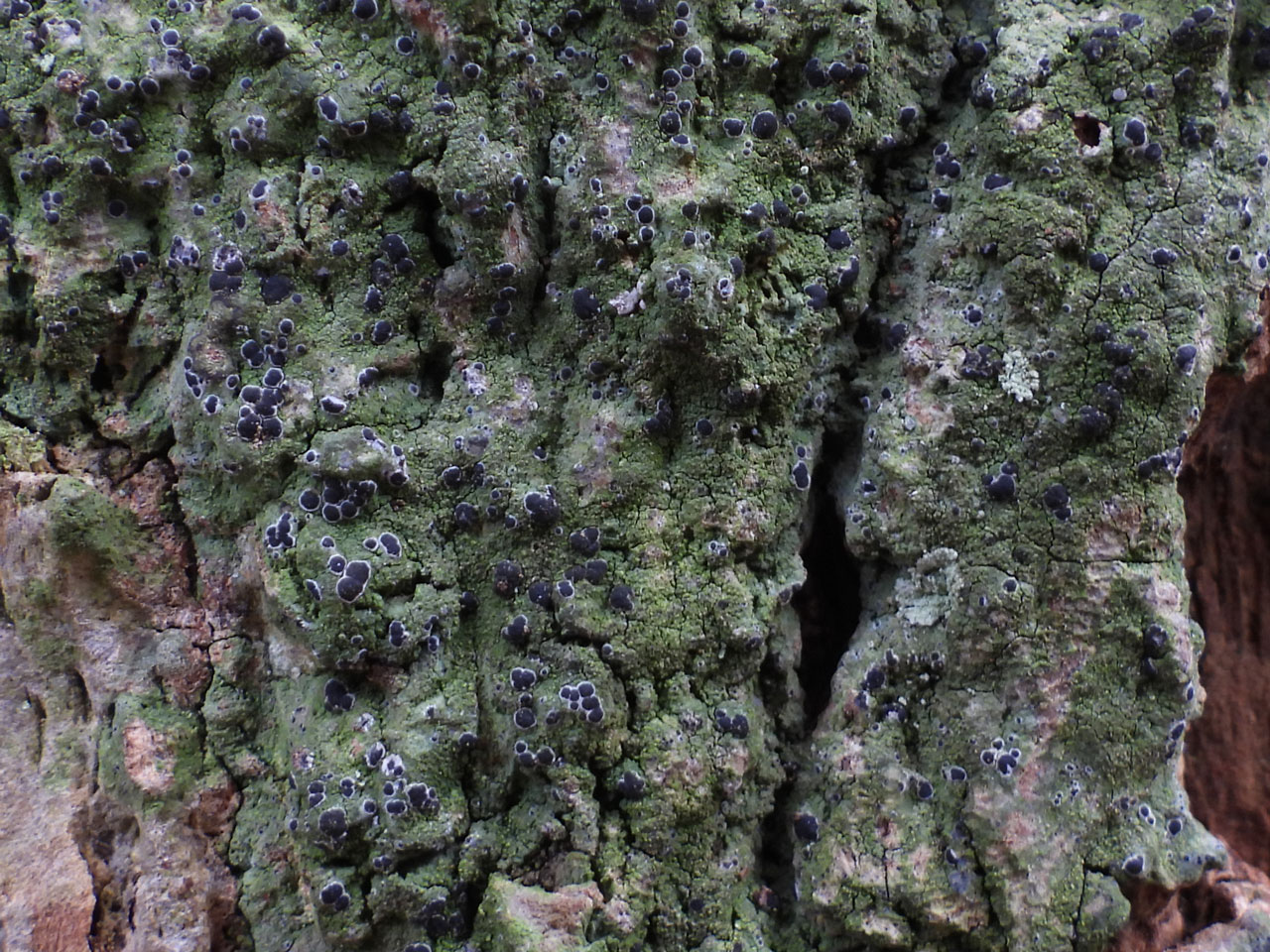
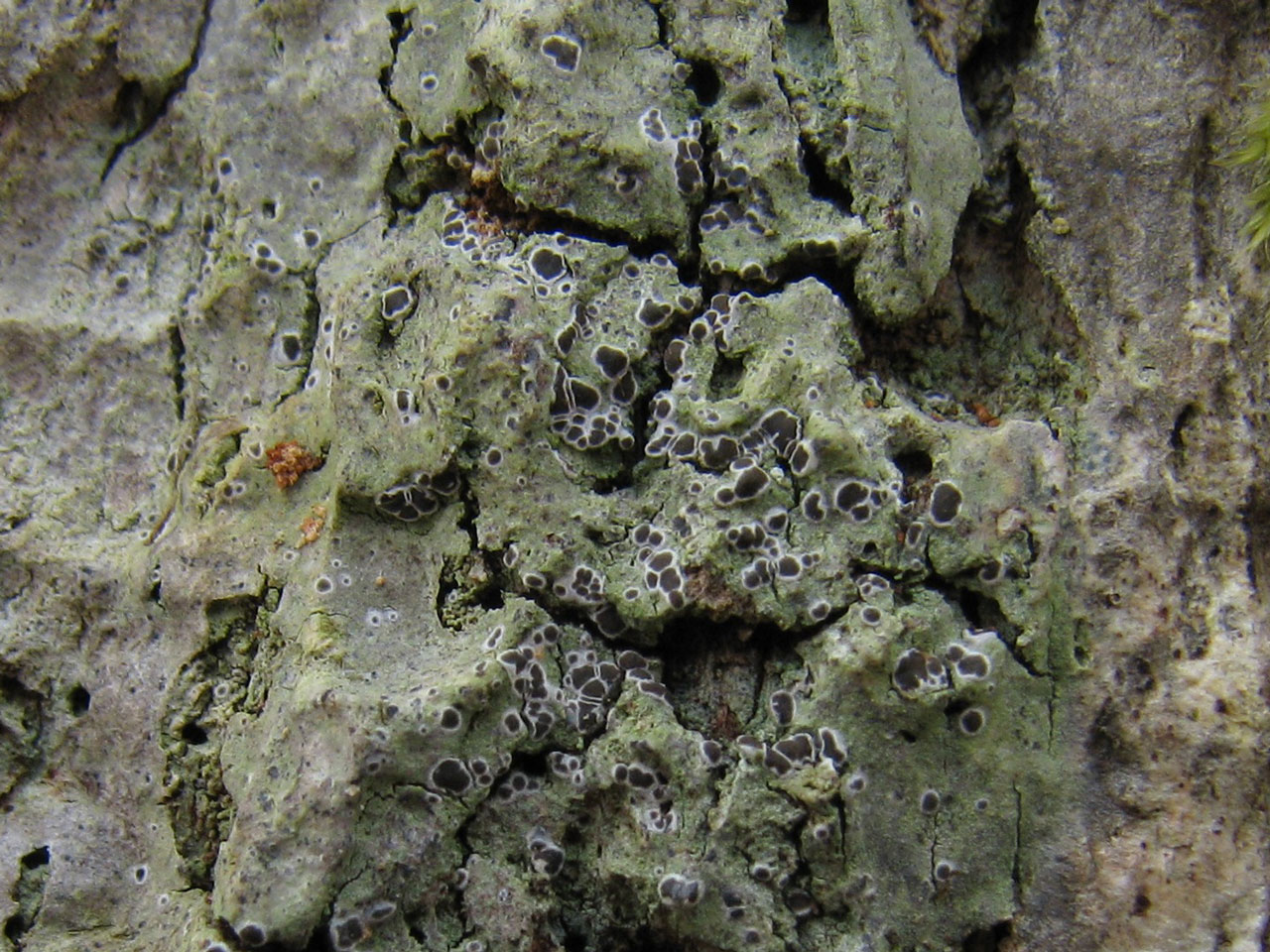
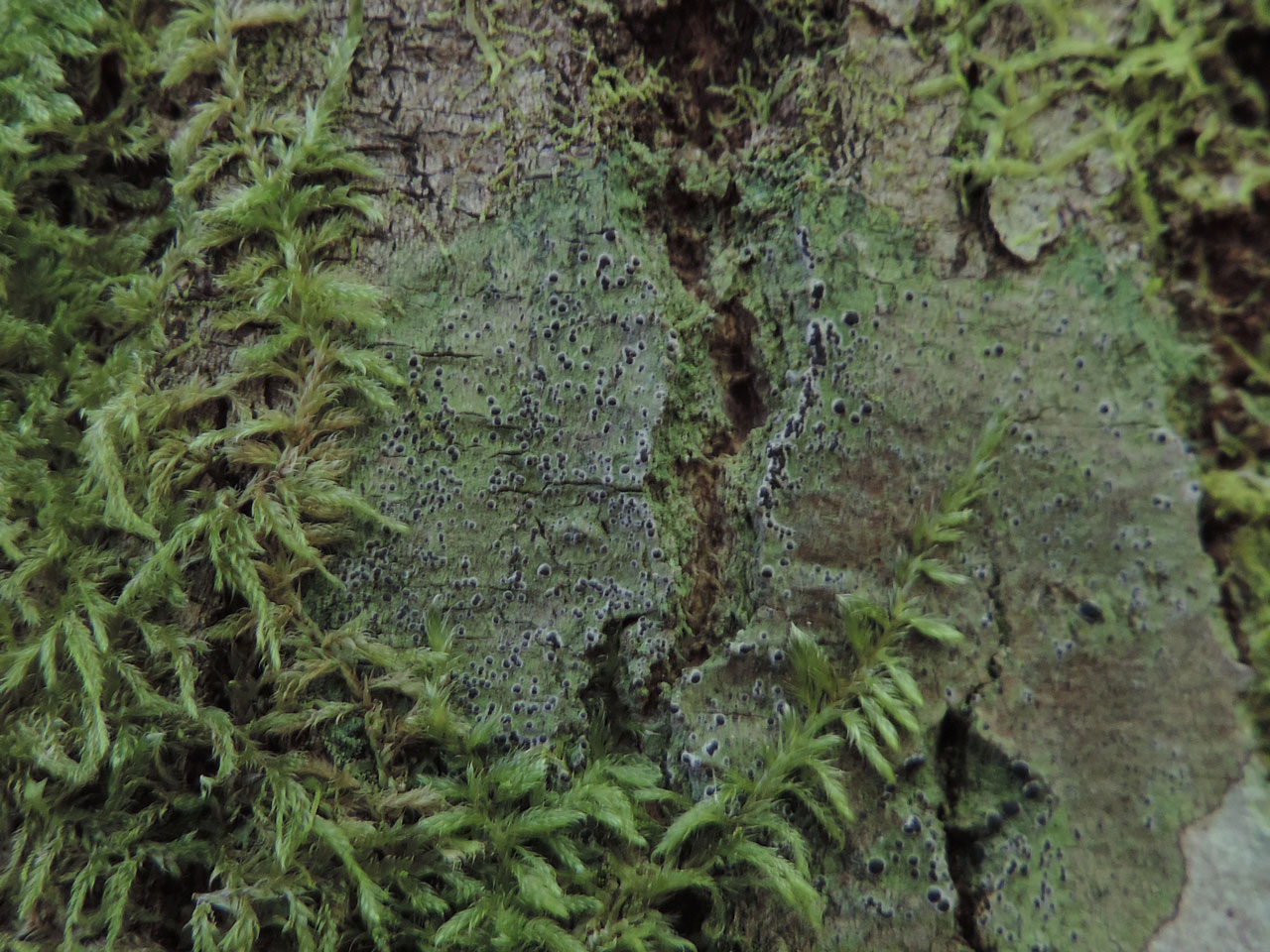
A striking and rather exotic lichen with numerous apothecia with black disks fringed by a white tomentose-arachnoid exciple set on a bright grey-green thallus. Separated from the similar Byssoloma leucoblepharum recently (Breuss, 2016); B. maderense has crystals (best seen in polarised light) inspersed in the exciple and epithecium and tends to have darker disks and is mainly found on bark. Byssoloma leucoblepharum lacks these crystals and is more often found on leaves. So far all previous records of B. leucoblepharum from the south coast (Hampshire, Isle of Wight, Sussex) have proved to be B. maderense where it is found on base-rich bark of old trees in old-growth pasture woodlands. Records of B. leucoblepharum from Lundy have not yet been checked, but as they were from Heather stems, they may be correct.
Thallus thin, greyish to greenish, roughened but not distinctly farinose or granular, to 20 mm (or more) diam. Apothecia numerous, round, 0.25–0.6 mm diam. and 120–180μm high, fully adnate or slightly constricted at the base; discs flat or slightly convex, brownish grey to black, irregularly pruinose, the exciple tomentose-arachnoid, thin but distinct, persistent, white, barely extending laterally over the thallus surface, formed by loosely woven hyphae with abundant adhering colourless crystals; crystals K–, not dissolving; hypothecium brown, contiguous with the pigmented central part of the apothecial base; hymenium colourless, covered by a thin layer of small, colourless to brownish crystals; paraphyses ca 1.5 μm diam., unbranched, with barely thickened apices; ascospores 3-septate, cylindrical, not or slightly constricted at the septa, with a thin epispore, 10–15 × 3–4 μm. Conidiomata apparently absent (not recorded).
Similar to B. leucoblepharum but with the exciple and epithecium inspersed with small colourless crystals (best seen in polarised light); see under that species for more information. The description has been adapted from Breuss (2016).
On base-rich bark of Oak, Beech and Sallow in old-growth pasture woodlands.
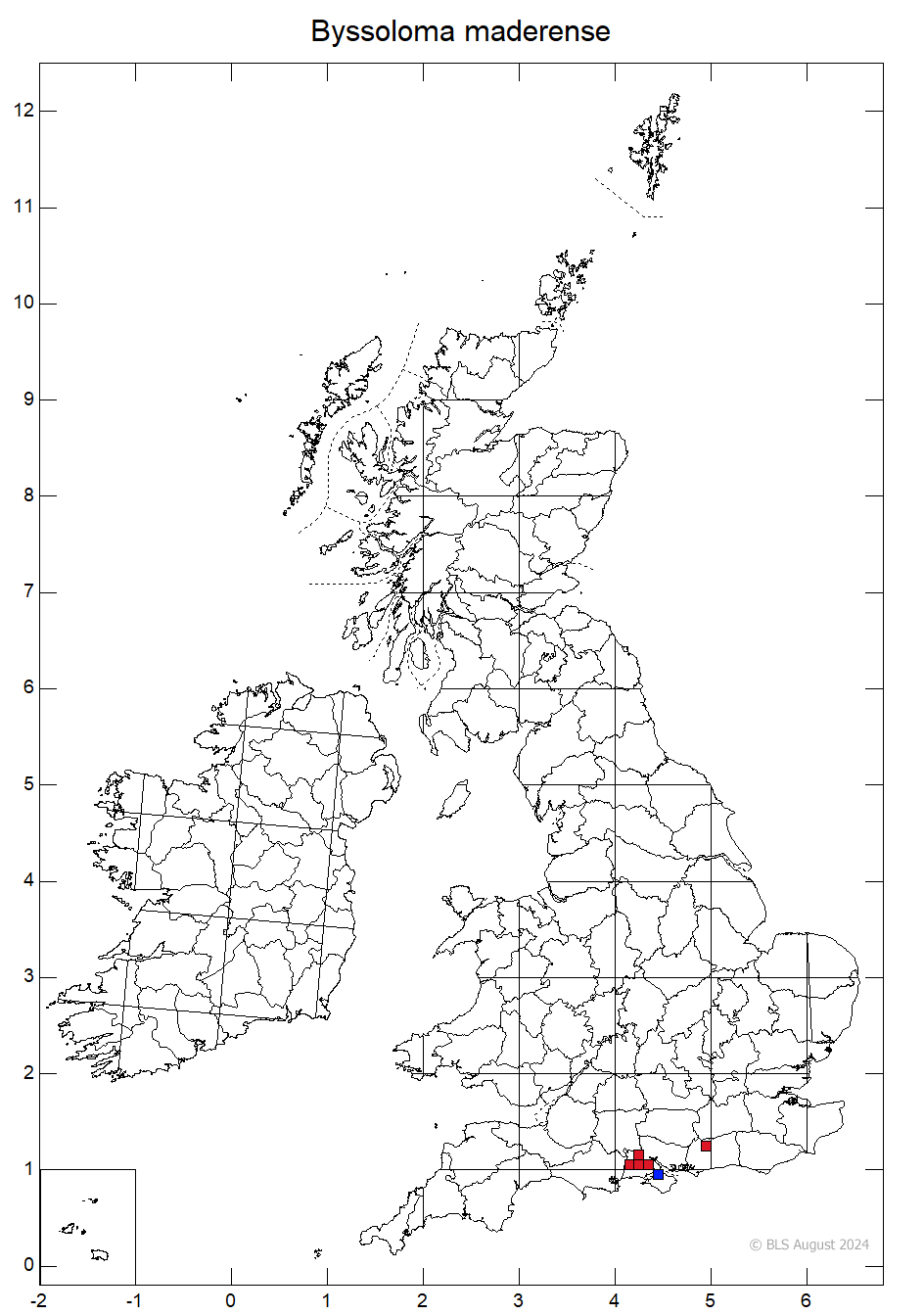

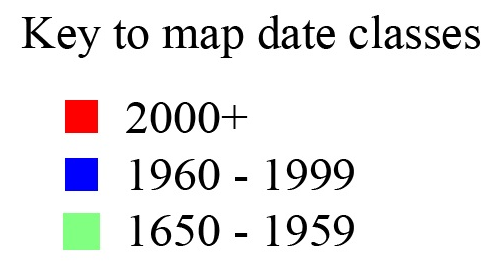
Rare, Hampshire (New Forest), Isle of Wight, Sussex.
The 2012 assessment of Near Threatened for Byssoloma leucoblepharum is best applied to Byssoloma maderense, as all recently examined populations previously recorded as B. leucoblepharum have proved to be B. maderense. The species has a small localised population on the south coast, with most records from the New Forest, Hampshire. Threatened by increasing shade in woodlands and not refound recently on the Isle of Wight.
Britain: Near Threatened
Breuss, O. (2016b). Byssoloma maderense is not endemic to Macaronesia. Evansia 33: 54–62.
Cannon, P., Orange, A., Aptroot, A., Sanderson, N., Coppins, B. & Simkin, J. (2022). Lecanorales: Pilocarpaceae, including the genera Aquacidia, Byssoloma, Fellhanera, Fellhaneropsis, Leimonis and Micarea. Revisions of British and Irish Lichens 27: 1-48.
Text by Neil A Sanderson based on Canon et al (2022)