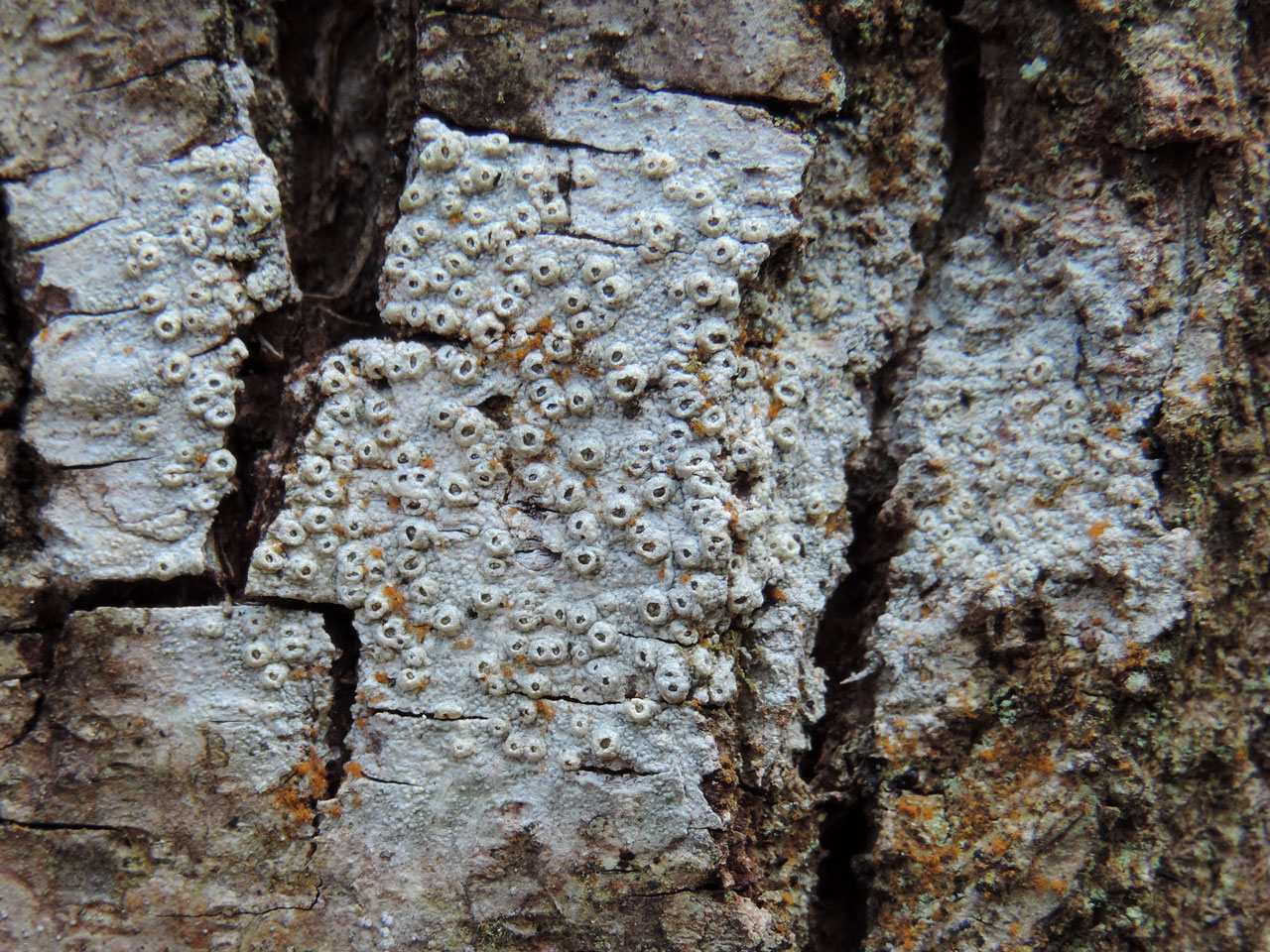
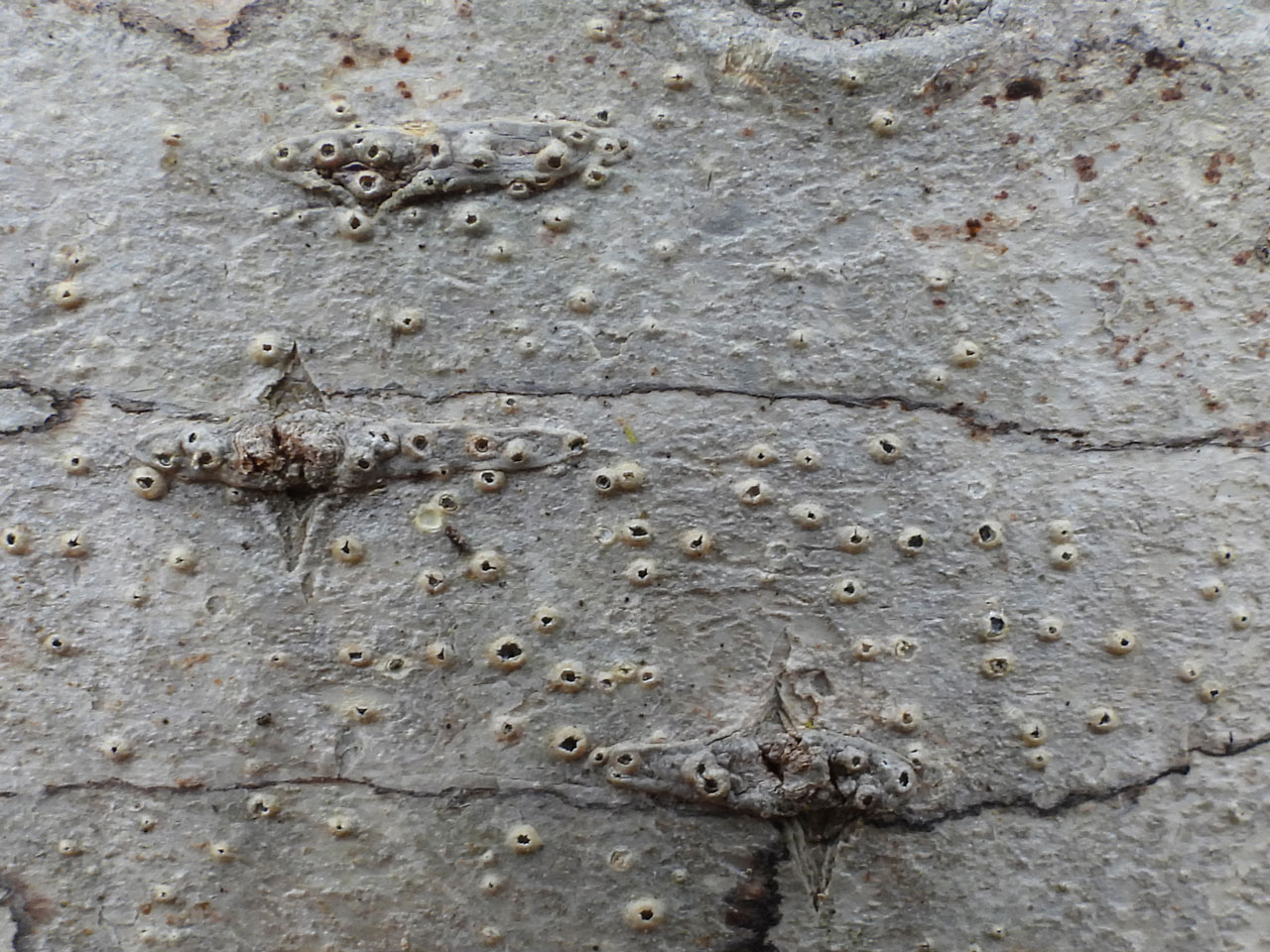
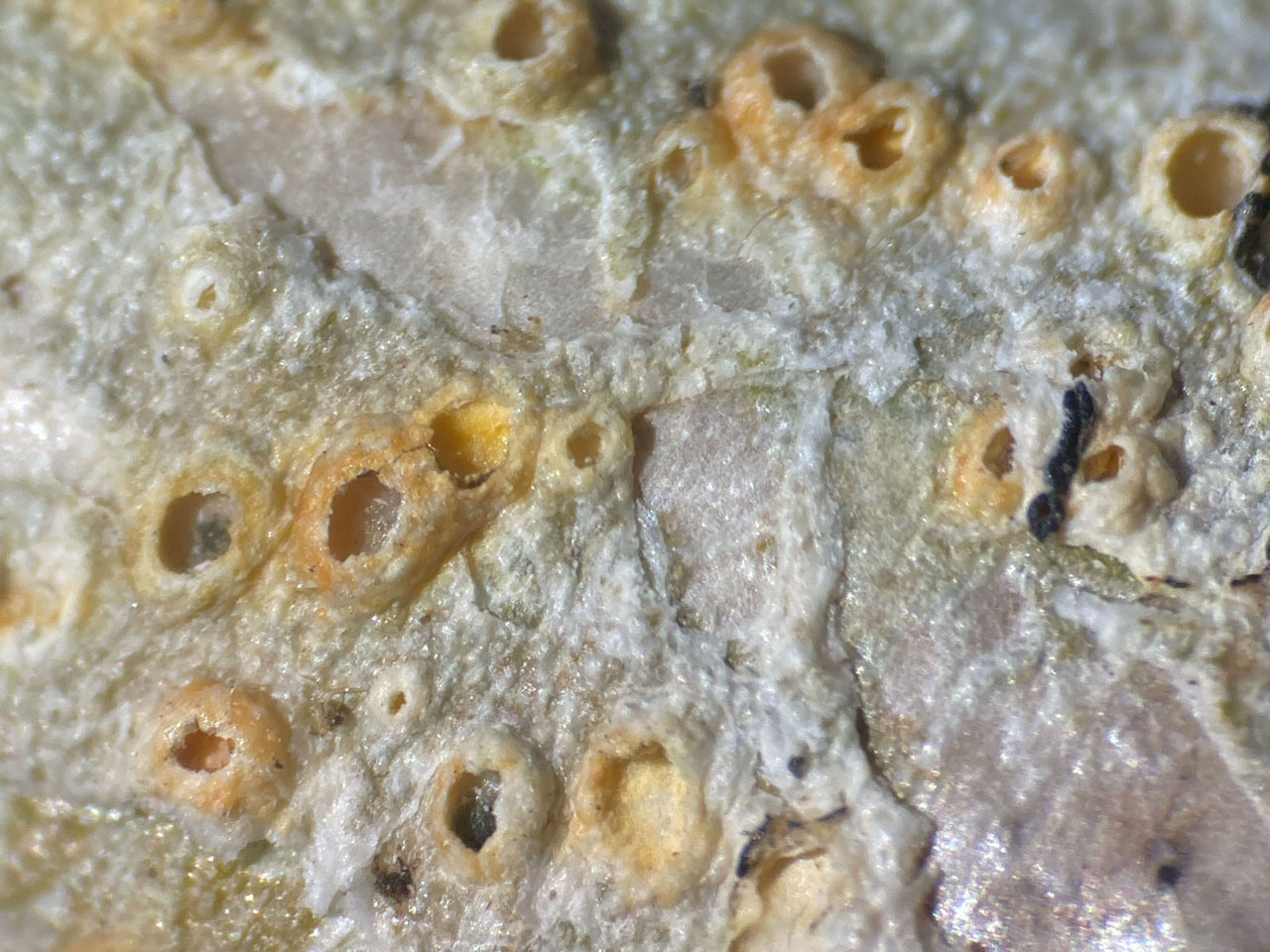
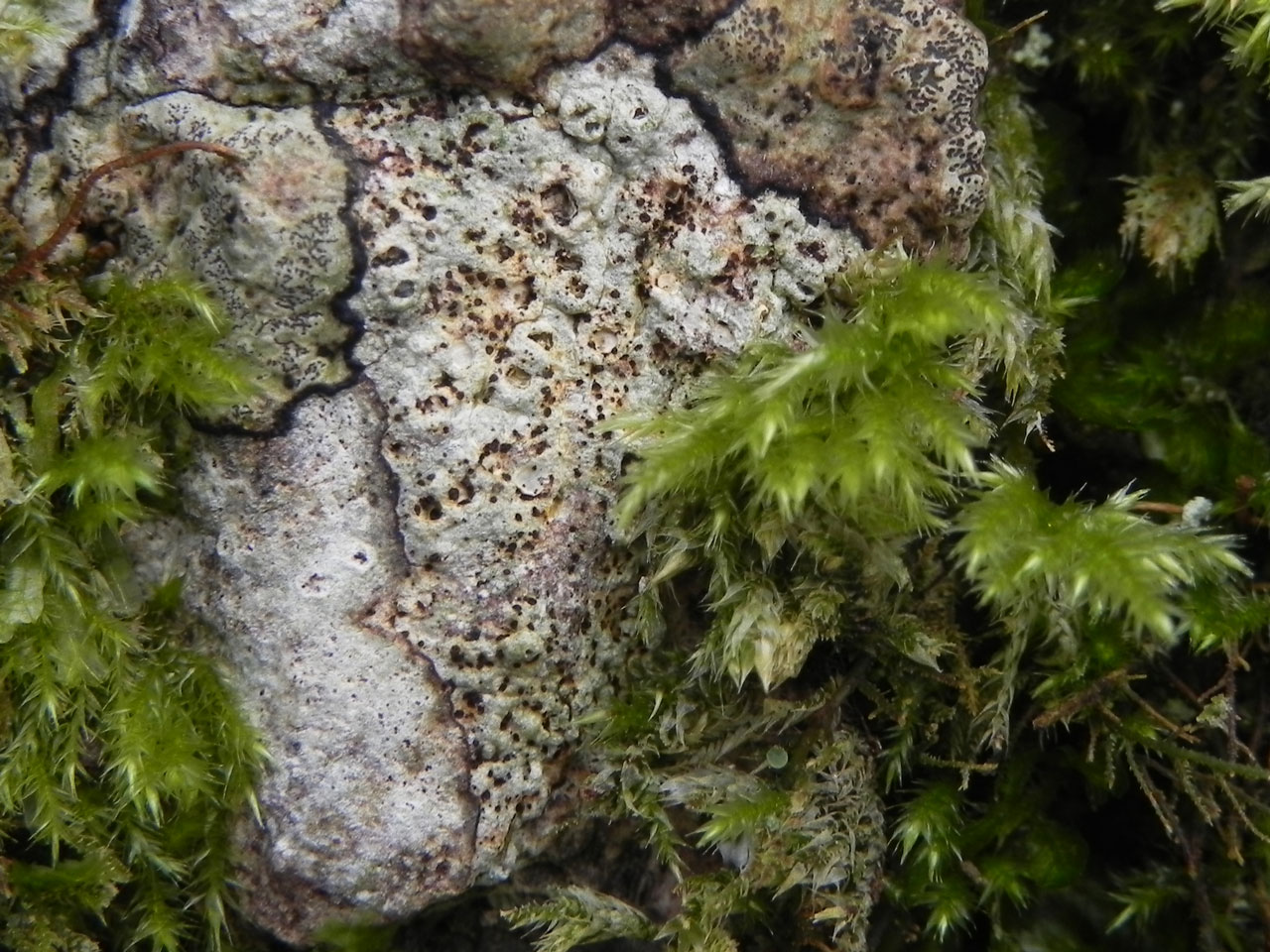
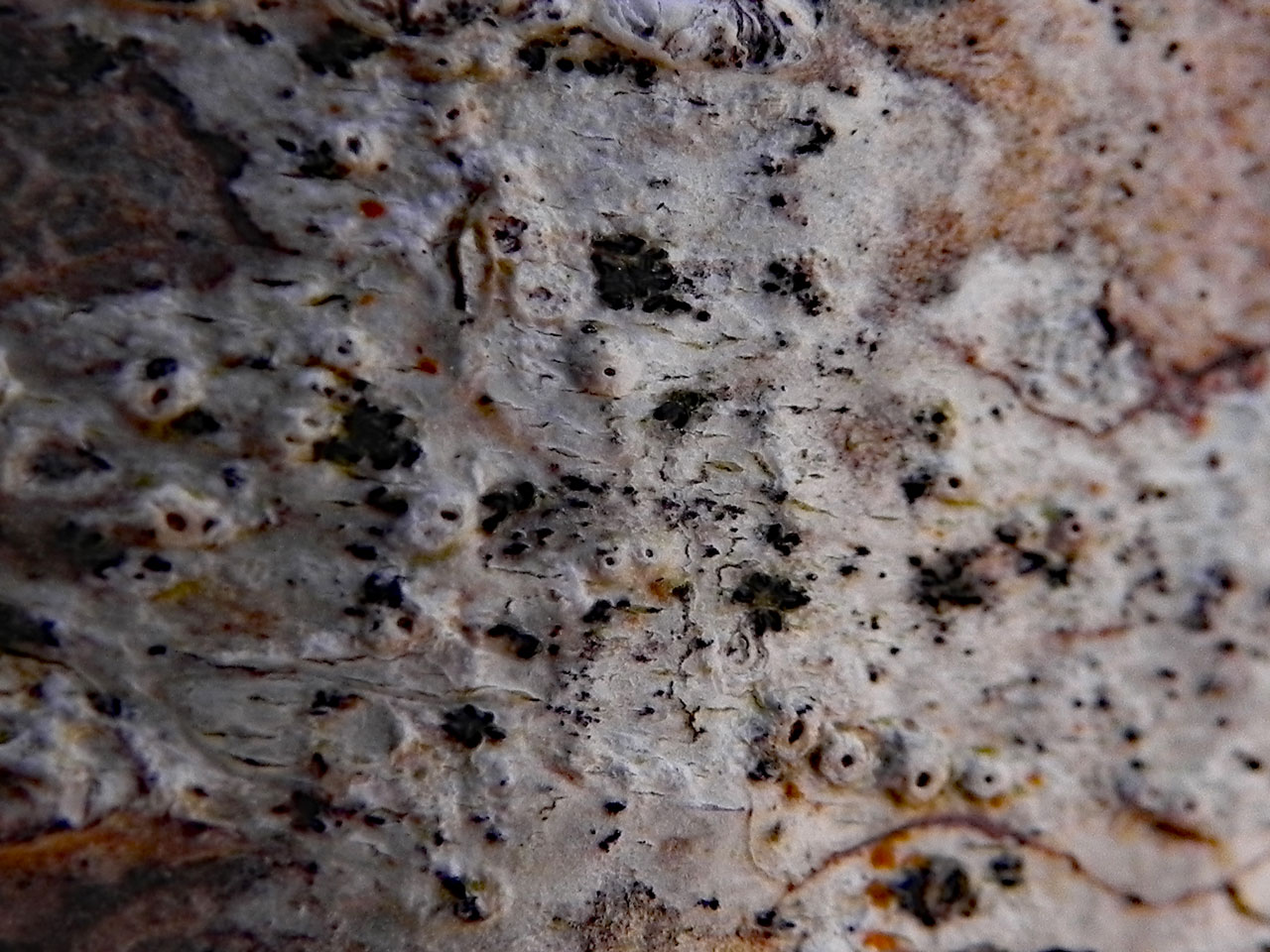
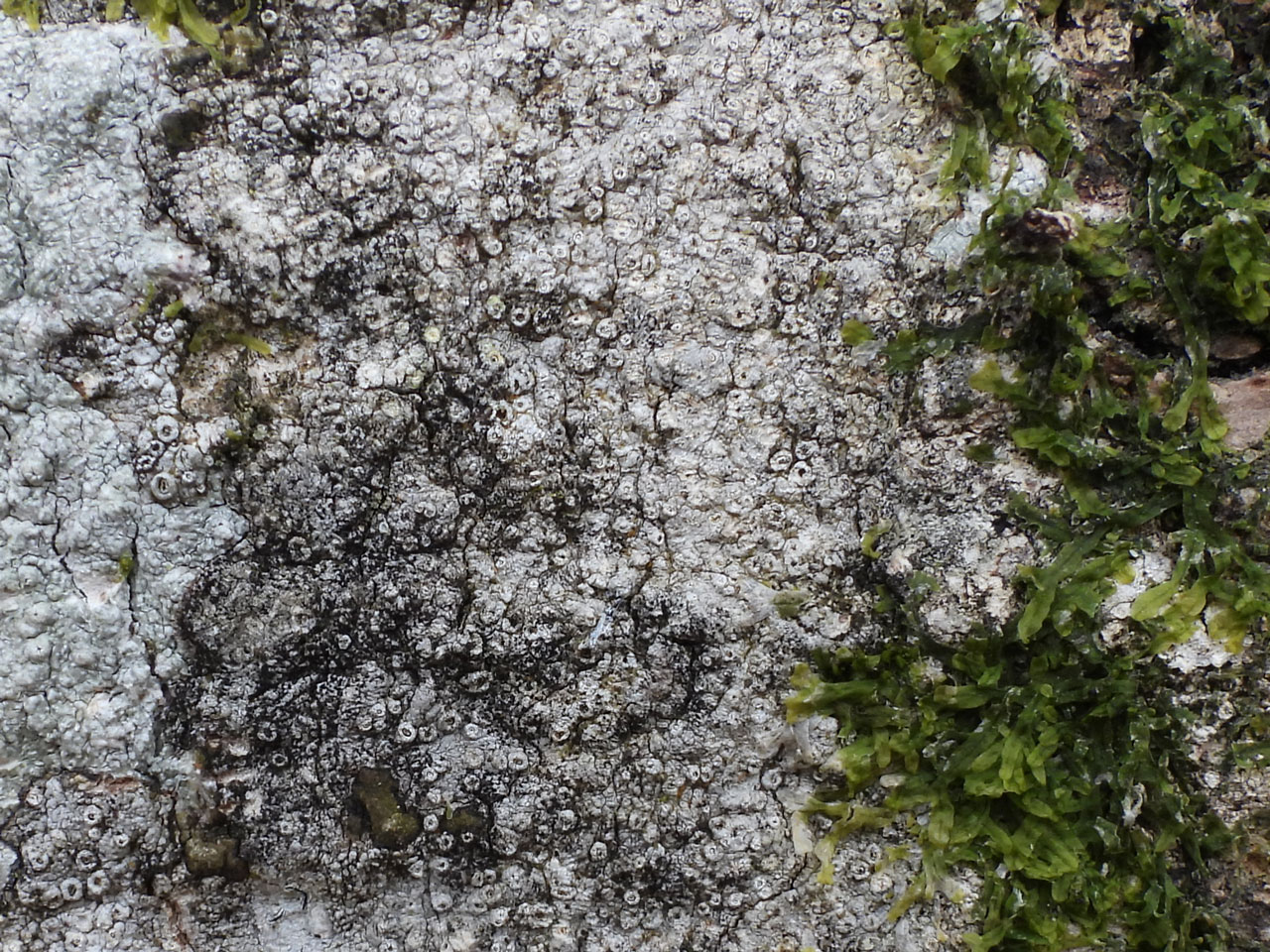
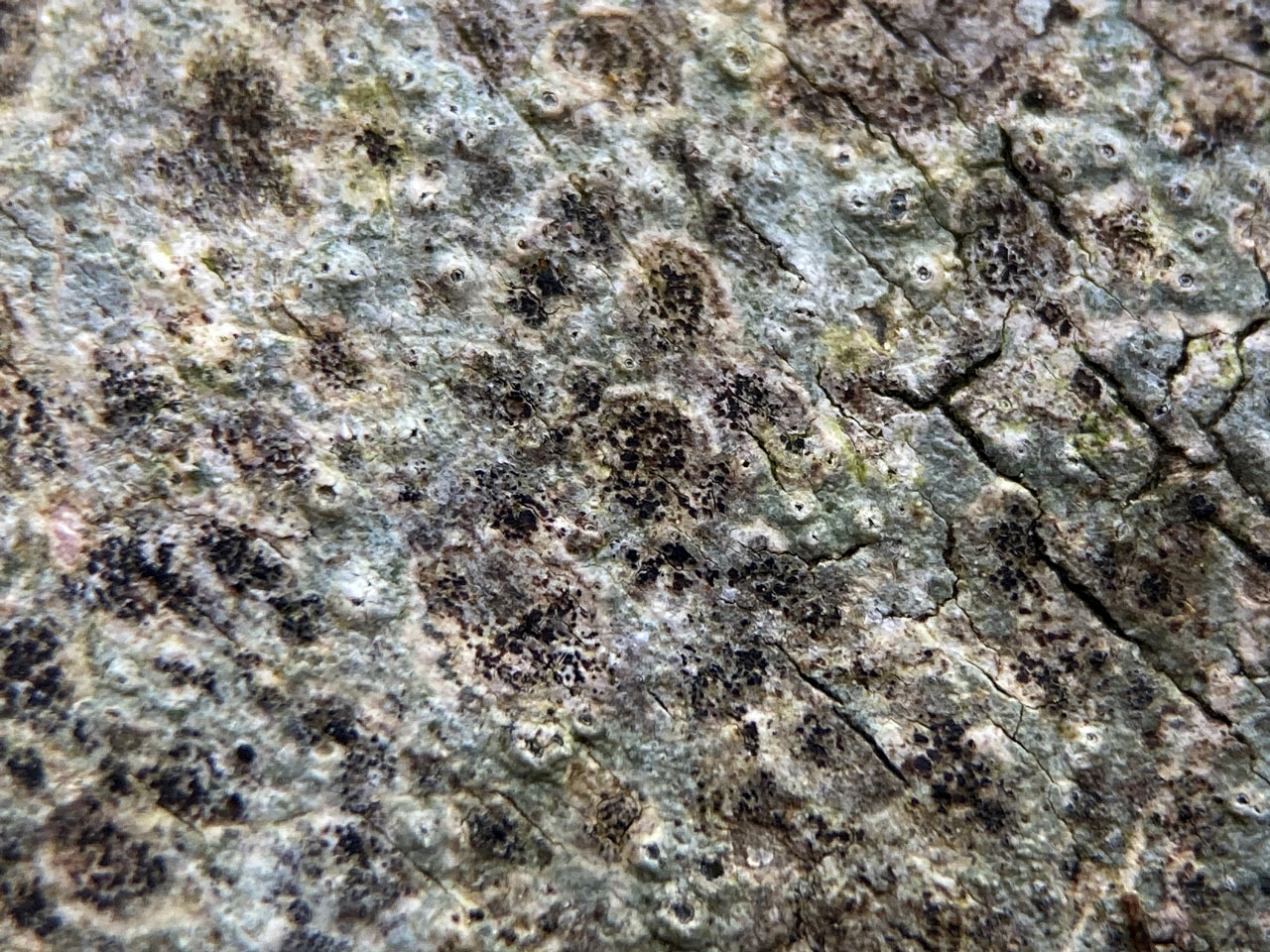
A distinctive lichen of acid to mesic bark in sheltered woodlands, with the apothecia contained within barnacle like warts. It can become locally very abundant in long undisturbed woods, but also colonises into woods recovering from disturbance. When frequent it is a good sign that other rarer woodland species may also be present. Morphs with yellow pigment in their medullas have been named Thelotrema lueckingii. In temperate rainforests the similar Thelotrema macrosporum also occurs, but this has a grey-green thallus and with apothecia with a narrower opening and if examined carefully in the field (x20 lens) the huge dark spores can often be spotted when expelled onto the thallus surface, looking like tiny mouse droppings.
Thallus thin to thick (to 2 mm in thickness), smooth, ± uneven, usually continuous, greyish fawn to pale ochraceous, mainly superficial, medulla in section with numerous crystals (calcium oxalate) which are particularly well-developed in the thalline margin of the ascomata. Apothecia numerous, discrete, ± evenly dispersed, (0.6–) 1–2 mm diam., immersed in hemispherical warts, urceolate, ostiolar opening to 0.5 mm diam., white; thalline margin entire; true exciple free, ± conspicuous when viewed through the ostiole, colourless, not striate; disc blackish, often ± white-grey pruinose, normally visible through an irregular hole in the true exciple; hymenium (120–) 140–190 (–200) µm tall. Asci (1-) 2- to 4- (to 8-) spored. Ascospores broadly fusiform, (30–) 60–135 (–150) × (10–) 15–25 (–33) µm, remaining colourless when mature, with (8–) 10–15 (–19) transverse and 1–3 (–5) longitudinal septa, I± weakly purple, with a thick gelatinous coating. Thallus and medulla C–, K–, KC–, Pd–, UV– (lichen products not detected by TLC but sometimes with internal crystals K+
yellow changing to red).
The shape of the apothecia is very variable; in dry situations on smooth bark of deciduous trees they are regularly volcano-like, smooth with a narrow opening; in moist, often shaded, sites the apothecia are larger and become more open and ulcerose with a thick, prominent, somewhat scurfy rim. Yellow pigment is frequent in the medulla, especially below the ascomata; these have recently been separated as Thelotrema lueckingii, but this split needs to be tested with gene sequencing.
Could be confused with the rarer Thelotrema macrosporum in temperate rainforest habitats, this has a grey-green thallus and with apothecia with a narrower opening. Also, if examined carefully in the field (x20 lens) the huge dark spores can often be seen expelled on to the thallus surface, looking like tiny mouse droppings.
On smooth and sometimes rougher bark of deciduous trees, rarely on siliceous rocks. Can be abundant in a variety of woodland epiphyic communites including on acid bark and also in several different Graphidion communities. General absent from flushed base rich bark (Lobarion).
Considered to be an indicator species of ancient woodland sites and can reach densities of over 400 occupied trees per ha in long-undisturbed sites. In areas where it is already frequent it can colonise well into recovering disturbed stands. An example in the New Forest, where Sanderson (2001) found it on 288 and 420 trees per ha in two old growth stands and 15 – 202 trees per ha in three 19th century Oak plantations. The highest densities are found old growth woods with strong shrub layers. However, in areas where disturbance was widespread it can become rare or be lost all together. For example, where extensive coppicing was carried out, even with pasture woodlands, eliminating shrub layers, even if old trees survive well. This can be seen in east Wales, where Thelotrema lepadinum may be absent from some valleys but frequent in near nearby ones (R. Woods, pers. com.).
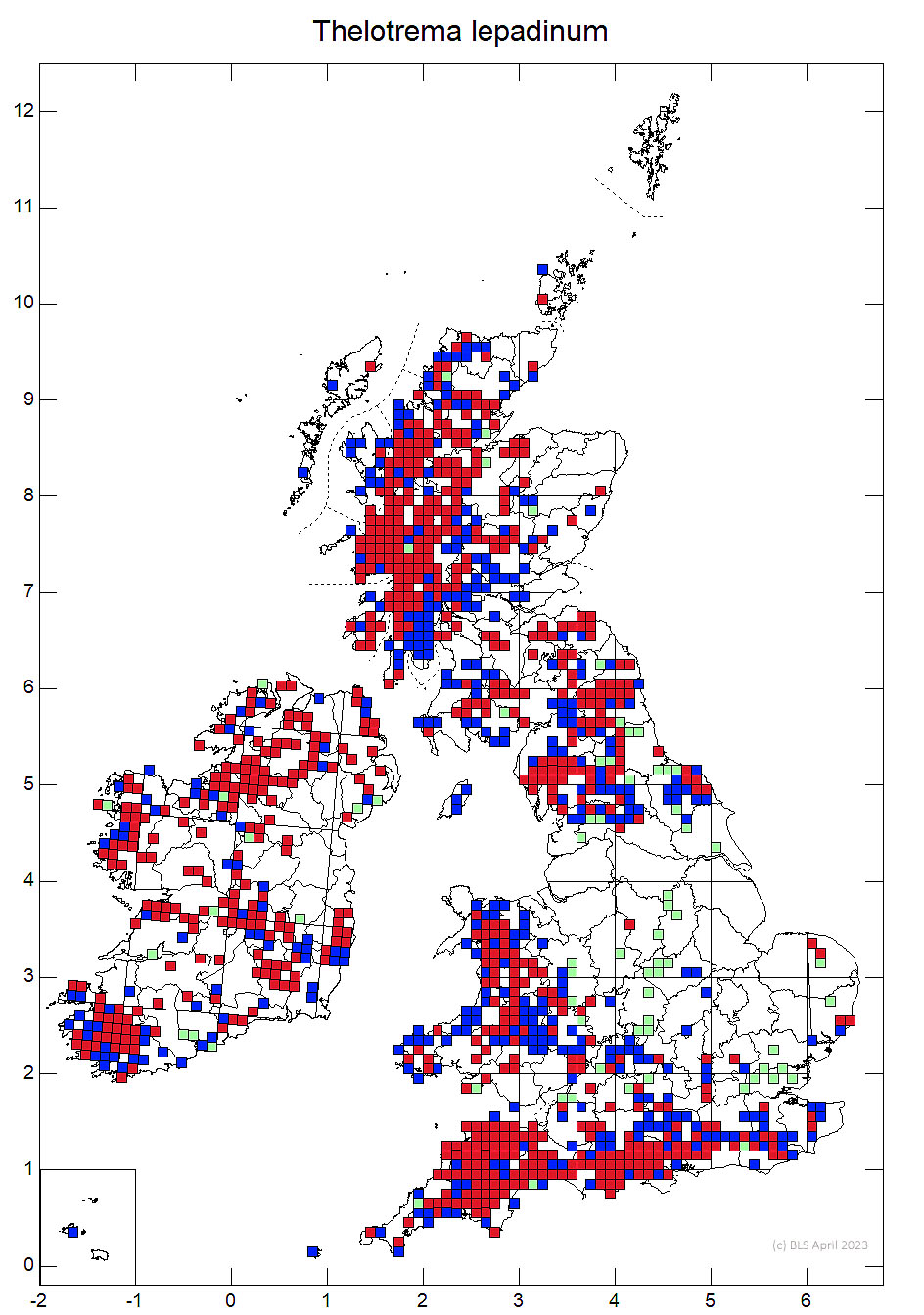

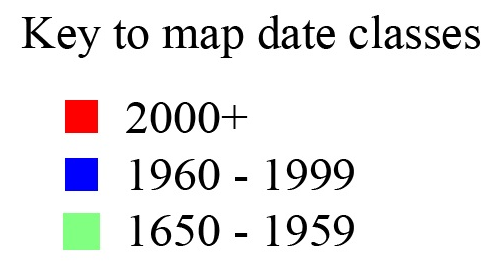
Scattered in suitable habitats throughout Britain and Ireland, locally abundant to the west. Absent only from polluted areas and largely deforested areas such as north east Scotland.
Aptroot, A., Weerakoon, G., Cannon, P., Coppins, B., Sanderson, N. & Simkin, J. (2023). Ostropales: Graphidaceae, including the genera Allographa, Clandestinotrema, Crutarndina, Diploschistes, Fissurina, Graphis, Leucodecton, Phaeographis, Schizotrema, Thelotrema and Topeliopsis. Revisions of British and Irish Lichens 36: 1-23.
Sanderson, N. A. (2001) Epiphytic Lichen Monitoring in the New Forest 2000. LIFE Job L33A2U. Lyndhurst: Forest Enterprise.
Text by Neil A. Sanderson based on Aptroot et al (2019)