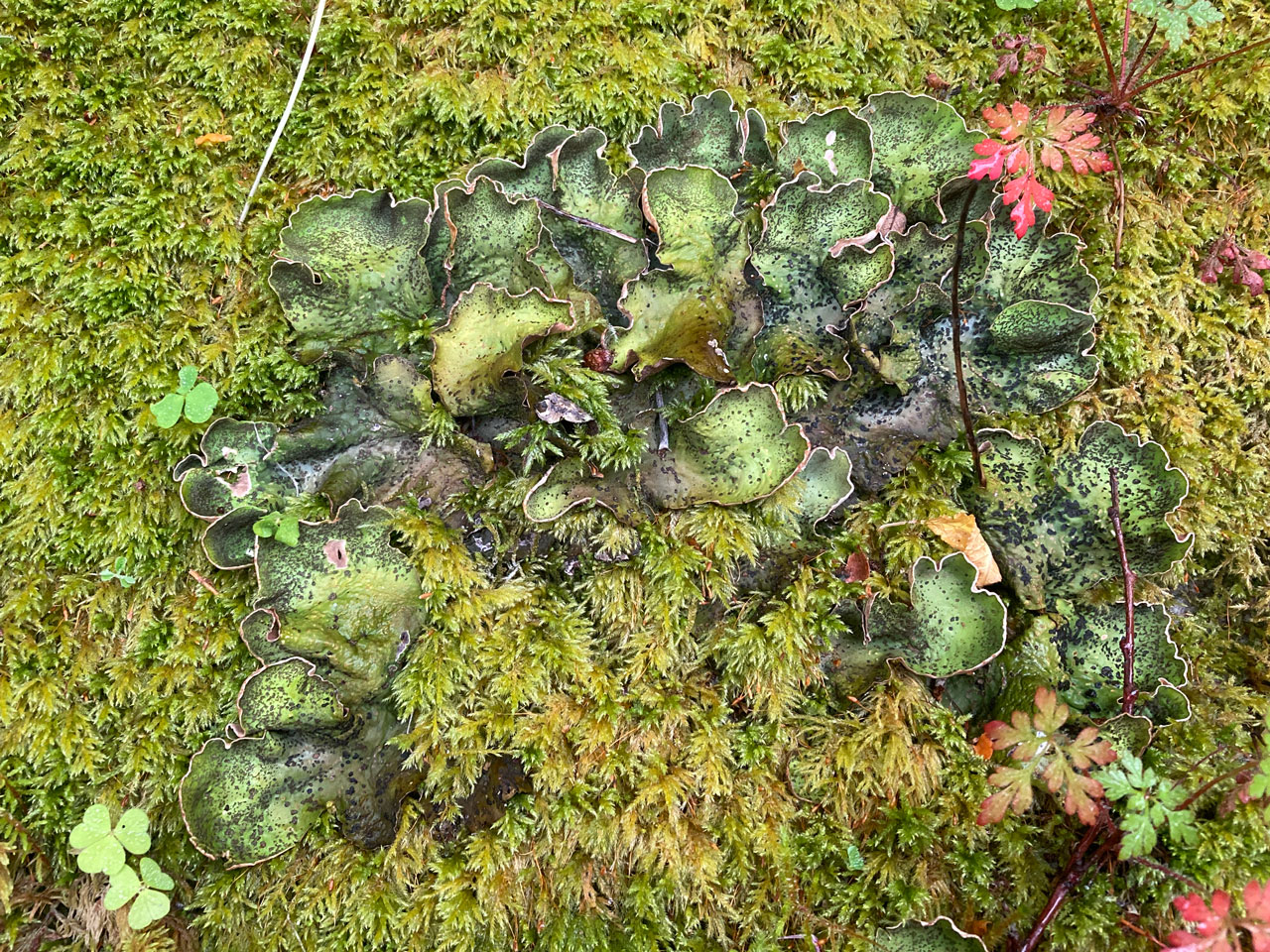
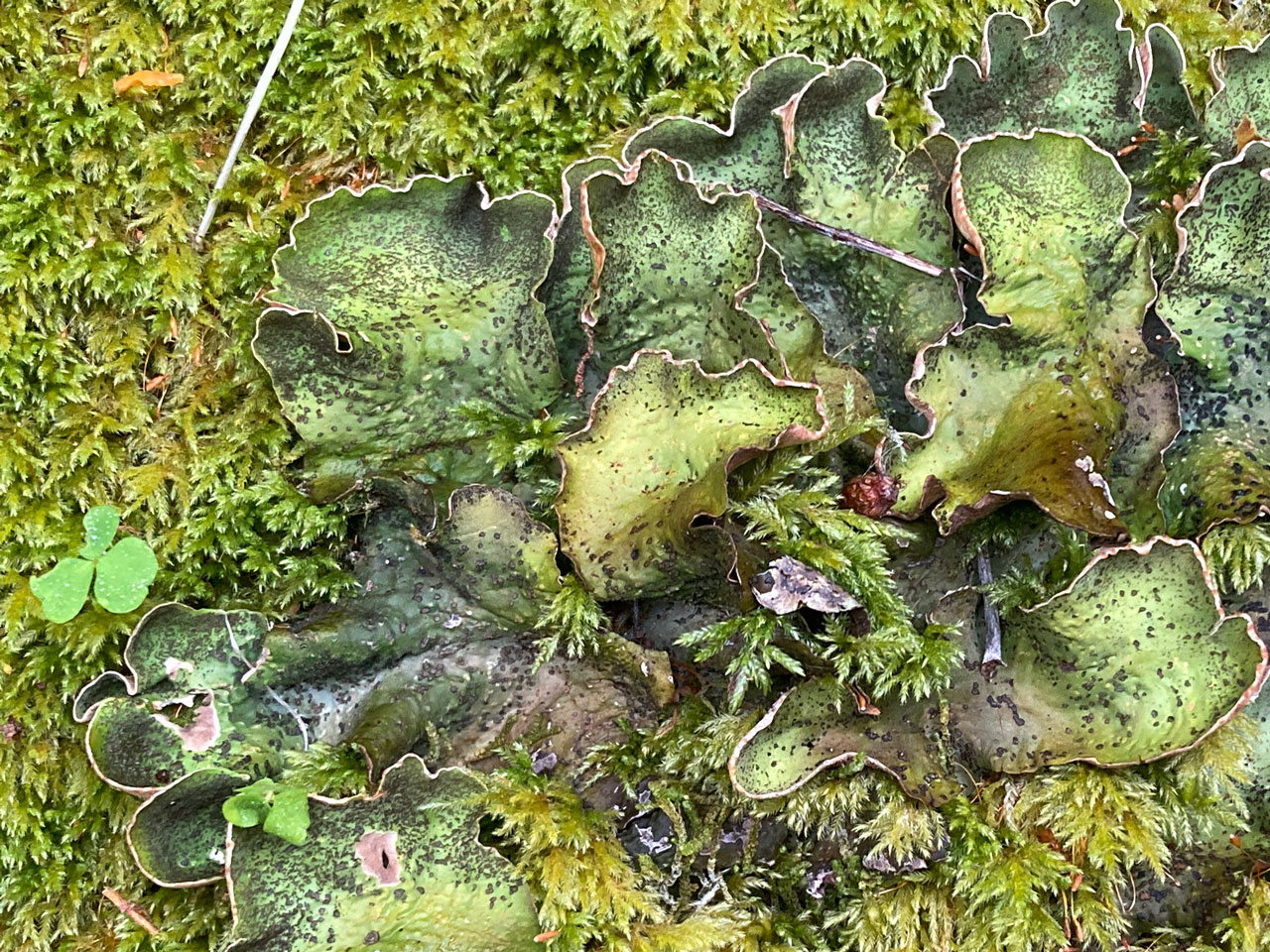
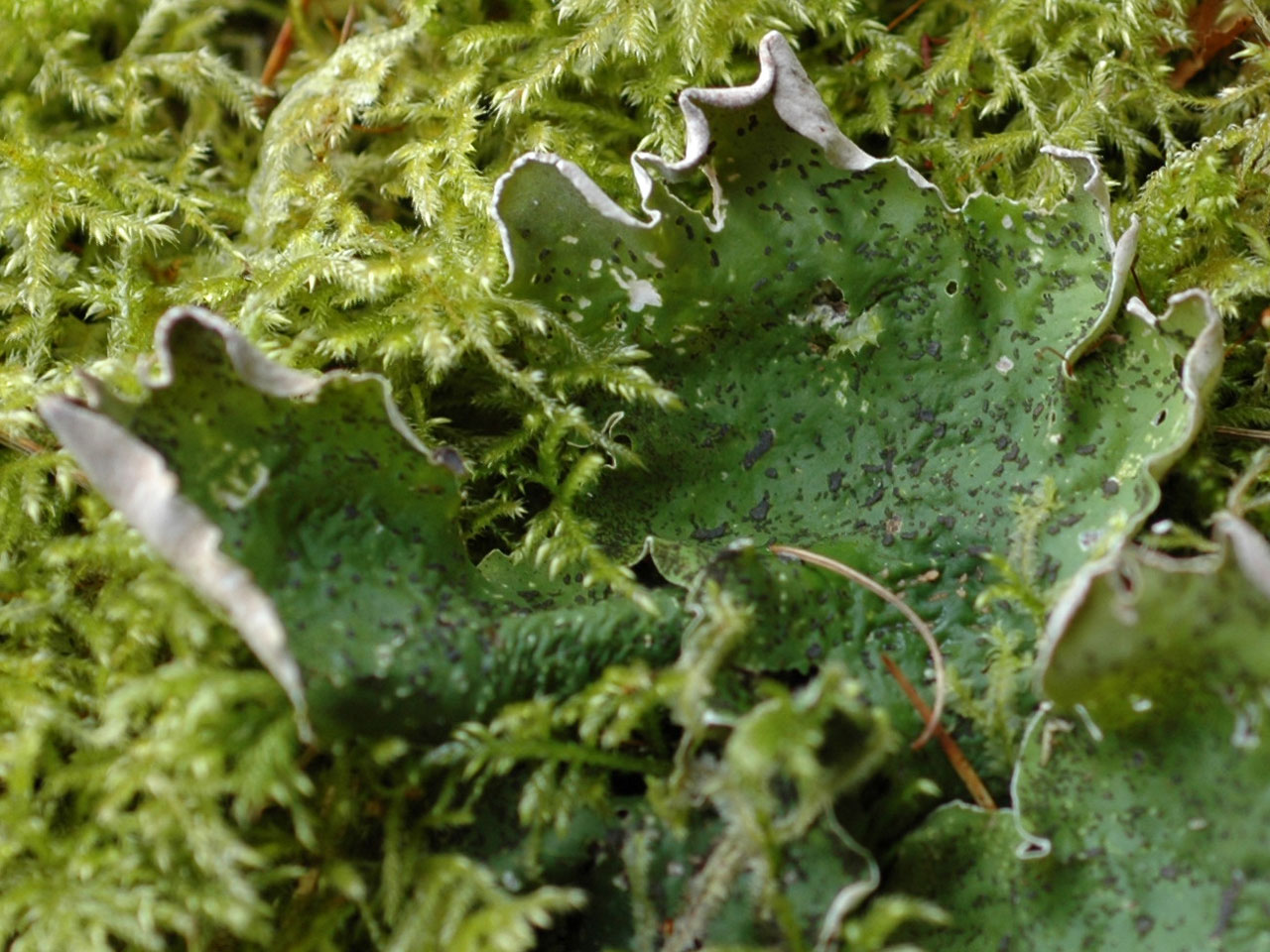
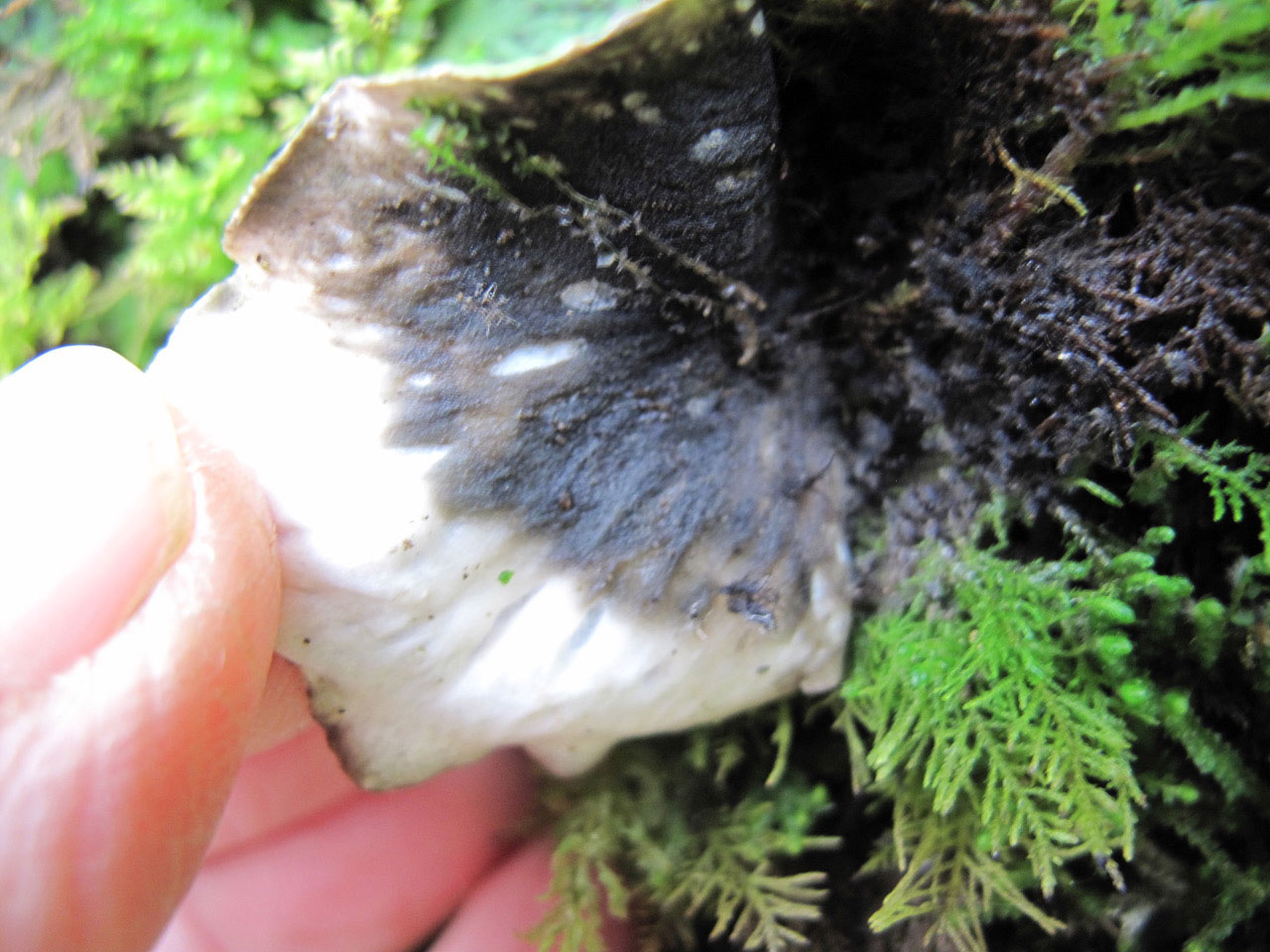
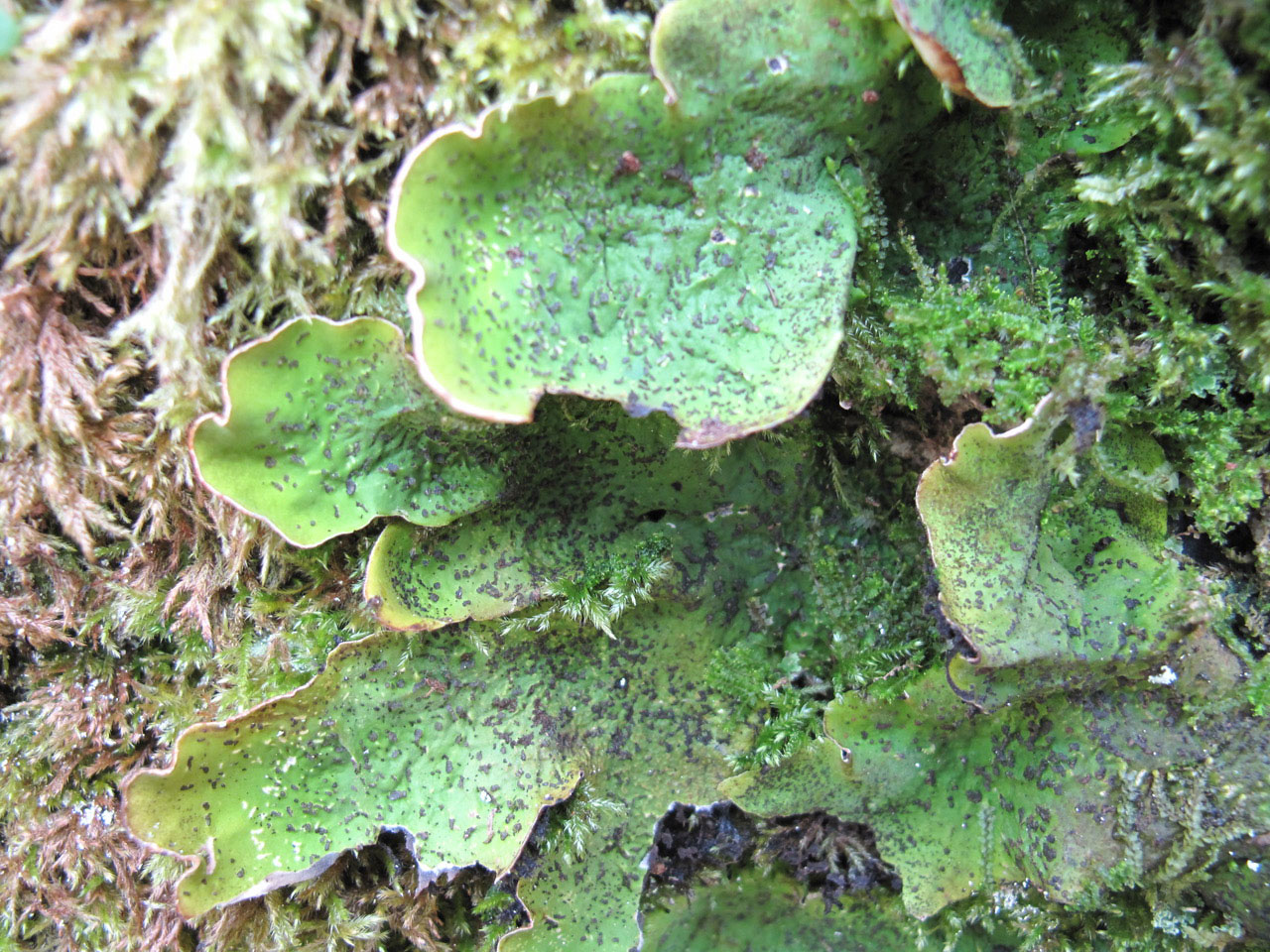
A beautiful Dogtooth, the Pictish Dogtooth, which is green when wet, like Peltigera leucophlebia, due to the green photobiont. The top surface is speckled with black cephalodia with Nostoc, which differ in shape from those of P. leucophlebia and are easily detached leaving white scars and also lacks distinct veins on the lower side. Found on bark or mossy rocks and walls in damp, sheltered habitats, often in woods, but avoiding calcareous sites. An oceanic species on a European scale but most frequent in the central and eastern Highlands in Britain but rare beyond.
Green when wet, like Peltigera leucophlebia, photobiont green (Coccomyxa), but the cephalodia (with Nostoc) on the upper surface are concave, button or saucer-shaped with free entire or somewhat crenulate edges, rarely proliferating margins and are easily detached leaving white scars; the lower surface usually undifferentiated or with indistinct veins; rhizines often few, in scattered groups, bottlebrush-like. Apothecia not seen in European material. Thallus with tenuiorin, methyl gyrophorate, ± gyrophoric acid (C± red), phlebic acid A and B, T2 and T5.
The more continental Peltigera aphthosa (L.) Willd. (1787), incorrectly recorded from Britain, has cephalodia which are appressed, convex, somewhat corrugate and not readily detached from the surface, the lower surface is blackened towards the centre, woolly but without rhizines and, unlike P. leucophlebia, the apothecia are uniformly corticate on the underside. The relationship between P. aphthosa and P. britannica is in need of further investigation; according to Miądlikowska et al. (2018) P. britannica nests within a paraphyletic P. aphthosa.
A blue-green morphotype has been recorded rarely in the Scottish Highlands which develops from the cephalodia and may become independent. The specimens are up to 3 cm across, have crenate or dentate margins with erect hairs; the upper surface is blue-grey with a characteristic network of pale interconnected spots, the underside is blackened, densely felted with scattered bundles of simple rhizines; secondary attached lobules of the green morphotype are usually present.
On bark or mossy rocks and walls in damp, sheltered habitats, often in woods but avoiding calcareous sites.
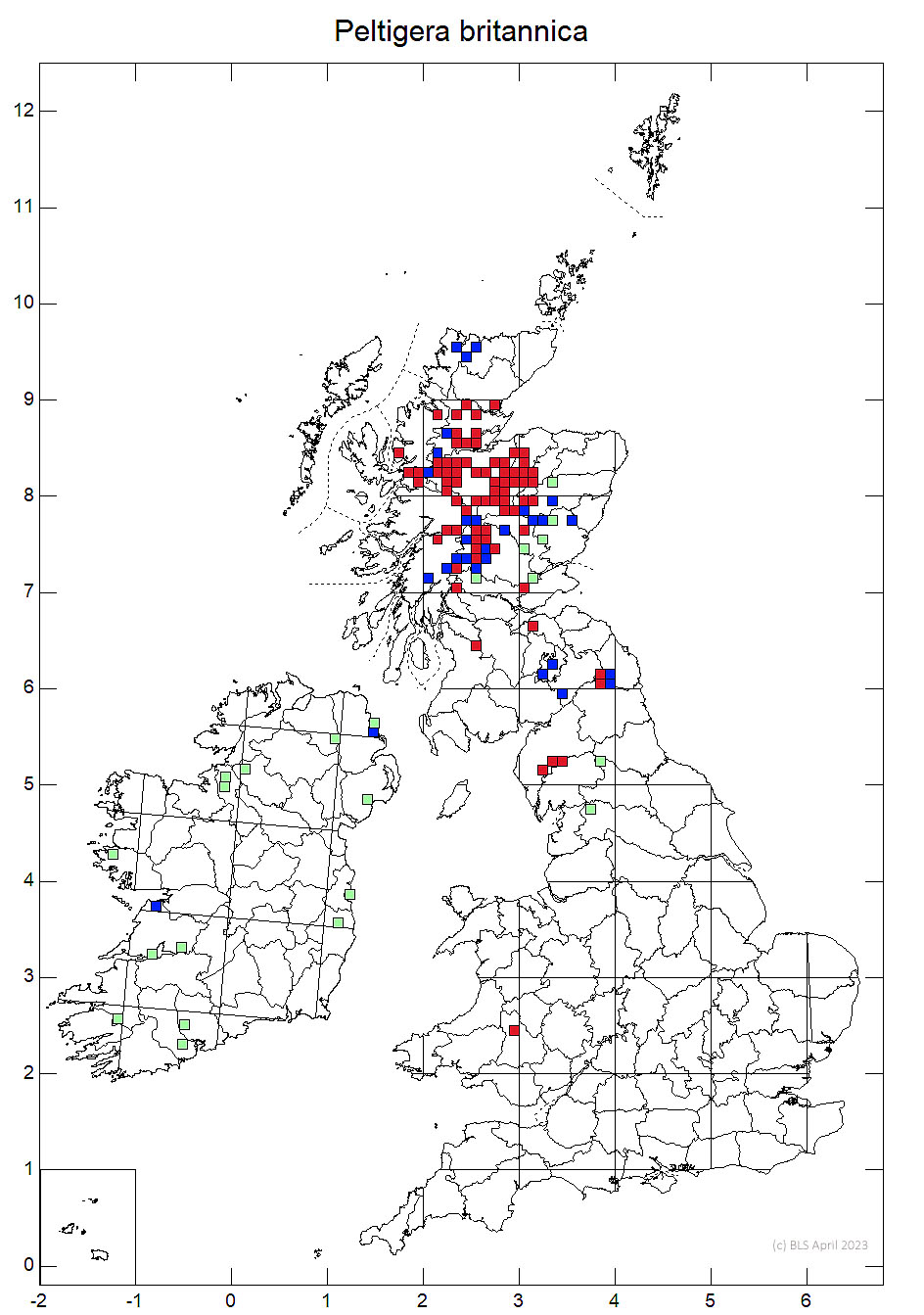


Rare, N. England, Wales (Brecon, Anglesey), and southern Scotland, local but widespread in the eastern and central Highlands. No recent records for Ireland.
An oceanic species with the central and eastern Highlands supporting an internationally significant European population, but rather rare beyond and very rare in Ireland.
Britain: Notable species & International Responsibility species
Scotland: Priority Taxon for Biodiversity in Scotland
Wales: Near Threatened
Cannon, P., Magain, N., Sérusiaux, E., Yahr, R., Coppins, B., Sanderson, N. & Simkin, J. (2021). Peltigerales: Peltigeraceae, including the genera Crocodia, Lobaria, Lobarina, Nephroma, Peltigera, Pseudocyphellaria, Ricasolia, Solorina and Sticta. Revisions of British and Irish Lichens 20: 1-34.
Text by Neil A Sanderson based on Cannon et al (2021)