Micarea isidioprasina
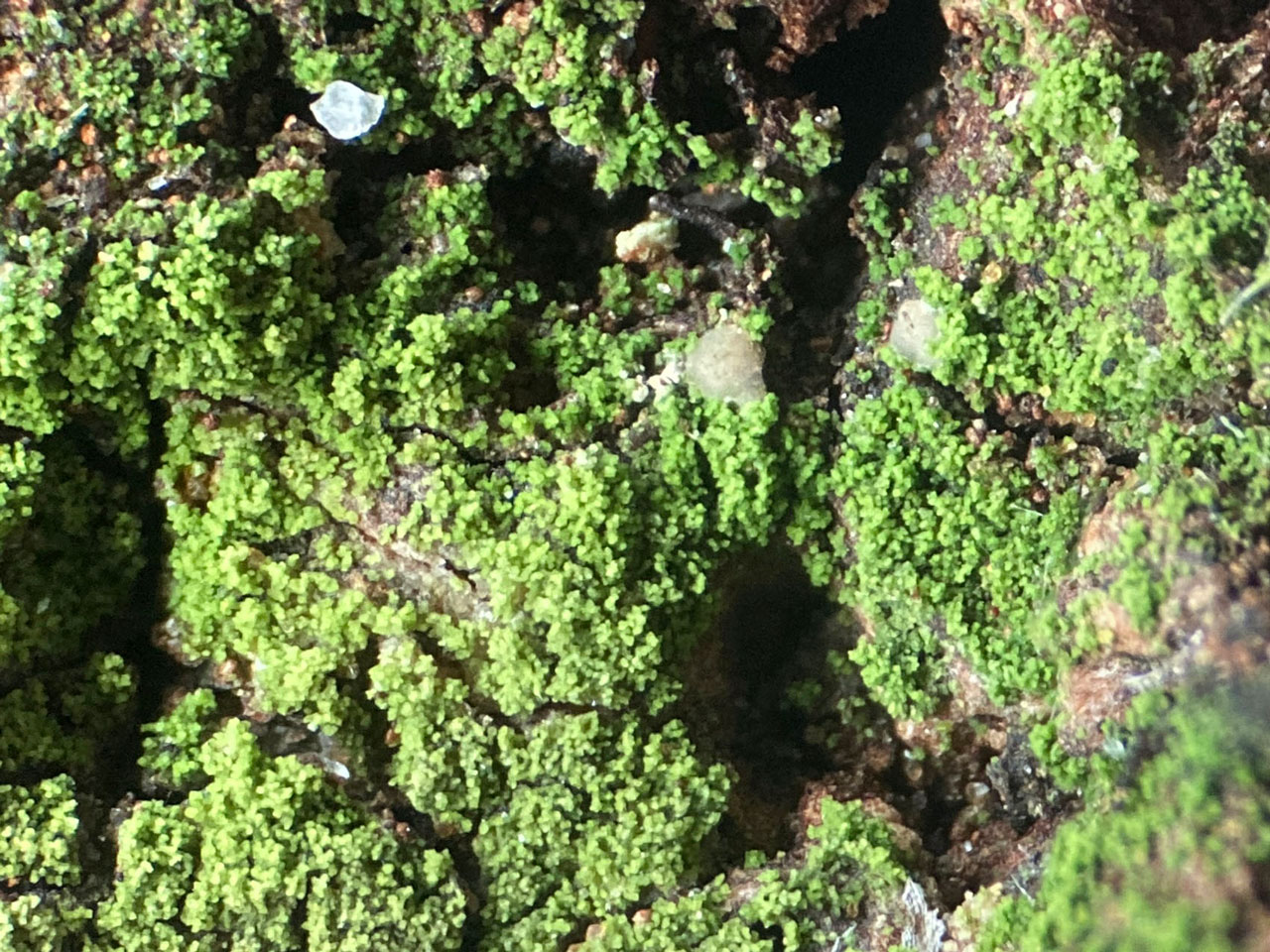
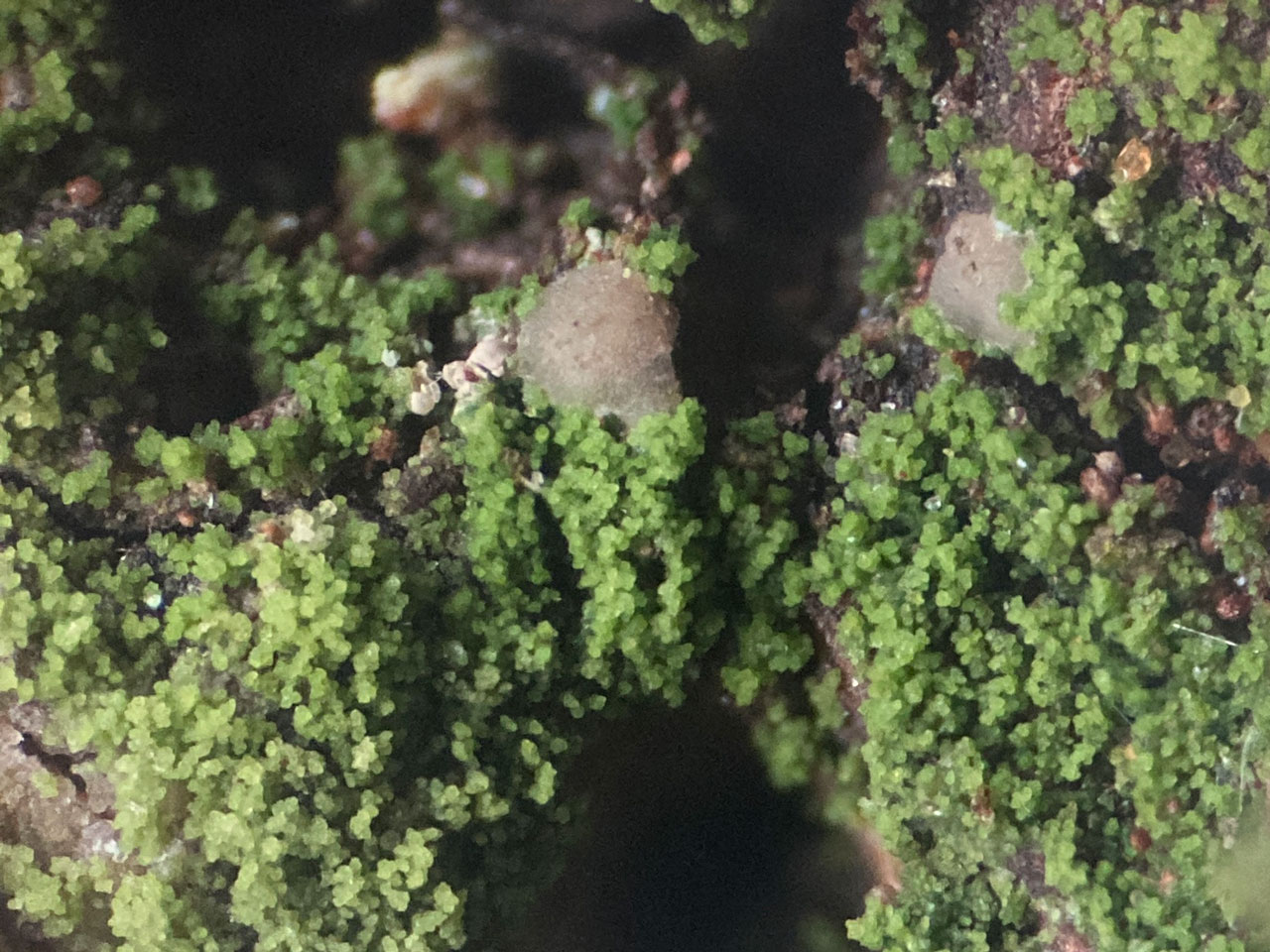
Crusts of isidiate Micarea prasina s. lat. taxa are a feature of acid bark and dead wood in old woodland, but their identity has long been obscure. Guzow-Krzemińska et al (2019) separated four species, of which three are now known in Britain. They are possible to separate when fertile, but unfortunately most thalli are sterile, in which case the species can only be reliable separated by sequencing. Micarea isidioprasina appears to be infrequently fertile, so establishing its range and ecology will not be easy. To date, sequenced and fertile specimens indicate that it may occur more widely on lignum but that it does also occur on acid bark. Found widely in the south in both old growth stands and in more disturbed woodlands.
Thallus crustose, granular-isidiate, indeterminate, ± immersed in non-isidiate parts and then as a thin greenish film over the substrate or minutely areolate, isidiate; prothallus not seen; areoles to 50 µm diam., green, soon developing isidia; isidia abundantly branched and coralloid, crowded and forming an almost continuous layer locally in older parts of the substrate, green to olive green (Sedifolia-grey, K+ violet), to 250 μm tall and 25 μm diam., with a distinct and complete hyphal layer. Photobiont cells 4–7 µm diam. Apothecia rarely developed, white to beige, some patchily grey, to 0.45 mm diam., convex; exciple poorly developed, as a narrow colourless zone of radiating hyphae; hymenium to 50 μm tall, colourless; epithecium and hypothecium colourless; paraphyses of one type, 1–1.5 μm diam., sparse, mostly apically branched and anastomosed, colourless throughout. Asci cylindric-clavate, 30–45 × 12–15 μm. Ascospores 0- to 1-septate, ovoid, ellipsoidal or cylindrical, 11–14 × 3.5–4.5 μm. Pycnidia not seen. Crystalline granules (studied in polarised light) present rather sparsely in the hymenium as strands between asci and paraphyses, and abundantly in isidia, soluble in K. Chemistry: micareic acid (TLC).
Distinctive for the production of isidia, and can be separated from the other isidiate Micarea species M. aeruginoprasina and M. atroviridis when fertile. M. aeruginoprasina has darker apothecia and with Sedifolia-grey frequent in the hymenium and or hypothecium, while those of M. atroviridis are even darker and have Cinereorufa-green as a conspicuous green apothecial pigment. Usually sterile, however, in which case M. atroviridis can be separated by the presence of methoxymicareic acid (TLC) but M. aeruginoprasina requires sequencing as it also contains micareic acid. The isidia of M. isidioprasina are often a brighter green than the other two isidiate Micarea species, but this is unlikely to be a reliable method of separating sterile thalli. M. prasina (s. str.) also contains micareic acid, but is not isidiate, often richly fertile and its thallus consists of goniocysts rather than isidia.
Originally confirmed on bark of Birch, Merioneth and on old Oak stump, Staffordshire. Subsequent records of fertile material have mainly been recorded from lignum on dead wood in woodlands but it has also recorded from acid Oak bark. Found in old growth stands but also in more disturbed sites than are typical of M. aeruginoprasina and M. atroviridis.
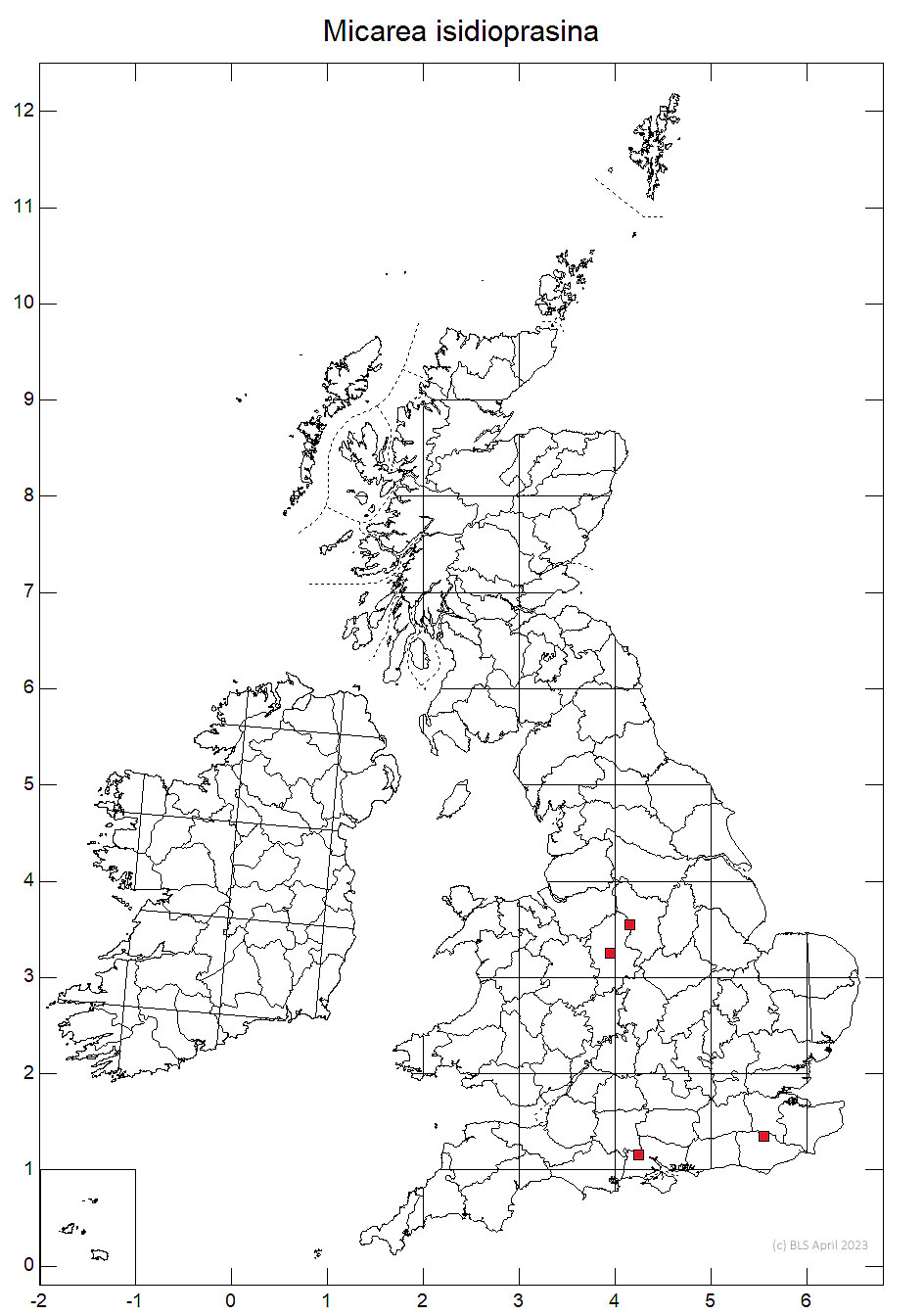


Originally confirmed Merioneth and Staffordshire, but with subsequent records from the south Britain. Known from various European countries on rotting wood and acidic bark in old-growth forests.
Not assesesed, not likely to be Threatened, but likley to be a Notable species.
Cannon, P., Orange, A., Aptroot, A., Sanderson, N., Coppins, B. & Simkin, J. (2022). Lecanorales: Pilocarpaceae, including the genera Aquacidia, Byssoloma, Fellhanera, Fellhaneropsis, Leimonis and Micarea. Revisions of British and Irish Lichens 27: 1-48.
Guzow-Krzemińska, B., Sérusiaux, E., van den Boom, P.P.G., Brand, A.M., Launis, A., Łubek, A. & Kukwa, M. (2019). Understanding the evolution of phenotypical characters in the Micarea prasina group (Pilocarpaceae) and descriptions of six new species within the group. Mycokeys 57: 1–30.
Text by Neil A Sanderson based on Canon et al (2022)