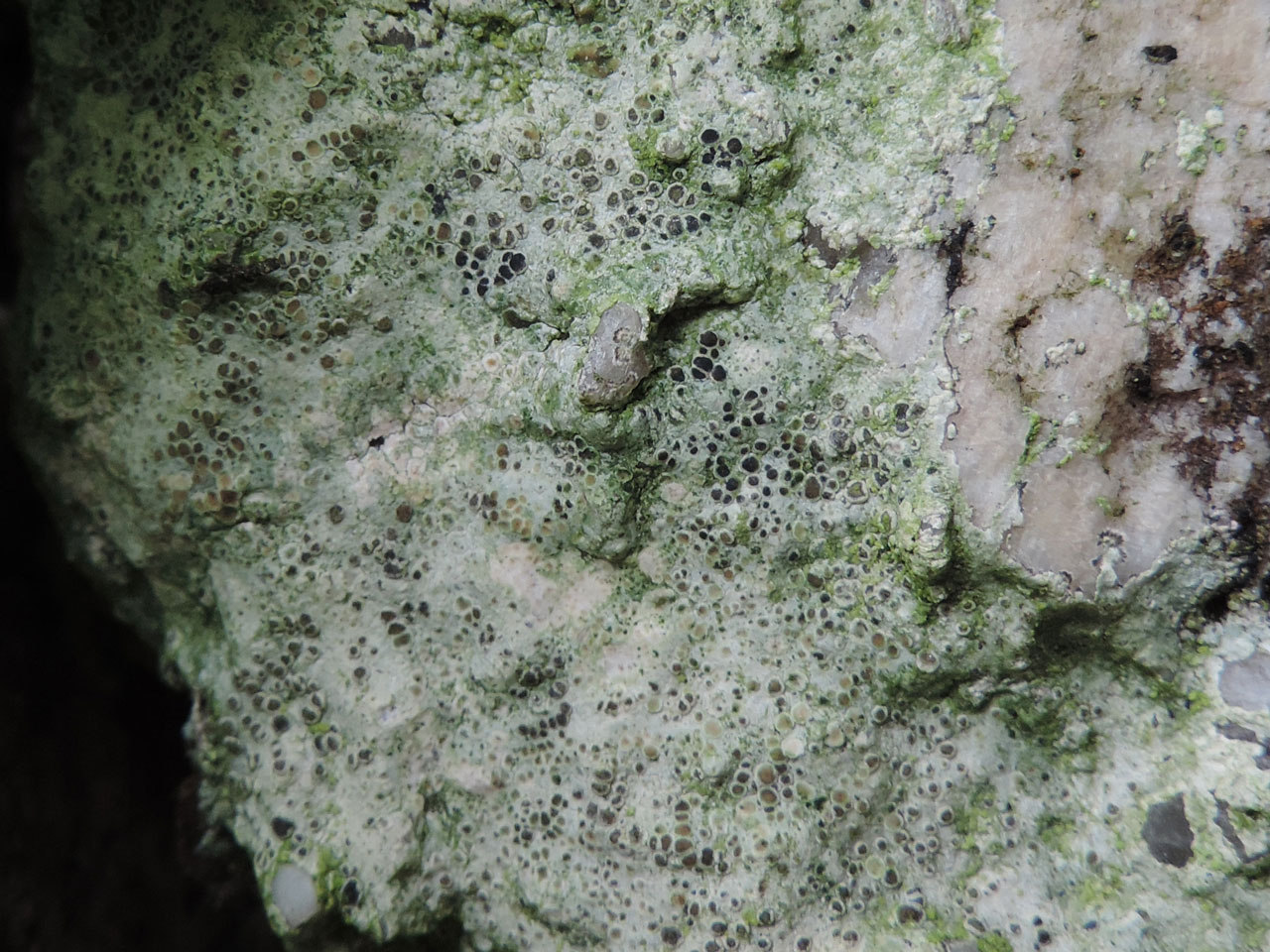
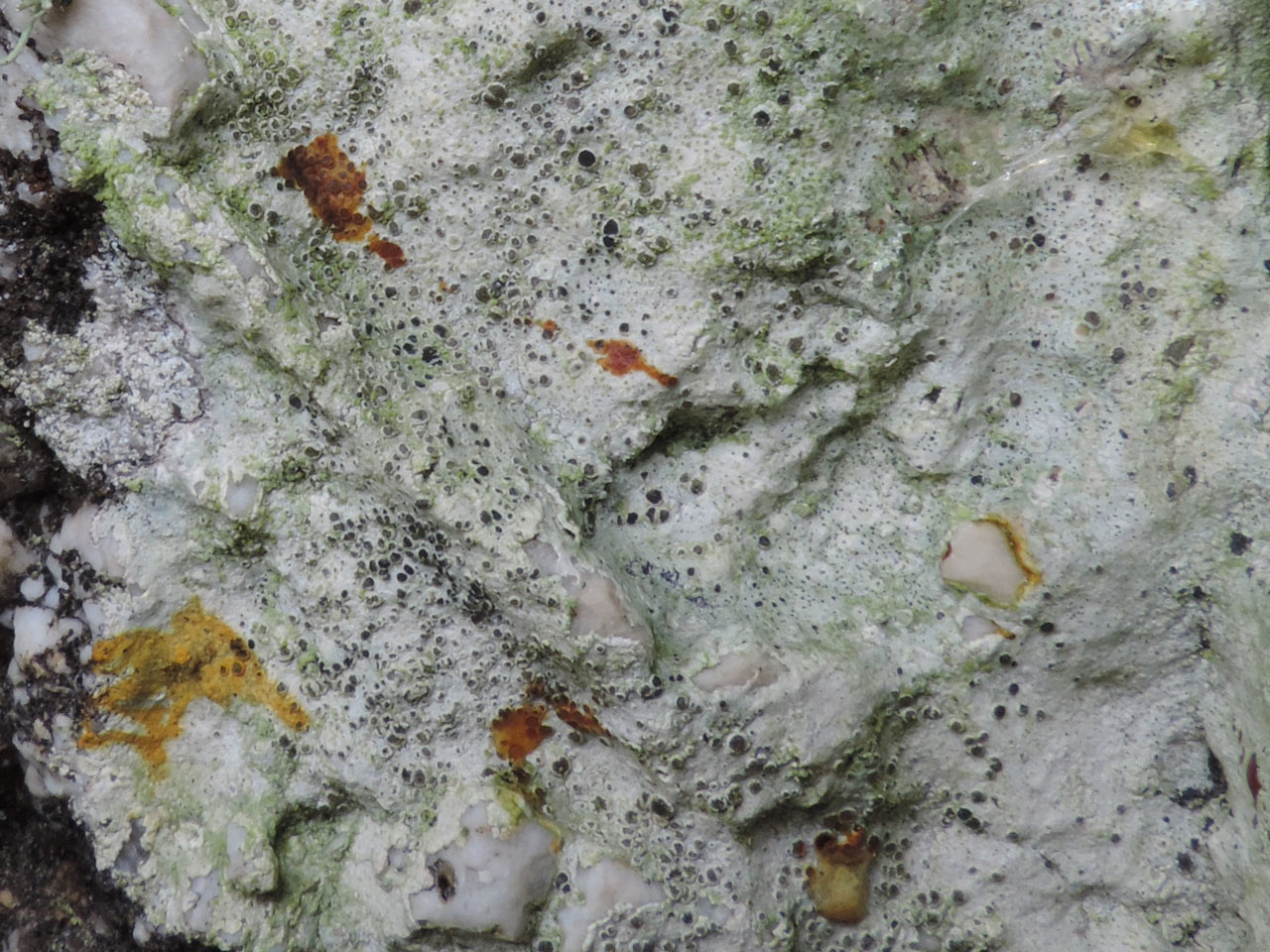
A distinctive member of the L. subfusca group, easily recognised by its occurrence on coastal siliceous rocks and the K+ yellow→red reaction. A rather local species, mainly found in the south west.
Thallus rimose, often uneven, effuse, areoles convex and often raised in clusters, white to yellow-white; prothallus zoned white and blue. Apothecia (0.3–) 0.5–1.5 (–1.8) mm diam., dispersed or in small groups, sessile, somewhat constricted below; thalline margin well-developed, crenulate to crenate, persistent, green-grey or as the thallus; disc pale brown to dark brown or black, often piebald, flat to slightly convex, sometimes white-grey pruinose; epithecium colourless or olivaceous, ± interspersed with granules, K+ red (with abundant red needle-like crystals); hymenium 70–90 µm tall; paraphyses 1.5–2 µm diam., unbranched or sparsely branched, anastomosed below, apices 2–3 µm diam., slightly swollen. Asci 50–65 × 16–18 µm, elongate-clavate. Ascospores (8–) 11–15 × (5–) 6–8 µm, ellipsoidal. Conidia 22–31 × ca 1 µm, thread-like to curved. Thallus C–, K+ yellow→red (crystals), Pd+ orange-red, UV– (atranorin, norstictic acid).
A distinctive member of the L. subfusca group, easily recognized by its ecology and K+ yellow→red reaction. See also Glaucomaria swartzii.
On ± vertical, somewhat sheltered coastal siliceous rocks.
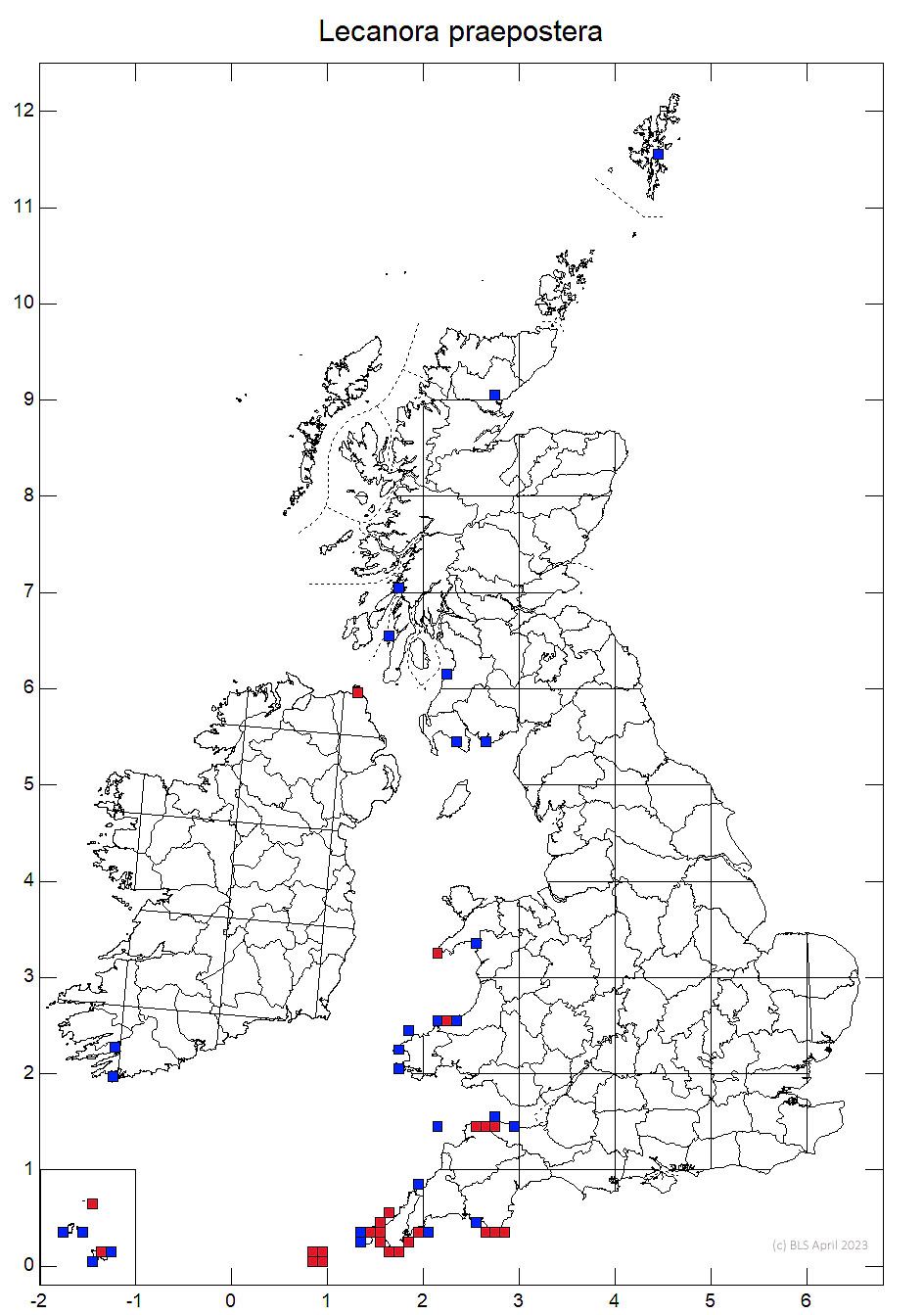

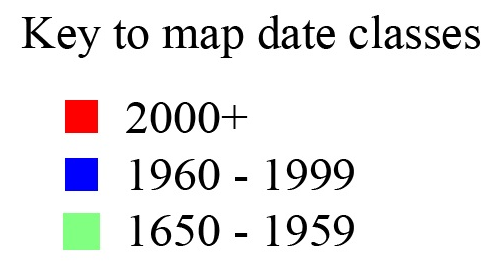
Local. S.W. England, Wales, Channel Islands, Isles of Scilly, Ireland.
A very localised coastal species, mainly found in the south west with few records beyond, may be threatened in places by vegetation overgrowth most populations are likely secure.
Britain: Notable
Cannon, P., Malíček, J., Ivanovich, C., Printzen, C., Aptroot, A., Coppins, B., Sanderson, N., Simkin, J. & Yahr, R. (2022). Lecanorales: Lecanoraceae, including the genera Ameliella, Bryonora, Carbonea, Claurouxia, Clauzadeana, Glaucomaria, Japewia, Japewiella, Lecanora, Lecidella, Miriquidica, Myriolecis, Palicella, Protoparmeliopsis, Pyrrhospora and Traponora. Revisions of British and Irish Lichens 25: 1-83.
Text by Neil A Sanderson based on Cannon et al (2022)