Lecanora cinereofusca
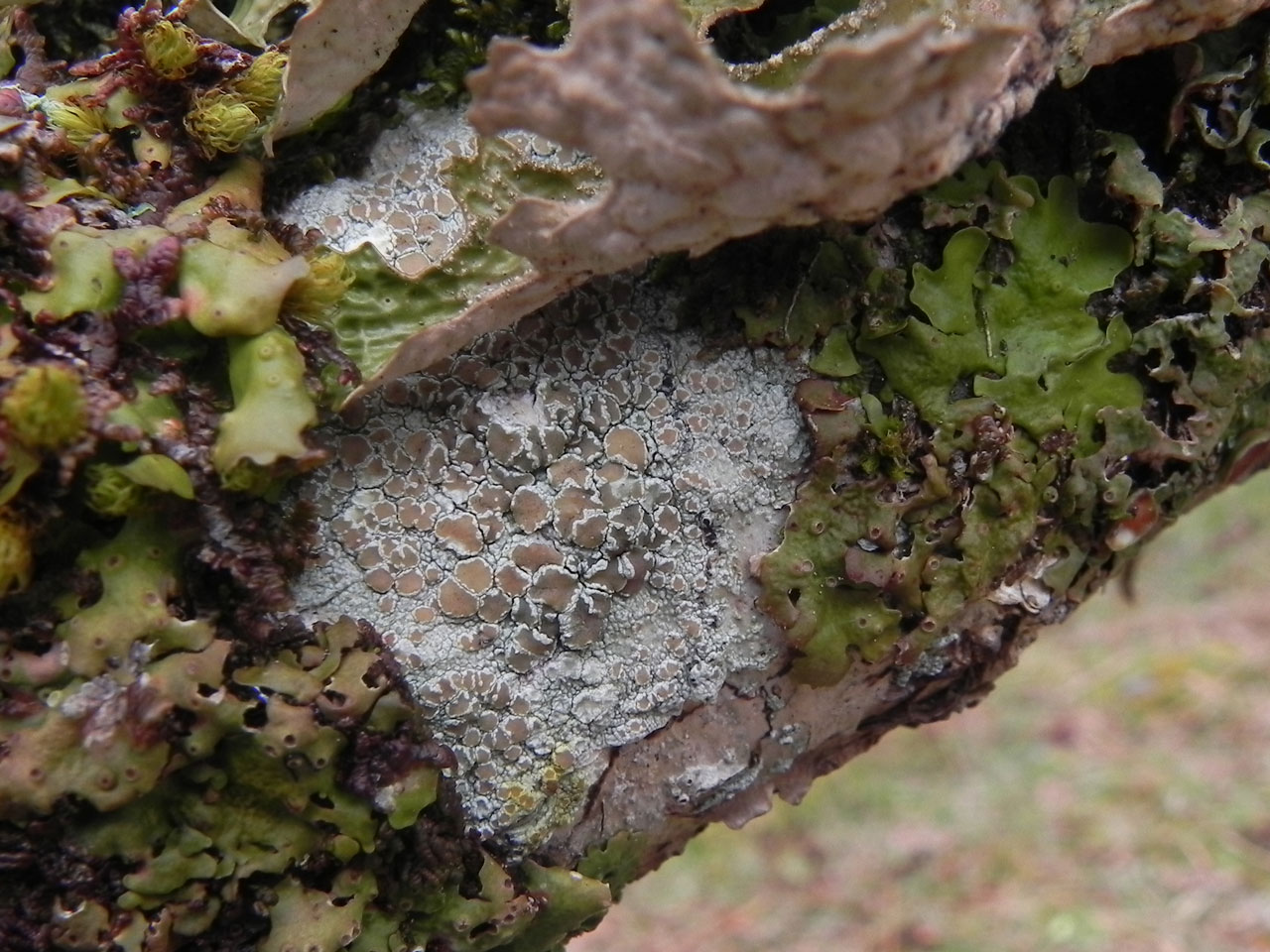
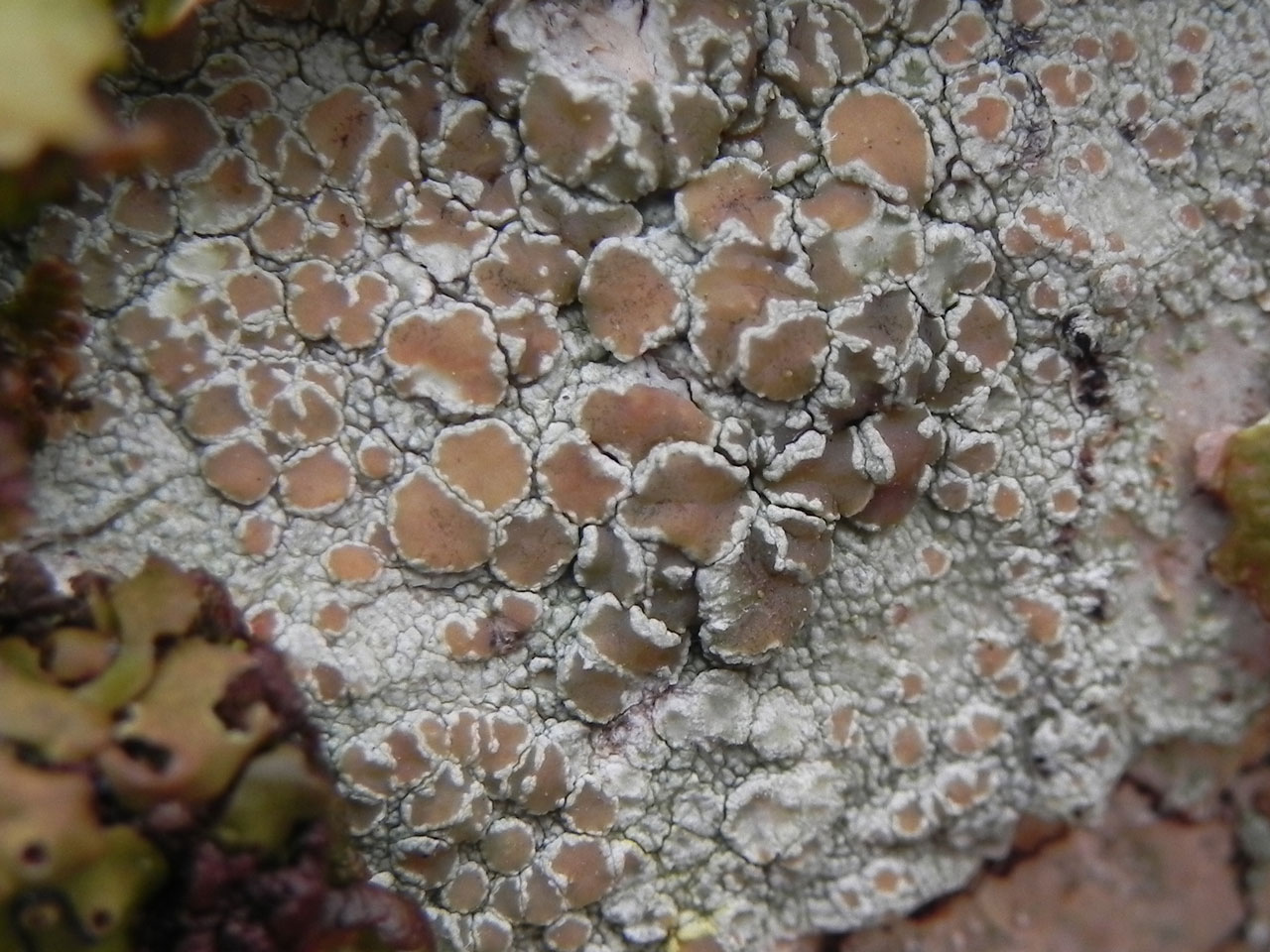
A rare member of the L. subfusca group found in a few open stands in high quality old growth temperate rainforests in the western Highlands and inner Hebrides. Distinctive in the combination of orange/red apothecial discs with a crenulate to flexuose margin that may resemble a double structure and confirmed by the Pd+ yellow-orange spot test on the thaline margin.
Thallus continuous or irregularly rimose, pale to medium grey, smooth to warted; prothallus absent or black. Apothecia 0.7–1.5 mm diam., immersed at first, finally sometimes sessile; thalline margin well-developed, persistent, coarsely crenate to almost dentate, flexuose with age, white or a paler grey than the thallus, medulla with very large crystals not soluble in K; disc flat to slightly convex, orange-brown or red-brown; epithecium red-brown, interspersed with coarse granules also present on the surface, ? not dissolving in K, Pd+ orange (with the formation of crystals); hymenium 60–85 µm tall; paraphyses 2–3 µm diam., sparsely branched and anastomosed, apices not or slightly swollen. Ascospores (7.5–) 10–14.5 × (6–) 7–8.5 (–9.5) µm, broadly ellipsoidal. Conidia 10–14 µm long, cylindrical. Thallus C–, K+ yellow, Pd–, UV– reflecting mauve-purple; thalline margin and epithecium Pd+ yellow-orange (atranorin, pannarin, ± placodialic acid, ± roccellic acid).
A member of the L. subfusca group in its broad sense. L. cinereofusca can often be separated from L. pulicaris by its young apothecia that are immersed in the thallus, more orange/red apothecial discs with a distinctive crenulate to flexuose margin that may resemble a double structure, and the Pd+ yellow-orange, not rust-red, reaction.
On Hazel, Ash, Birch and Sallow in open humid old growth woodlands in the temperate rainforest zone.
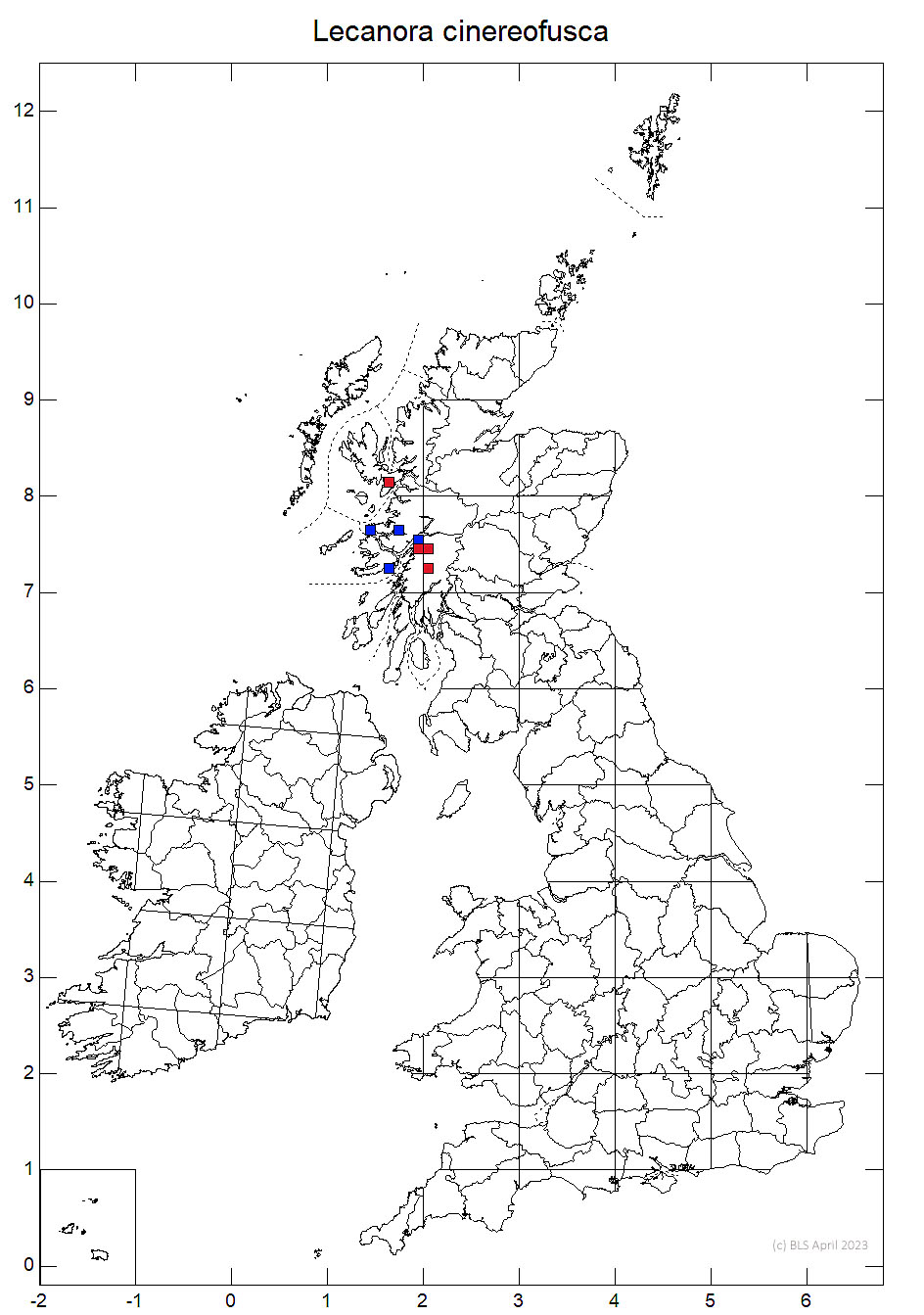

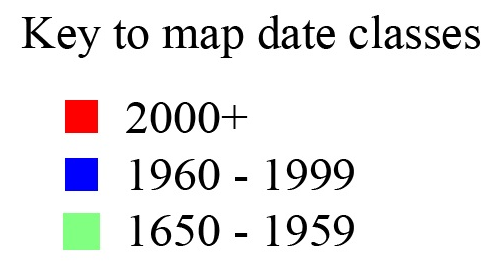
Very rare. W. Scotland (Argyll, Westerness).
A vey localised species confined to open old stands in high quality old growth temperate rainforests in the western Highlands, Mull and Skye. Threatened by increased shade from well meaning attempts to ameliorate the impact of overgrazing by removing all grazing and allowing over dense regeneration to occur. Sanderson (2010) observed direct losses, with a thallus on a dead shaded Hazel stem with a deer fenced area at Coille Thogabhaig, Skye. The species is not a classic rainforest species, i.e. an oceanic temperate – warm temperate species, but is also a species of humid montane woods in central Europe, so could occur in other Highland woods further east.
Britain: Vulnerable
Scotland: Priority Taxon for Biodiversity in Scotland
Cannon, P., Malíček, J., Ivanovich, C., Printzen, C., Aptroot, A., Coppins, B., Sanderson, N., Simkin, J. & Yahr, R. (2022). Lecanorales: Lecanoraceae, including the genera Ameliella, Bryonora, Carbonea, Claurouxia, Clauzadeana, Glaucomaria, Japewia, Japewiella, Lecanora, Lecidella, Miriquidica, Myriolecis, Palicella, Protoparmeliopsis, Pyrrhospora and Traponora. Revisions of British and Irish Lichens 25: 1-83.
Sanderson, N. A. (2010) Site Condition Monitoring for Lichens, Coille Thogabhaig SSSI. A report by Botanical Survey & Assessment to Scottish Natural Heritage.
Text by Neil A Sanderson based on Cannon et al (2022)