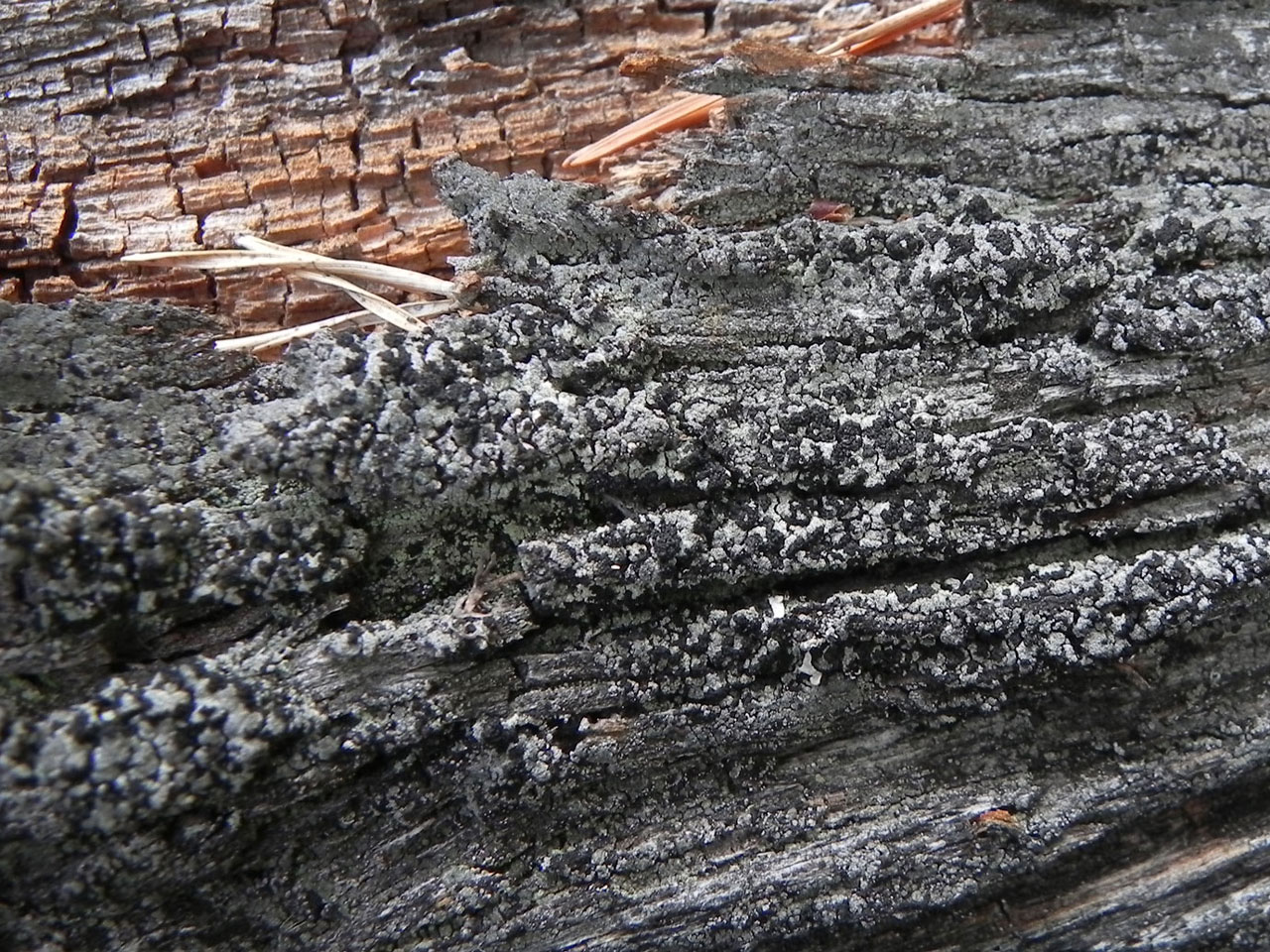

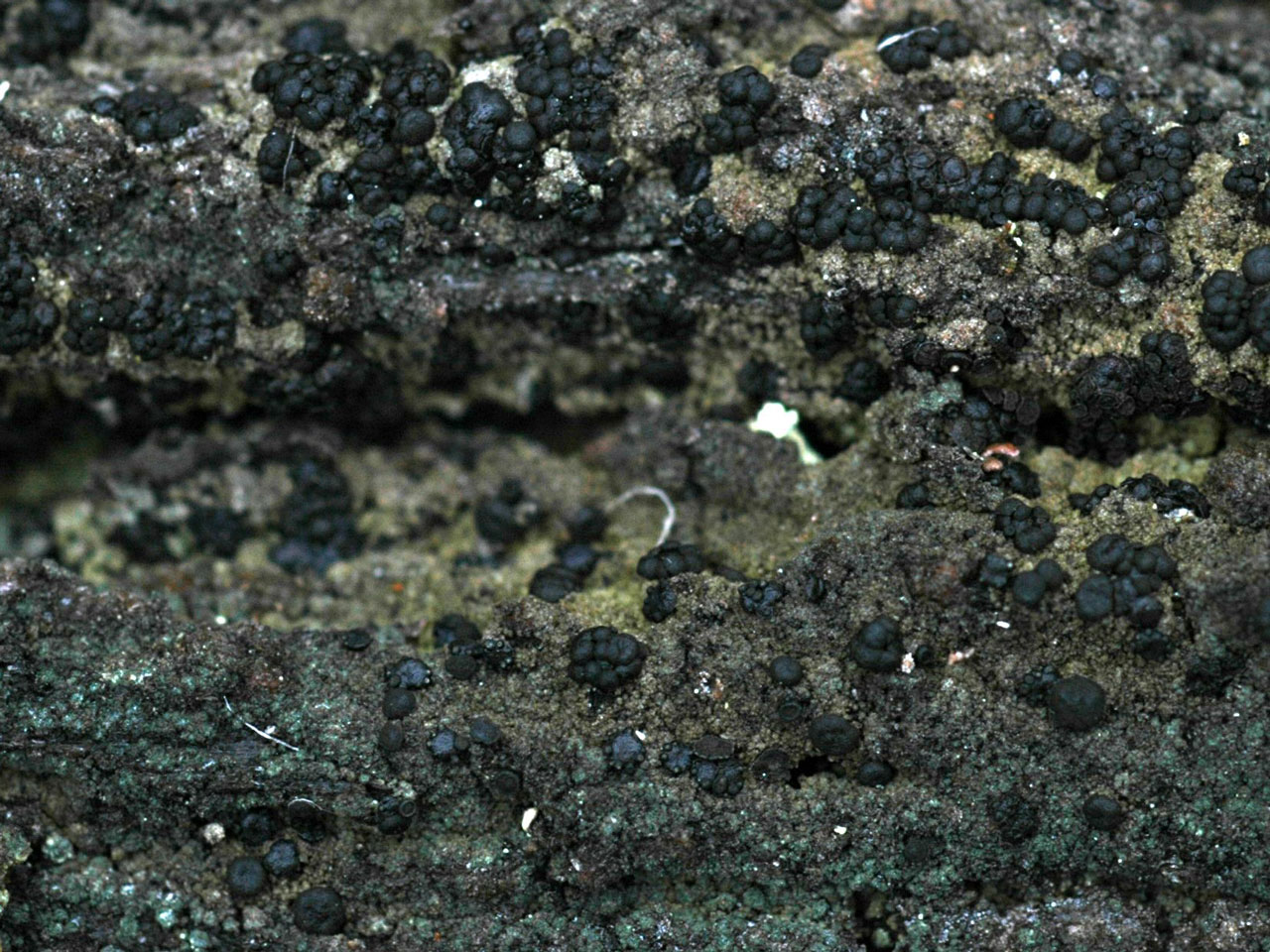
Mainly a special and attractive lichen of old weathered lignum on fallen pine trees (pine bones) in open old growth pinewoods (native pinewoods). It also, rather excitingly, has turned on similar habitat on dead Oak hulks an ancient deer park (Chatsworth Park) and an ancient forest (Sherwood Forest) in eastern England. Very distinctive when fertile with the combination of a pale grey to brownish leprose-sorediate crust, which has negative spot tests but is UV+ white, with apothecia typically forming dense and botryose clusters.
Thallus rather thick, pale to dark grey, greenish or brownish, composed of scattered incised subsquamulose warts 0.1–0.4 mm diam. that soon coalesce, become sorediate and at length form a thick contiguous leprose-sorediate crust; photobiont cells 5–12 µm diam. Apothecia 0.15–0.35 (–0.6) mm diam., typically forming dense, ± substipitate botryose clusters; disc dark brown to brown-black, sometimes greyish pruinose, flat or weakly convex, sometimes slightly concave; margin thin, typically pale to dark brown and paler than the disc, ± pruinose when young, in section patchily dark brown with a greenish or reddish hue and with a dark brown outer edge; hymenium colourless to pale brownish, 35–55 µm thick with a brown to red-brown, granular epithecial layer that dissolves and becomes colourless in KOH; hypothecium dark brown, inverted cone- shaped; paraphyses 0.7–1.5 µm thick, with a brown apical cell 1–2 µm diam. Asci 28–33 × 6–10 µm. Ascospores ellipsoidal, aseptate or very rarely 1-septate, 7–11.3 (–16) × 3–3.9 (–5) µm. Conidia 13–14 × ca 1 µm. Thallus K–, KC–, C–, Pd–, UV+ white (perlatolic acid).
Very distinctive when fertile with the combination of a leprose-sorediate crust with apothecia typically forming dense and botryose clusters. Sterile thalli could be confused with other sorediate crusts with negative spot tests, which are UV+ whitish, and found on dead wood and acid bark, such as Mycoblastus caesius and Lecidea nylanderi, which see.
On wood and exposed old bark of Pine and Oak in open old growth native pinewoods in Scotland and an ancient deer park and a former royal forest in E. England.
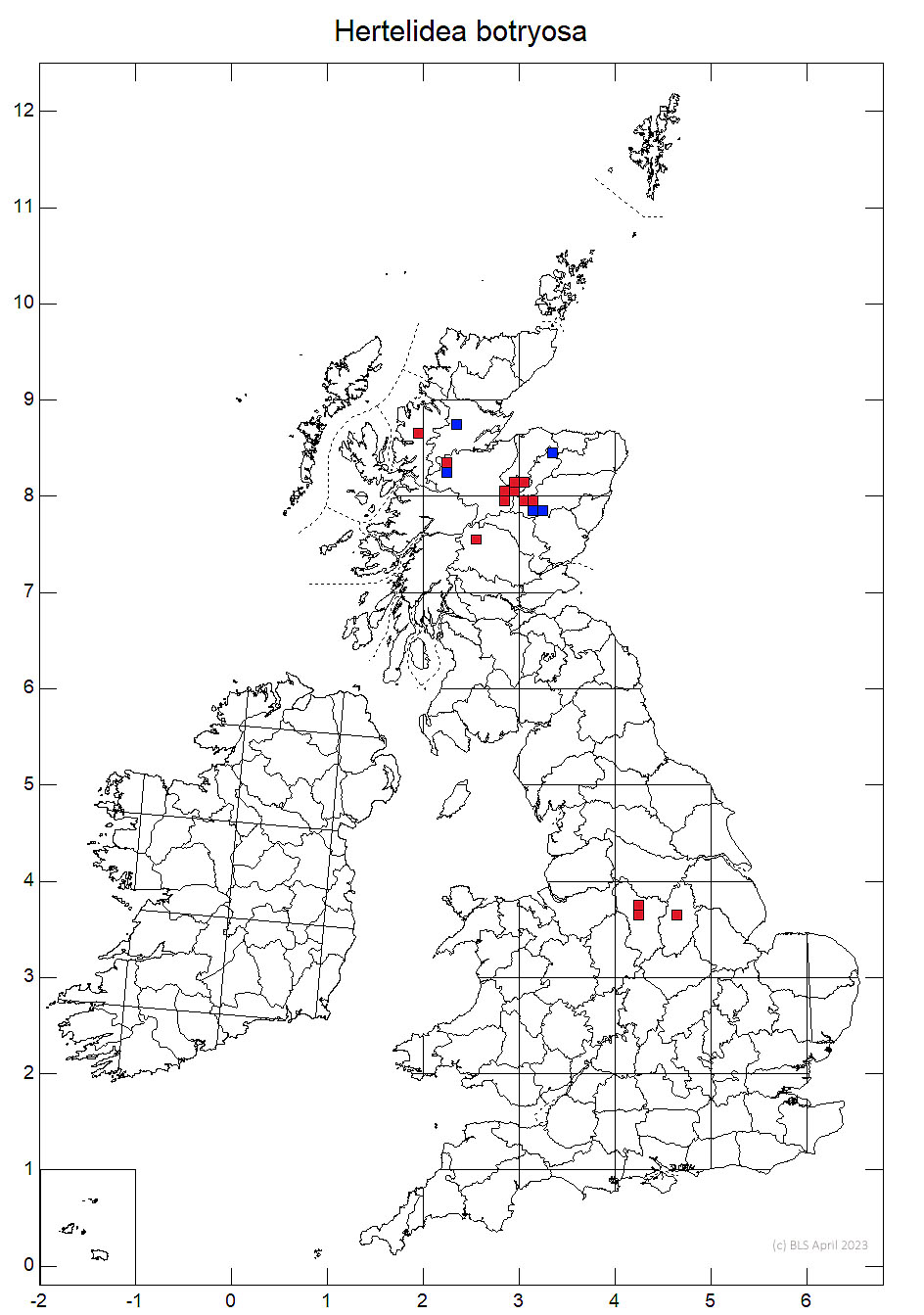

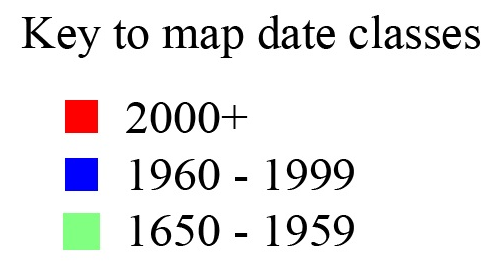
Rare, England (Chatsworth Park, Peak District and Sherwood Forest, Nottingham) and N. Scotland (C. & E. Highlands).
Dependant fallen dead wood that is left to age and does not become too shaded (pine bones or kelo wood). Grazing reductions within old growth pinewoods to allow regeneration can lead to increased shade on deadwood unless care is taken. The conservation objectives for native pinewood sites need to take account of the biodiversty importance of the combination of open space and dead wood within this iconic habitat.
Britain: Near Threatened
Scotland: Priority Taxon for Biodiversity in Scotland
Yahr, R., Cannon, P., Coppins, B., Košuthová, A., McCune, B., Aptroot, A. & Simkin, J. (2025). Lecanorales: Stereocaulaceae, including Hertelidea, Lepraria, Squamarina and Stereocaulon. Revisions of British and Irish Lichens 49: 1–24.
Text by Neil A. Sanderson based on Yahr et al (2025)