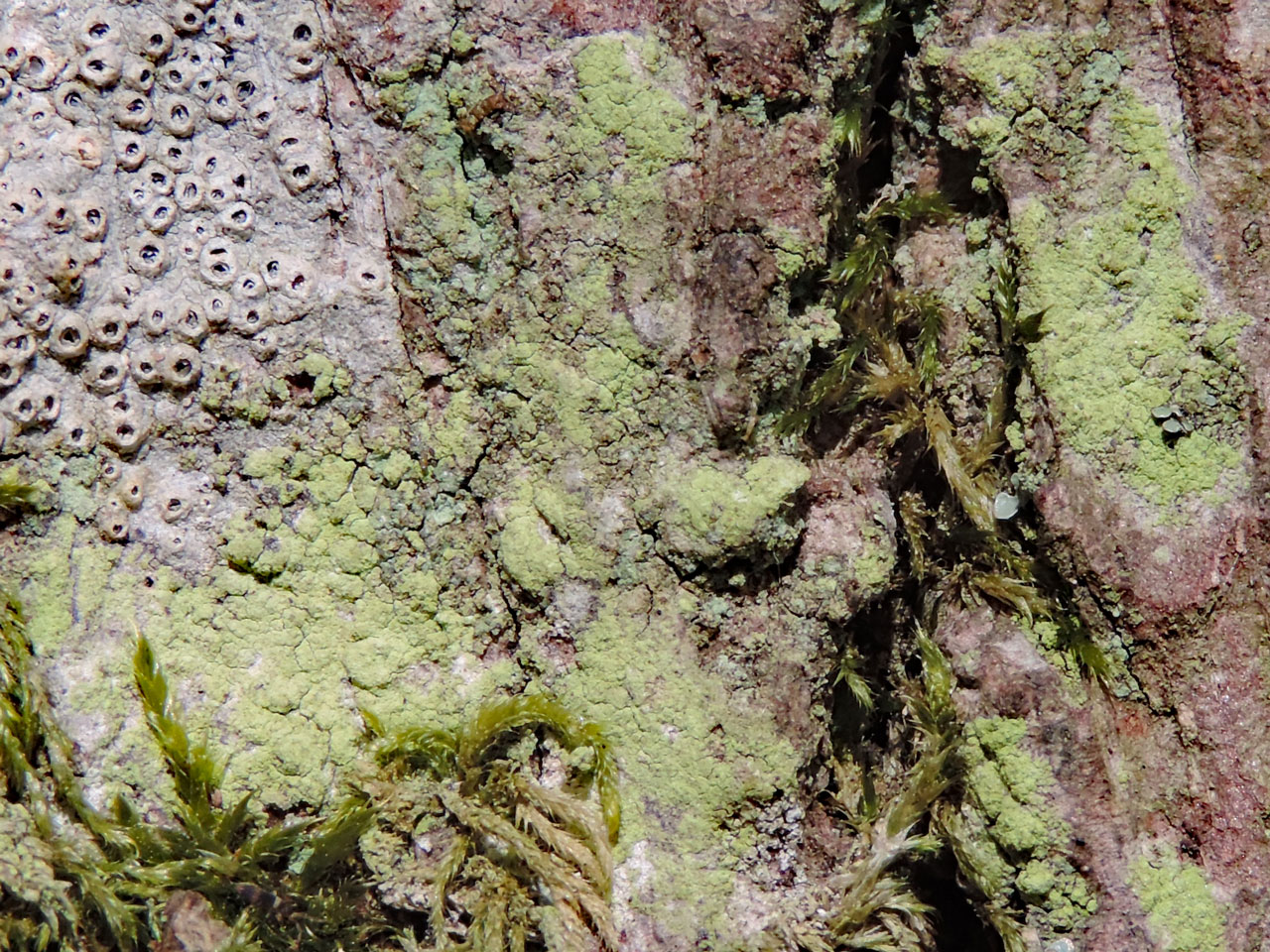
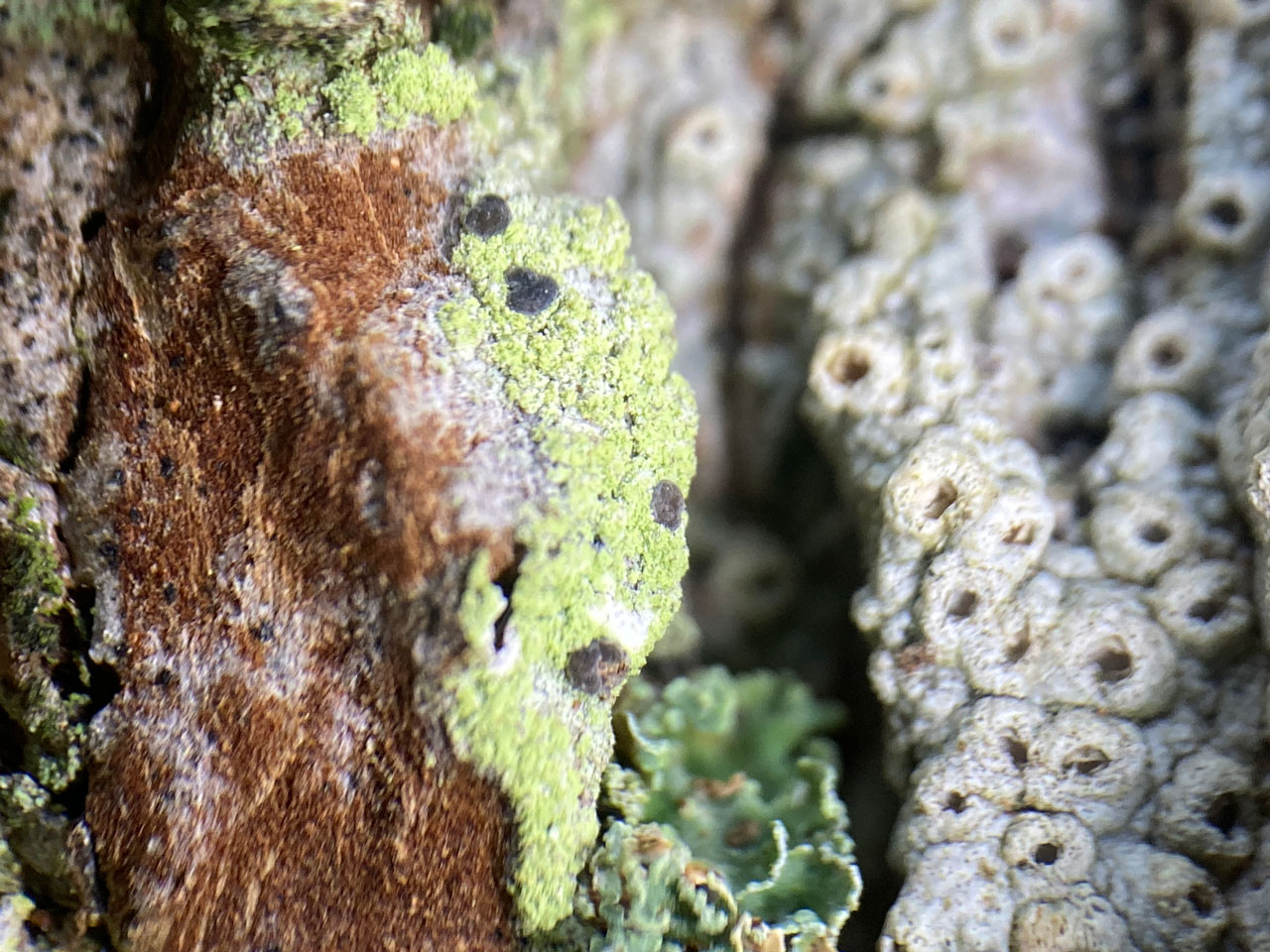
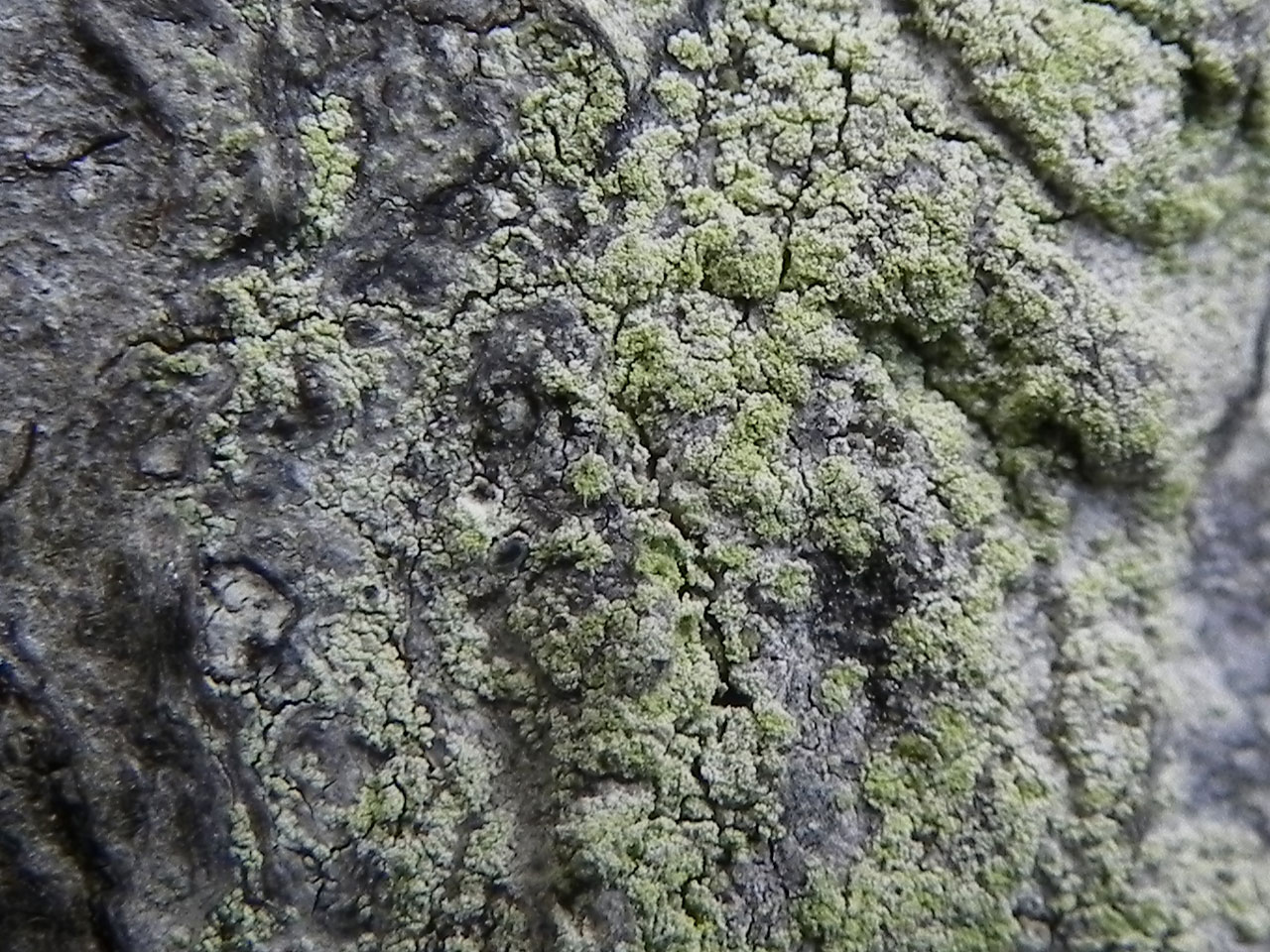
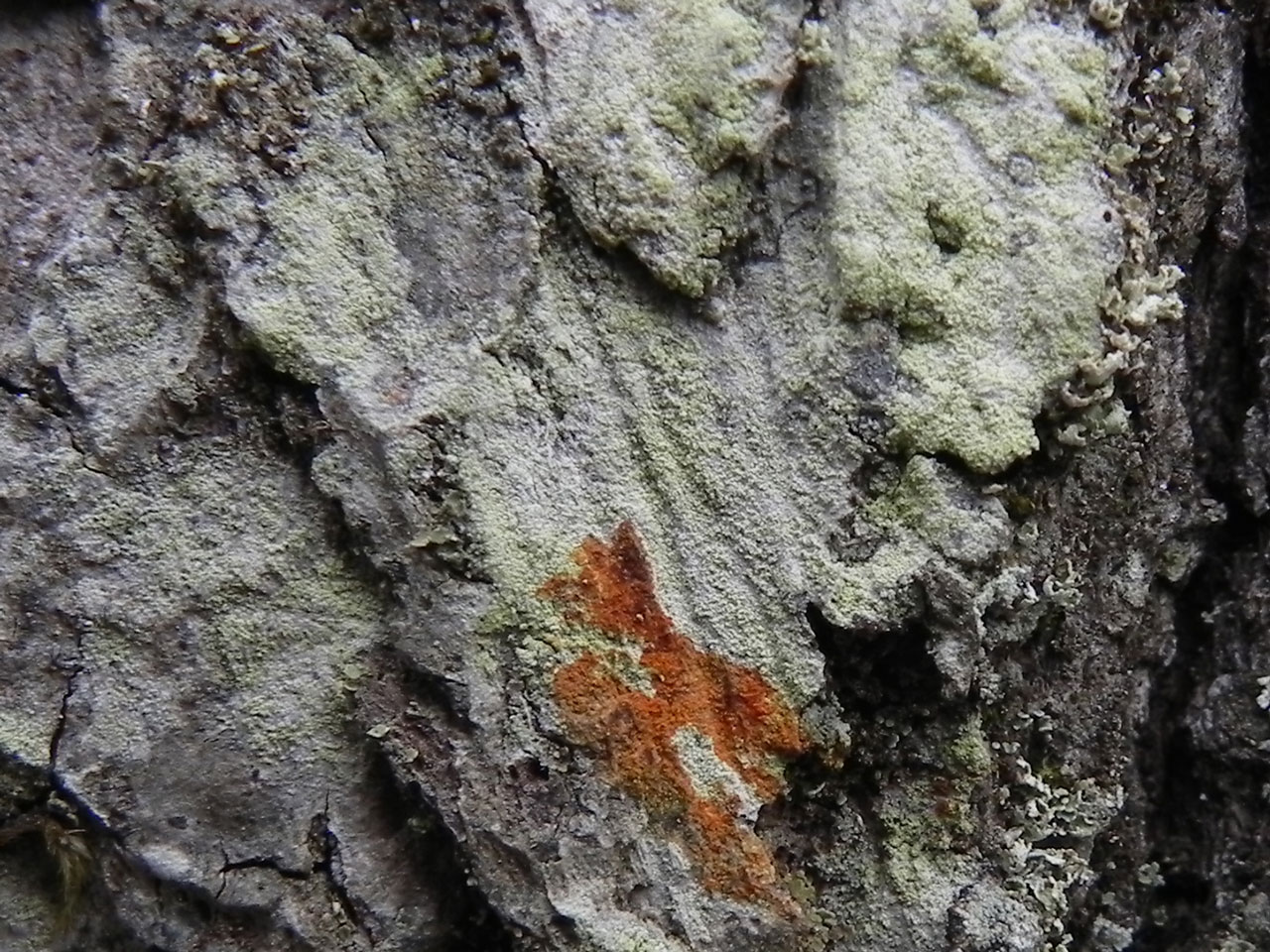
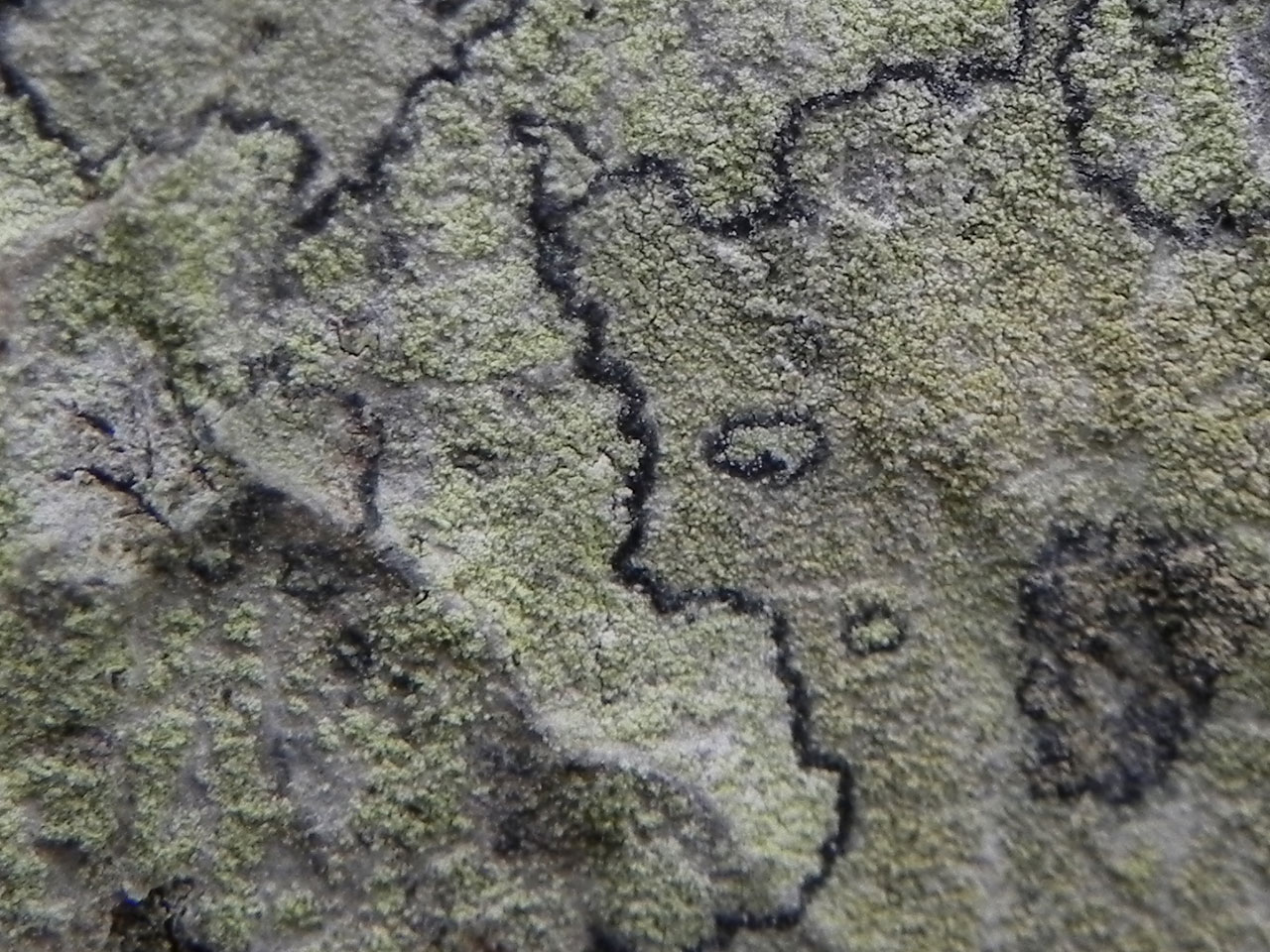
A local yellow soreditae crust of more acidic bark that is easily overlooked among the common yellow crusts Lecanora expallens and Pyrrhospora quernea and typically found with the latter. Can be separated by spot tests, as it is C– and Pd+ red, while the look a likes are C+ orange and Pd–. However, it is best spotted by a distinctive combination of sulphur-yellow to greenish-yellow colour and very fine farinose soredia.
Thallus forming small patches, <2 cm diam., thin, continuous, sulphur-yellow to greenish-yellow, delimited by a whitish to black hypothallus. Surface ecorticate, totally farinose-sorediate with soredia 12–20 (–25) µm diam. Apothecia scarce, 0.3– 0.5 mm diam., concave when young, becoming flat, disc light brown with a thick non-sorediate margin, disc and true exciple may be irregularly stained dark grey; hymenium 40–50 µm high, colourless, I+ blue. Asci 8-spored, ascospores (0-) 1- septate, ellipsoidal, guttulate, 8–13 × 2.5–3.5 (–4) µm. Pycnidia rare, colourless; conidia drop-shaped. Thallus C–, K–, KC–, Pd+ red (usually yellow first then rapidly turning red), UV–; atranorin (trace) and fumarprotocetraric acid.
Similar in appearance to Lecanora expallens but brighter yellow and C–, Pd+ red; the finely farinose soredia and brighter colour separate this species from L. conizaeoides. Often grows with Pyrrhospora quernea which has darker yellow course granular blastidia and is Pd– and C+ orange.
On the trunks of deciduous trees in sheltered situations, on mildly acidic to acid bark, commonest in old growth woodland but found in disturbed younger woodland as well.
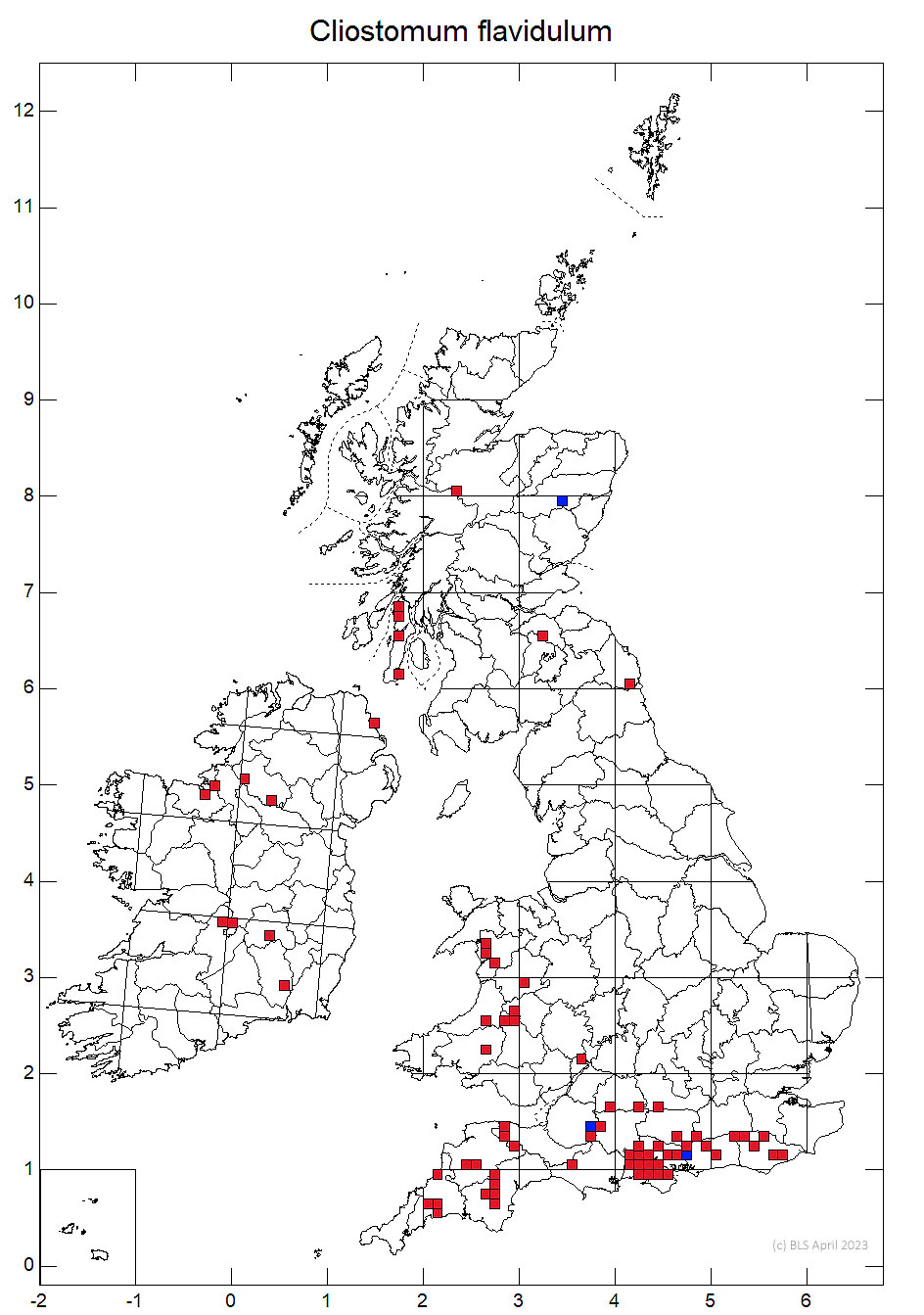


Most frequently recorded from S. & S.W. England and Wales but it is also recorded from W. & E. Scotland and Ireland; widespread but much under-recorded.
A local species, but can be frequent in less disturbed woodlands and on older trees. As an acid bark species likley to be sensative to ammonia pollution.
Britain: Notable
Cannon, P., Ekman, S., Kistenich, S., LaGreca, S., Printzen, C., Timdal, E., Aptroot, A., Coppins, B., Fletcher, A., Sanderson, N. & Simkin, J. (2021). Lecanorales: Ramalinaceae, including the genera Bacidia, Bacidina, Bellicidia, Biatora, Bibbya, Bilimbia, Cliostomum, Kiliasia, Lecania, Megalaria, Mycobilimbia, Phyllopsora, Ramalina, Scutula, Thalloidima, Toninia, Toniniopsis and Tylothallia. Revisions of British and Irish Lichens 11: 1-82.
Text by Neil A Sanderson based on Cannon et al (2021)