

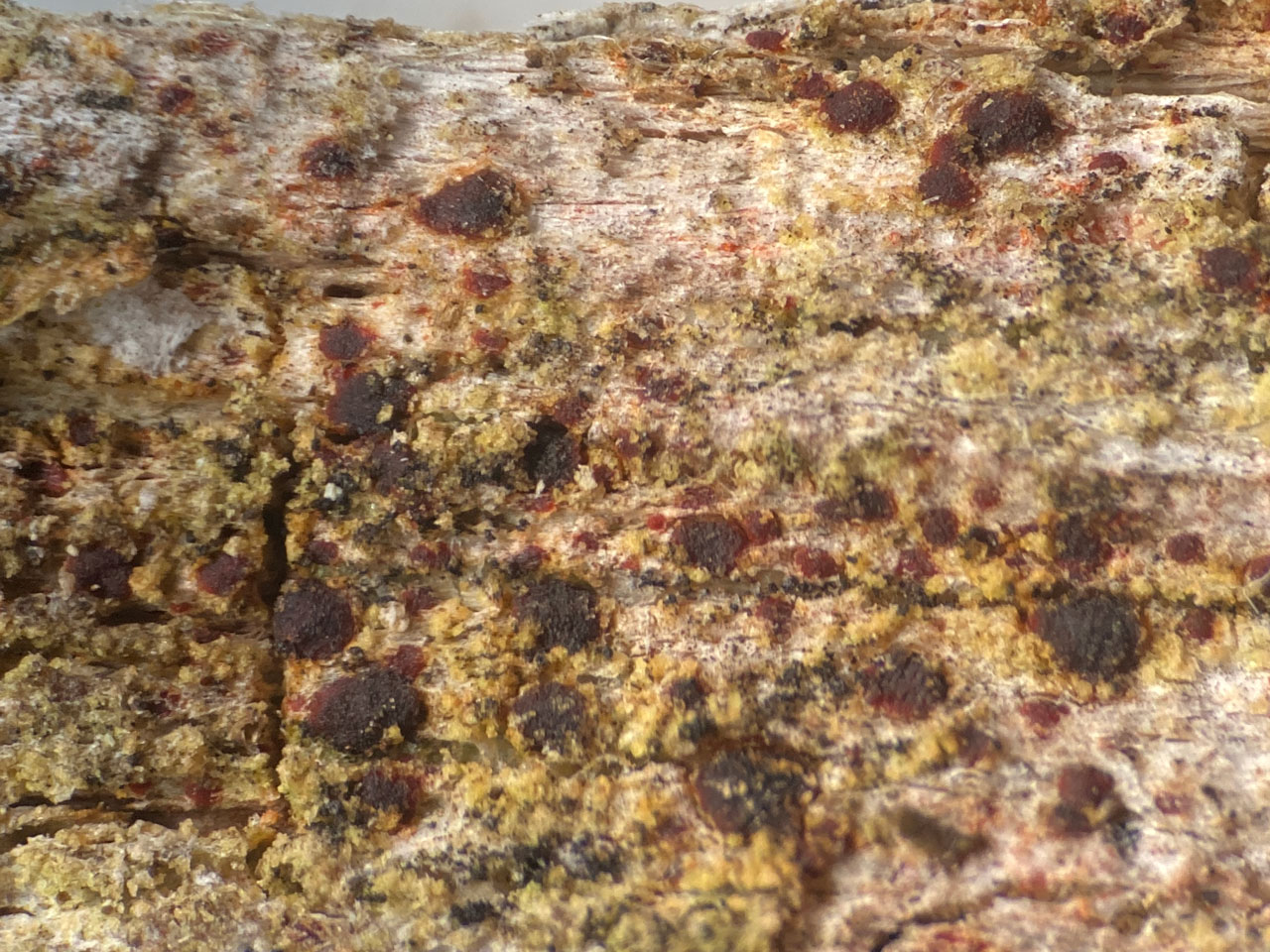
A widespread lichen of older woodland, absent only from previously heavily polluted areas or long deforested areas. Distinctive in the pale fawn thallus, with K+ purple dull pale yellow to orange-yellow patches, pycnidia forming red flecks and convex, orange-red-brown to brown-black apothecia.
Thallus immersed or thinly powdery to scurfy-granular, effuse, white to pale fawn, or more usually stained orange-yellow, sometimes pink when fresh, often with dull pale yellow to orange-yellow patches, K+ purple. Apothecia 0.2–0.5 (–0.6) mm diam., rounded, convex, orange-red-brown to brown-black, usually matt, not pruinose; in section 85–140 µm tall, yellow-orange-red throughout or brown-red in upper hypothecium, K+ magenta and K+ purple with pigments dissolving; epithecium indistinct; hymenium 33–40 µm tall; hypothecium 45–100 µm tall; paraphysoids 0.5–1 (–1.5) µm diam., mostly neither swollen nor dark-walled above, a few sometimes with dark walls and apical caps. Ascospores 11–15 × 4–5 µm, obovoid-ellipsoidal to clavate, 1-septate, colourless but old ascospores are brown and warted. Pycnidia frequent, 40–60 µm diam., the wall red-brown, K+ purple; conidia (3.5–) 4–6 × ca 1 µm, bacilliform or slightly curved. Thallus C–, K± pale purple (pigment), Pd–, UV– (unidentified orange anthraquinone).
See also Diarthonis spadicea, with its smaller ascospores and pigment not dissolving in K. According to Frisch et al. (2018), however, the two species are not closely related and A. vinosa is phylogenetically close to A. didyma.
There are several collections of an unidentified Chaenothecopsis on A. vinosa.
On bark or lignum of older trees, especially Oak but often also Alder. In the south quite mobile and colonises into older young growth stands dating from the 19th century, but more confined to old growth in the north. In the New Forest, Hampshire, Sanderson (2001), found this lichen to actually be more frequent in three early 19th century Oak plantations (on 15 – 55 trees per ha) than in two old growth stands (on 2 & 4 trees per ha). In the south mainly found in drier parts of less acidic mesic bark communities (typically shaded forms of the Pertusarietum amarae), but to the north more frequent in the damper parts of dry bark communities (often in the Lecanactidetum abietinae).
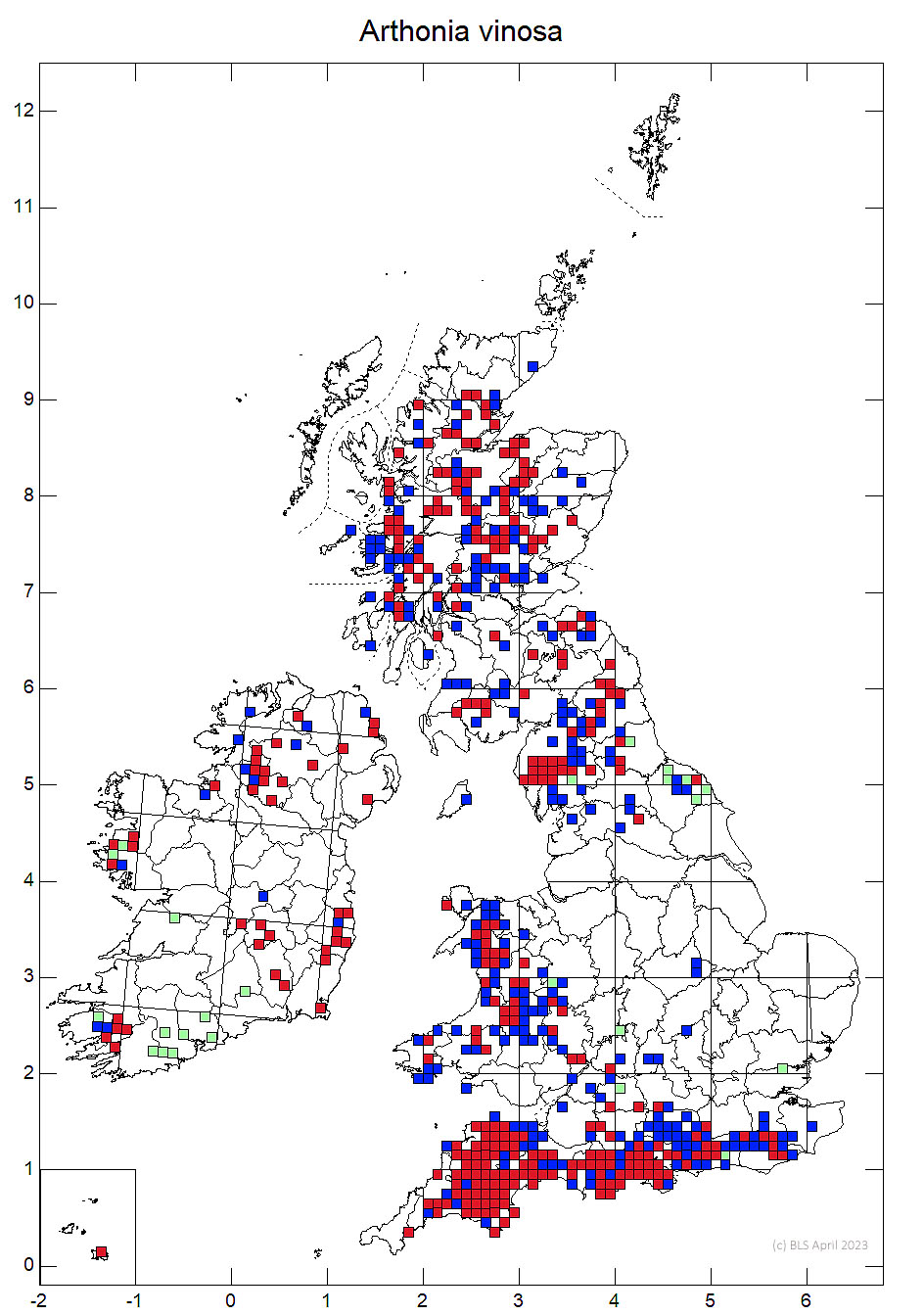

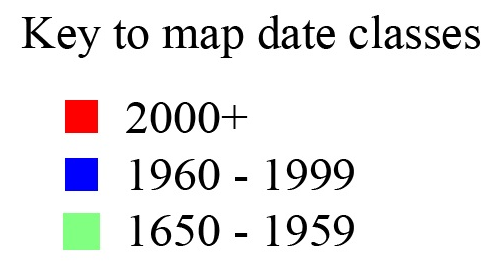
Common in S. W. & N. Britain, scattered in Ireland, absent from the central plain.
Cannon, P., Ertz, D., Frisch, A., Aptroot, A., Chambers, S., Coppins, B. J., Sanderson, N. A., Simkin, J. & Wolseley, P. (2020) Revisions of British and Irish Lichens Volume 1 August 2020 Arthoniales: Arthoniaceae.
Frisch, A., Thor, G., Ertz, D. & Grube, M. (2014). The Arthonialean challenge: restructuring Arthoniaceae. Taxon 63: 727–744.
Sanderson, N. A. (2001) Epiphytic Lichen Monitoring in the New Forest 2000. LIFE Job L33A2U. Lyndhurst: Forest Enterprise.
Text by Neil A Sanderson, based on Cannon et al (2020)